Who is this for?
The useful starting point is the child's accepted foods and the practical conditions of their lunch, rather than a label aimed at children.
Families managing texture preferences
If a child accepts yoghurt but rejects fruit pieces or unfamiliar mixtures, begin with a familiar flavour and check the exact pot's texture. The NHS advises offering small portions and continuing to offer variety without forcing rejected food.
Shoppers comparing everyday multipacks
Individual pots make portions easy to identify, but pot sizes, ingredients and nutrition differ. Compare the products you would actually serve rather than assuming that a children's label or a plain-looking pack tells the whole story.
Families packing school lunches
Check the pot's storage instructions and how it will be carried. For food that needs to stay chilled, East Lancashire Hospitals NHS Trust recommends a cool bag with an ice pack or frozen drink carton.
How to choose a yoghurt multipack
Decide which texture is familiar first, then compare the exact pots for portion size, labelling and lunchbox handling.
Smooth fruit pots
Consider when: Your child accepts a familiar fruit flavour but avoids pieces or mixed textures.
Trade-off: A children's format does not tell you the sugar content or establish that every pot in the range has the same texture.
Plain individual pots
Consider when: Your child accepts plain yoghurt, with any familiar accompaniment offered separately.
Trade-off: A plain pot may not appeal to a child who expects a fruit flavour; check the current label rather than assuming every plain product is alike.
Split pots
Consider when: Your child already likes a separate fruit component and the flavours in the pack.
Trade-off: The extra component introduces another texture to accept, while a mixed-flavour pack may leave unwanted pots.
| Priority |
What to check |
Your needs |
| Flavour and texture |
Check the exact flavour and whether the pot is plain, smooth-fruit or served with a separate topping. Look at the number and size of pots before trying a new assortment. |
I'd start with a flavour my child recognises and change one texture at a time. The NHS advises small portions and repeated, low-pressure offers of variety. |
| Nutrition and portions |
Compare total sugars per 100g and per pot on the current labels, alongside ingredients and pot size. A 2018 BMJ Open survey of UK supermarket yoghurts found substantial variation between product categories; its category figures do not describe every pot sold now. |
A children's pack might fit my lunchbox, but I still want to know what is in the portion my child would eat. |
| Storage |
Read the specific pack's unopened and opened storage directions and its use-by date. If it needs chilling, plan how to keep it cold until lunch. |
For a chilled pot, I need a way to carry lunch cool. East Lancashire Hospitals NHS Trust recommends a cool bag and an ice pack or frozen drink carton. |
| Ingredients and allergens |
Read the full ingredient list and highlighted allergens on the exact flavour or variant; check again when switching products. |
If milk or another ingredient matters for my child, a familiar-looking front label is not enough. I need to check the particular pack and follow our school's food rules. |
Brand and range references
These examples show different formats to compare; a range name alone does not establish the texture, ingredients or suitability of every variant.
Onken
Tesco lists Onken Kids Raspberry & Banana in 4 × 90g pots. Onken separately describes its Raspberry & Banana yoghurt as containing fruit with “no bits”; check the particular multipack before relying on that description.
- The listed multipack provides individual 90g portions.
- Onken identifies milk in its Raspberry & Banana ingredients; a smooth-fruit description cannot establish that a child will accept the flavour.
Yeo Valley
Tesco lists Yeo Valley Organic Little Yeos Fruity Favourites in 4 × 85g pots. Yeo Valley describes other formats and recipes within its wider Little Yeos range.
- The listed multipack has four individual 85g pots.
- Claims attached to another Little Yeos recipe, such as no added sugar, should not be assumed to apply to Fruity Favourites.
Müller
Tesco lists Müller Corner Strawberry, Peach & Apricot as six 136g pots, with fruit compote served on the side.
- A separate compote lets someone who accepts the format decide whether to mix it into the yoghurt.
- The additional texture and multiple flavours may not suit a child who accepts only a consistent plain or smooth yoghurt.
Activia
Tesco lists Activia multipacks among its UK yoghurt options, including 4 × 115g and 8 × 115g formats.
- Different pack counts offer a portioning comparison.
- Check the exact flavour, ingredients, allergens and nutrition; the range's positioning does not establish suitability for a fussy eater.
Tesco
Tesco lists its Greek Style Yogurt as four 100g plain individual pots.
- A plain pot leaves a familiar accompaniment to be offered separately, if the child wants one.
- A child who only accepts fruit-flavoured yoghurt may not accept a plain pot; check the exact ingredients and allergens.
Joybuy yoghurt options
This individually portioned banana-and-yoghurt bundle is an option to consider if banana is already a familiar flavour. Its baby-food positioning and pack directions need checking before choosing it for an older child's school lunch.
 No image available
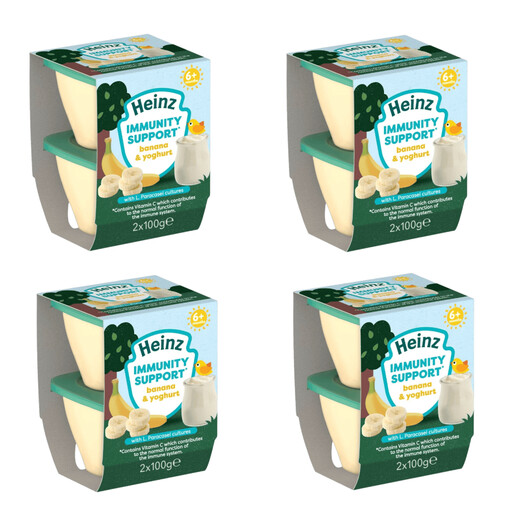
Heinz Banana & Yoghurt 6+ Months, 4 × (2 × 100g)
For a child who already accepts banana flavour, the individual 100g pots allow one portion to be offered at a time.
The bundle contains four packs of two pots, eight pots in total, and is labelled for ages 6+ months. It contains milk. Check whether the flavour and baby-food format suit an older child, and read the pack's storage and transport directions before putting a pot in a school lunchbox.
View on Joybuy
Yoghurt multipack questions
Where should I start if my child rejects new yoghurts?
Start with a small pot in a flavour and texture they already accept, then offer other options gradually. The NHS advises small portions, repeated offers of variety and not forcing rejected food.
Do children's yoghurt multipacks all have similar sugar content?
No. A UK supermarket product survey published in BMJ Open in 2018 reported median total sugars of 10.8g per 100g for the children's products it surveyed, compared with 5.0g per 100g for its natural and Greek-style category. Those historical category figures do not describe every current pot, so compare the exact labels per 100g and per portion.
Can a yoghurt pot go in a school lunchbox?
Yes, if its pack instructions and the way you carry it allow it to be stored as directed until lunch. For food that needs chilling, East Lancashire Hospitals NHS Trust recommends a cool bag with an ice pack or frozen drink carton; check the particular pot's directions rather than assuming every yoghurt product has the same storage requirements.
Which date matters when packing yoghurt?
Follow a use-by date where one is given, along with the pack's storage instructions. The Food Standards Agency explains that use-by dates concern safety, while best-before dates concern quality; storage at the wrong temperature can also make food unsafe.
What should I check if milk is an allergen for my child?
Read the full ingredients and highlighted allergens on the exact pot, and follow the child's existing allergy plan and school rules. Do not assume that a different flavour or a familiar brand has the same ingredients; Onken, for example, identifies milk in its Raspberry & Banana yoghurt.


