Choose pots that suit the eater’s appetite and a pack count you can use across your planned outings, then compare the exact recipe and milk label. For refrigerated yoghurt packed without fridge access, the NHS advises an insulated lunchbox with an ice pack to keep food cool. Check each product’s storage directions rather than assuming every yoghurt pot has the same requirements.
Who is buying for?
The useful pot size and recipe depend on who will eat the yoghurt and where the lunchbox will be kept.
Parents packing young children’s lunches
Look for a portion and recipe suited to the child, and check how the pot must be stored. For nursery lunchboxes without fridge access, the NHS advises an insulated box with an ice pack and recommends checking the nursery’s food policies.
Families planning several outings
Match the number of individual pots to the people and trips planned. Current Tesco Groceries listings include children’s 6 × 42g and 4 × 90g packs, as well as a Müller fruit multipack with six 136g pots; those sizes serve different portion needs.
Adults packing a portable lunch
Compare the portion weight and exact recipe rather than choosing by pack count alone. If a product is labelled low fat or mentions live cultures, still check its ingredients, milk allergen declaration and storage instructions.
What matters when choosing a pack?
Start with the storage plan, then choose the portion, pack size and recipe for the people who will eat it.
| Priority |
What to check |
Your needs |
| Storage |
Read the exact pot’s storage directions. If a refrigerated yoghurt will be packed without fridge access, the NHS advises an insulated lunchbox with an ice pack. |
I need the pot to stay cool until lunch, or a product whose own directions suit how I can carry and store it. |
| Portions and pack count |
Compare grams per pot and the number of pots. Tesco Groceries listings include 42g children’s pots and 136g Müller Corner pots; check the use-by date when planning several outings. |
A smaller child may leave part of a large pot, while an older eater may want a larger one. I also want a pack I can use in time. |
| Recipe and sugars |
Compare sugars per 100g for the exact flavour and read the ingredients. Tesco Groceries lists 12.0g to 13.4g sugars per 100g across the flavours in its Müller Corner Strawberry, Peach & Apricot 6 × 136g pack; Rachel’s Organic lists 12.5g per 100g for Luscious Fruits 4 × 110g. |
I want to know what is in the particular pot, rather than treating a children’s label or organic ingredients as a description of its sugar content. |
| Milk suitability |
Check the full ingredient and allergen label of the exact product. The Food Standards Agency identifies milk as a common yoghurt ingredient; live-culture or lactose-digestion wording does not establish milk-allergy suitability. |
If the intended eater must avoid milk, I need a clearly suitable alternative, not an assumption based on the yoghurt’s name or other claims. |
What should you avoid assuming?
-
Assuming chilled yoghurt can travel without cooling
A refrigerated pot may spend hours away from a fridge during a day out. Tesco Groceries labels its Müller Corner 6 × 136g pack “Keep refrigerated”.
Follow the exact product’s storage label. For a nursery lunchbox without fridge access, use the insulated box and ice pack advised by the NHS.
Pots you cannot keep or use as directed may go to waste.
-
Judging sugars by the pack design
Fruit flavours, children’s branding and organic ingredients do not tell you the sugars per 100g. Tesco Groceries lists 12.0g to 13.4g per 100g across the Müller Corner Strawberry, Peach & Apricot pack’s flavours; Rachel’s Organic lists 12.5g per 100g for Luscious Fruits.
Compare the nutrition panel for the exact flavour. If you prefer to add fruit yourself, the NHS also lists plain unsweetened yoghurt with sliced banana as an option for young children.
-
Confusing lactose wording with milk-allergy suitability
The Food Standards Agency identifies milk as common in yoghurt and a possible risk for people with an allergy or intolerance to milk or its constituents. A statement about lactose digestion does not mean a product is milk-free.
When milk must be avoided, check the complete ingredient and allergen label for a specifically suitable product.
-
Choosing pack size without counting outings
A six-pack may leave surplus pots if only a few lunches are planned, while a very small pot may not suit every eater.
Count the portions likely to be eaten and compare both pot weight and pack count against the use-by date.
Unused chilled pots can become food waste.
Relevant brands and retailer ranges
These examples illustrate pack formats and product-specific checks; a brand name alone does not establish the recipe or suitability of another variant.
Müller
Its Corner Strawberry, Peach & Apricot 6 × 136g pack is an example of larger individual fruit-yoghurt portions.
- Tesco Groceries lists six 136g pots in this pack.
- The same listing says to keep it refrigerated, declares milk and gives sugars of 12.0g to 13.4g per 100g depending on flavour.
Onken
Its Kids range includes a Raspberry & Banana 4 × 90g multipack listed by Tesco Groceries.
- The 90g pot offers a distinct portion size to compare with smaller children’s pots.
- Check the ingredients, nutrition and allergen label of the exact Raspberry & Banana pack; claims about Onken’s wider Kids range need not describe every flavour.
Yeo Valley
Tesco Groceries lists Little Yeos No Added Sugar 6 × 42g and Fruity Favourites 4 × 85g among its children’s multipacks.
- The two formats offer different pot weights and pack counts for comparison.
- Check the selected flavour’s age guidance, ingredients, nutrition and allergen information; “No Added Sugar” identifies the named range, not every Little Yeos pack.
Rachel’s Organic
Luscious Fruits Bio-Live Yogurt comes in a 4 × 110g format for shoppers seeking that particular organic fruit recipe.
- Rachel’s Organic describes the product as made with British milk in West Wales.
- Its product information lists 12.5g sugars per 100g. Organic does not mean milk-free or describe the sugar content.
Activia
The Strawberry 4 × 115g multipack is an option to examine when low-fat yoghurt and live cultures are specific recipe preferences.
- Tesco Groceries describes this variant as low fat and containing live cultures.
- Do not treat its lactose-digestion wording as evidence that it suits someone with a milk allergy; check the exact label.
Tesco
Tesco Groceries lists own-label Greek Style Yogurt 4 × 100g alongside branded multipacks.
- The listed 100g pot provides another portion weight to compare.
- Open the exact product listing or check the pack for its ingredients, nutrition, allergens and storage directions before deciding whether it suits the lunchbox.
Joybuy product options
This option is a bundle of individual Heinz banana-and-yoghurt pots labelled for babies aged 6 months and over. It is a different lunchbox choice from the refrigerated fruit-yoghurt multipacks discussed above, so follow its own storage and serving directions.
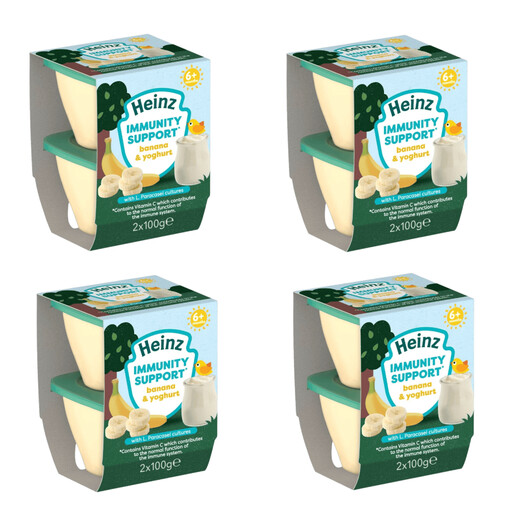 Image unavailable
Heinz Banana & Yoghurt 6+ Months, 2 × 100g, bundle of 4
Eight individual 100g pots offer several servings when packing for a baby aged 6 months or over. The product description says unopened pots should be stored in a cool, dry place and may be served at room temperature or chilled; check the pack directions before taking them on a hot outing. Contains milk. Follow the stated instructions for a clean baby spoon and adult supervision.
View on Joybuy
Common questions
Can I pack yoghurt in a summer-holiday lunchbox?
Yes, if you can follow that product’s storage directions throughout the outing. For a nursery lunchbox without fridge access, the NHS advises an insulated box with an ice pack to keep food safe and cool; Tesco Groceries labels the Müller Corner 6 × 136g pack “Keep refrigerated”.
Is a children’s yoghurt multipack always the right choice for a child?
No. A children’s pack may offer smaller pots, but compare the exact portion weight, ingredients, sugars and allergen label with what the child will eat. The NHS also lists plain unsweetened yoghurt with sliced banana as an option for young children.
Do live cultures mean a yoghurt suits someone with a milk allergy?
No. The Food Standards Agency identifies milk as a common yoghurt ingredient and a possible risk for people with an allergy or intolerance to milk or its constituents. Check the exact product’s full ingredient and allergen label; a lactose-digestion statement does not establish milk-allergy suitability.
Should I check a nursery or childminder’s food policy?
Yes. The NHS advises checking the setting’s food policies and telling the nursery or childminder about a child’s food allergy. Check before packing the yoghurt and any toppings or foods served with it.


