Choose a yoghurt multipack by the portion your child usually finishes: a 42g mini pot offers a smaller serving, while the listed 90g to 136g pots offer more per lunch. If reducing added sugar matters, check the claim on the exact product; follow its storage instructions and, for yoghurt that needs chilling, use an insulated lunchbox with an ice pack when no fridge is available.
Who is each format for?
Pot size matters most when a packed lunch has to suit one child’s appetite and be manageable away from home.
Parents packing for younger children
For a child who usually finishes a small serving, compare the 42g Little Yeos pots with larger child-focused options such as Onken Kids 90g pots. Check whether the child can open the chosen format and use any spoon it needs.
Families planning several outings
Compare both the number of pots and the amount in each one. A six-pack of mini pots provides different-sized lunches from a six-pack of 136g pots, even though the pack counts match.
Parents looking for a no-added-sugar option
Yeo Valley identifies a Little Yeos No Added Sugar range, including 6 × 42g pots. Check the exact product and flavour rather than assuming the claim applies to every yoghurt from the brand.
What should you check?
Start with a portion the child will eat, then check the label and how the yoghurt will be stored until lunch.
| Priority | What to check | Your needs |
|---|
| Portion size |
Compare grams per pot and pack count. Tesco Groceries lists examples from Little Yeos 6 × 42g and Onken Kids 4 × 90g to Activia 4 × 115g and Müller Corner 6 × 136g. |
A smaller pot suits us if my child rarely finishes a larger yoghurt; for a bigger appetite, I would check the larger individual servings. |
| Ingredients and sugar |
Read the ingredients and nutrition panel for the exact flavour. Look for a product-specific no-added-sugar statement if that matters to you. |
I want to know what is in the pot, rather than judging its contents by child-focused packaging. |
| Storage until lunch |
Follow the pack’s storage instructions. For food that needs chilling, the NHS recommends an insulated lunchbox with an ice pack when the lunchbox cannot be refrigerated. |
Our lunch may stay in a bag during an outing, so I need a way to follow the product’s storage directions until it is eaten. |
| Allergens and venue rules |
Check the current allergen declaration for the exact product and flavour. Check any food policy at the holiday club, nursery or other venue. |
If a child must avoid an ingredient, or food is going to an organised activity, I need to check both the pack and the venue’s rules. |
| Ease of eating |
Check whether the child can open the pot or pouch and whether a spoon is needed. Consider whether a separate topping or a reusable pot will be manageable on the outing. |
For lunch away from home, I would choose a format my child can manage with the utensils we have packed. |
Lunchbox mistakes to avoid
-
Choosing by pot count alone
Six 42g mini pots and six 136g pots offer very different amounts per serving. The larger pot may not be finished by a child who usually eats a small portion.
Compare grams per pot as well as pack count, and choose a serving close to what the child normally finishes.
-
Ignoring storage during the outing
A packed lunch may not have access to a fridge. The NHS recommends an insulated lunchbox with an ice pack when lunchboxes are not refrigerated.
Read the product’s storage instructions before packing it. If it needs chilling, plan how to keep it cool until lunch.
-
Assuming children’s packaging tells you the ingredients
A small pot or child-focused name does not establish the sugar content of every flavour. A no-added-sugar statement applies to the product carrying that claim.
Check the exact pack’s ingredients and nutrition panel when choosing a flavour or switching products.
-
Skipping allergen and venue checks
The Food Standards Agency identifies milk as a common ingredient in yoghurt. An organised holiday activity may also have its own food policy.
Read the current allergen declaration and check the venue’s rules before packing the yoghurt.
Brand and format references
These examples show how pot sizes and formats differ; check the exact product label before choosing one for a packed lunch.
Müller
Tesco Groceries lists a Müller Corner multipack of 6 × 136g pots; Müller also identifies Corner among its yoghurt ranges.
- Six individual pots can cover several lunches when the 136g portion suits the child.
- Check the exact Corner format, ingredients and whether the child can manage any separate topping.
Onken
Tesco Groceries lists Onken Kids Raspberry & Banana Yoghurt as four 90g pots.
- The 90g pot offers a larger individual serving than a 42g mini pot.
- Check the exact flavour’s ingredients, allergens and nutrition panel.
Yeo Valley
Yeo Valley identifies Little Yeos No Added Sugar products, including a 6 × 42g pot format listed by Tesco Groceries.
- The named 42g multipack offers small, individually portioned pots with a product-specific no-added-sugar claim.
- Check whether 42g is enough for the intended lunch and whether the claim appears on the exact flavour chosen.
Rachel’s
The Rachel’s example listed by Tesco Groceries is a 450g tub, not a pack of individual lunchbox pots.
- A tub lets a family portion the amount they want into their own containers.
- Packing a portion takes a suitable container and a spoon; follow the tub’s storage instructions.
Activia
Tesco Groceries lists an Activia Strawberry multipack of four 115g pots.
- The 115g format is an option to compare when a child finishes a larger individual pot.
- Judge it by its serving size and exact label, not by gut-health wording in the product name.
Tesco
Tesco Groceries lists the child-sized and standard multipacks above, as well as the Rachel’s 450g tub.
- Its listings provide pack counts and pot sizes that can be compared across these formats.
- Tesco advises reading the product label because food products can be reformulated.
Joybuy yoghurt pots
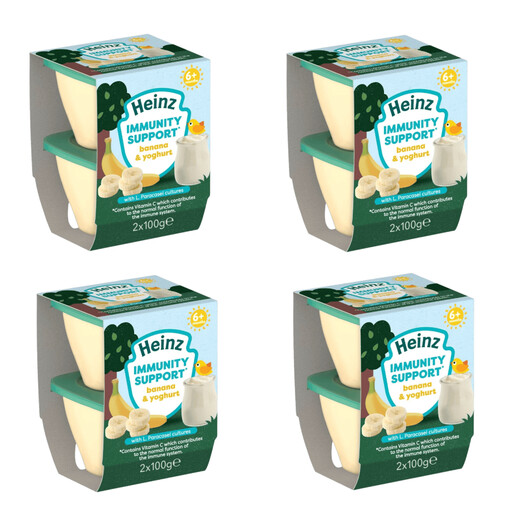
This Joybuy option is a bundle of Heinz yoghurt pots labelled for babies aged 6+ months. Check that the age labelling, 100g serving and pack directions suit the child’s holiday lunch.
 No image available
Heinz Banana & Yoghurt Pots 6+ Months, 2 × 100g, bundle of four
Eight individual 100g pots provide separate servings for repeated lunches if that portion suits the child. The product is labelled for ages 6+ months and contains milk. Check the current ingredients and nutrition panel if added sugar matters, and follow the pack’s storage and serving directions for the outing.
View on Joybuy
Frequently asked questions
Does yoghurt need an ice pack in a holiday lunchbox?
If the yoghurt needs chilling and the lunchbox will not be refrigerated, use an insulated box with an ice pack. This follows NHS advice for lunchboxes kept away from a fridge; also follow the storage instructions on the exact product.
What yoghurt pot size should I choose for a younger child?
Choose a portion close to what the child usually finishes. Tesco Groceries lists 42g Little Yeos mini pots and 90g Onken Kids pots, giving you two different child-focused serving sizes to compare.
Does no added sugar apply to every yoghurt from the same brand?
No. Yeo Valley identifies a specific Little Yeos No Added Sugar range; check that wording on the exact product and flavour you buy. Tesco Groceries also advises reading the current label because recipes can change.
Can I assume a children’s yoghurt is free from milk allergens?
No. The Food Standards Agency identifies milk as a common ingredient in yoghurt. Read the allergen declaration on the exact product and flavour, and check any food policy at the child’s holiday venue.


