Parents packing primary-school lunchboxes
Individual pots make portions straightforward to pack. Check the grams per pot against what your child is likely to eat, rather than relying on the number of pots in the pack.


Choose the portion and format before the brand: small individual pots can suit a smaller lunchbox portion, while larger pots may suit older children or a bigger appetite; a family tub needs portioning into a separate container. Check the current pack for milk and other allergens, sugar information and storage directions, and confirm the school’s lunchbox policy before packing it.
Individual pots make portions straightforward to pack. Check the grams per pot against what your child is likely to eat, rather than relying on the number of pots in the pack.
Standard dairy yoghurt is not a substitute for a milk-free product. The Food Standards Agency identifies milk as a common yoghurt ingredient; read the current ingredients and allergen information before packing a pot.
Smaller children’s pots, larger individual pots and a tub portioned at home involve different serving sizes and preparation. Check how each format fits the people eating it and the storage directions on its pack.
Start with the amount in each pot, then check whether its ingredients, format and storage directions work for the school day.
| Priority | What to check | Your needs |
|---|---|---|
| Portion size | Compare grams per pot, not just pot count. Tesco Groceries lists children’s examples at 42g and 90g per pot; the exact variety and pack size matter. | For a smaller appetite, I want a portion my child is likely to finish. An older child may prefer a larger individual pot. |
| Milk and school rules | Read the current ingredients and emphasised allergens. The Food Standards Agency identifies milk as a common ingredient in yoghurt; check the individual school’s lunchbox and allergy policy too. | If milk is an allergen for my child, I need to rule out a dairy yoghurt. I also need to know what their school allows in packed lunches. |
| Sugar and flavour | Compare the ingredients and sugars per 100g for the exact flavour. Tesco Groceries describes Little Yeos as having no added sugar while containing naturally occurring sugars. | I want to understand what the label says about this pot, rather than assume that every flavour or product from the same brand has the same ingredients. |
| Storage | Follow the directions on the current pack. Tesco Groceries states that the cited Little Yeos pots should be kept refrigerated; check how the lunchbox journey and school arrangements fit those directions. | Can I follow the pot’s storage instructions from packing the lunch until my child eats it? |
| Pack format | Check whether each serving is in its own pot or needs portioning from a tub. For split pots, consider whether the separate component works in the lunchbox. | On a busy morning, a sealed individual pot takes less preparation than filling another container. A split pot may need more care when opened. |
Milk is a common yoghurt ingredient, according to the Food Standards Agency. A familiar brand name or flavour does not establish what is in the current pot.
Read the ingredients and emphasised allergen information each time, and follow the child’s established allergy arrangements and school policy.
Tesco Groceries describes Little Yeos as having no added sugar and containing naturally occurring sugars. Those statements mean different things.
Check both the wording on the pack and the nutrition panel for the exact variety you are buying.
Six mini pots do not give the same portion per serving as six larger pots. Tesco Groceries lists Little Yeos at 42g per pot and Onken Kids at 90g per pot.
Look at grams per pot and choose a portion that fits the child and the rest of their lunch.
A sealed pot should not be assumed to suit every school-bag routine. The cited Little Yeos product carries a keep-refrigerated instruction.
Check the directions on your chosen pack and whether the journey, lunchbox and school arrangements can follow them.
These examples show how pot size and format differ; check the current pack for the particular variety you choose.
Tesco Groceries lists Little Yeos as a 6 x 42g children’s yoghurt multipack.
Tesco Groceries lists Onken Kids Raspberry & Banana as 4 x 90g. Onken also describes a 1kg natural yoghurt tub.
Rachel’s Organic lists Luscious Fruits Bio-Live Yogurt in a 4 x 110g format.
Tesco Groceries lists Activia Strawberry yoghurt as a 4 x 115g multipack and describes it as containing live cultures.
Sainsbury’s lists Müller Corner Mixed Red Fruits as six 136g split pots, with cherry or blackberry-and-raspberry compote on the side.
Tesco Groceries lists children’s yoghurt multipacks alongside own-label multipack formats.
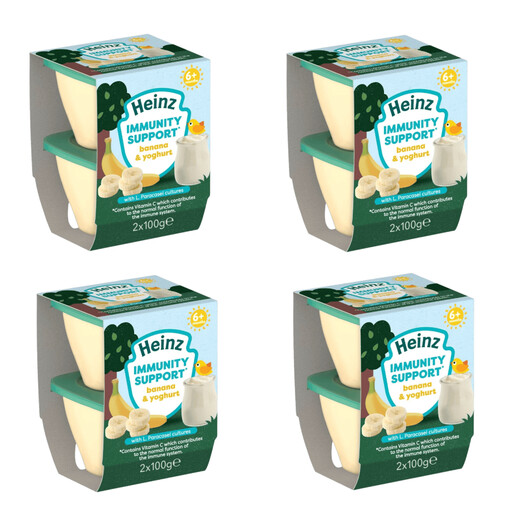
The option below is an eight-pot bundle of Heinz Banana & Yoghurt pots labelled for ages 6+ months. For a primary-school lunchbox, check whether this product’s portion, ingredients and storage directions suit your child and the school’s arrangements.
 No image available
Eight separate 100g pots offer a pre-portioned format, but the 6+ months label does not by itself establish that this product suits a primary-school child’s lunch. The listing identifies milk, so check the current ingredients and allergen information; also confirm the pack’s storage directions and the school’s lunchbox policy.
Check your child’s school policy before packing it; rules and allergy arrangements need to be confirmed with the individual school. Standard yoghurt commonly contains milk, so read the current product label as well.
Read the current ingredients list and emphasised allergen wording. The Food Standards Agency identifies milk as a common yoghurt ingredient and states that allergens present in prepacked food must be emphasised in its ingredients list.
No. Tesco Groceries describes the cited Little Yeos multipack as having no added sugar while containing naturally occurring sugars. Check the nutrition panel for the exact product and flavour.
Follow the directions on the particular pack. The cited Little Yeos product says to keep it refrigerated, so check whether your lunchbox and school-day arrangements can meet its instructions.
Individual pots avoid portioning a tub into another container. A tub is an alternative when you can prepare a suitable portion, prevent leaks and follow that product’s storage directions; compare the serving size as well as the preparation involved.