Parents planning several days of snacks
Individual pots or pouches make it easier to count out snacks for children during the holidays. Check whether the pack has enough servings and whether each one suits the child’s appetite.


Choose individual pots or pouches when ready-to-serve portions will make school holiday snacks easier to plan. Compare the number and size of servings with your household’s needs, then check the exact pack’s nutrition, ingredients, allergens and storage instructions; larger multipacks may suit mixed-age households, but their portions are not necessarily right for every child.
Individual pots or pouches make it easier to count out snacks for children during the holidays. Check whether the pack has enough servings and whether each one suits the child’s appetite.
If ingredients or nutrition information guide your choice, compare the exact flavours and pack sizes under consideration. Check the allergen statement as well as any front-of-pack traffic-light labels.
Older children and adults may share a multipack with larger individual pots. Check the serving size and ingredients before assuming the same pack suits younger children.
Start with the number of snack occasions you are planning for, then compare portions and exact-pack labels.
| Priority | What to check | When it matters |
|---|---|---|
| Enough servings | Count the pots or pouches and note the grams in each. Tesco lists examples ranging from Little Yeos 6 × 42g to Greek Style Yogurt 4 × 100g. | I’m planning snacks for several children or several days, so both the count and the portion size matter. |
| Nutrition and ingredients | Compare the exact products’ nutrition panels, serving sizes and ingredients. The NHS advises using traffic-light information where it appears rather than relying on packaging alone. | A child-focused name or a ‘no added sugar’ claim does not tell me everything I want to know about the yoghurt. |
| Allergens | Read the current ingredient list and allergen statement for the chosen flavour and pack. The Food Standards Agency identifies milk as a common ingredient in yoghurt. | Someone eating the snack needs me to check for milk or another relevant allergen on the exact pack. |
| Storage and dates | Follow the pack’s storage instructions and use-by date. The Food Standards Agency warns that storing food too long or at the wrong temperature can make it unsafe. | I need a pack count we can use while following its storage instructions and use-by date. |
Pot counts and serving sizes differ, so two packs can cover different numbers of snack occasions.
Count the servings and check grams per pot or pouch against the number of children and days you are planning for.
Neither description replaces the nutrition panel, ingredient list or serving size. The NHS recommends checking packaging and traffic-light information for packaged snacks.
Compare the exact packs you would serve, including their sugars, fat and ingredients, rather than choosing by a single front-of-pack phrase.
The Food Standards Agency identifies milk as a common yoghurt ingredient; Onken’s Raspberry & Banana ingredient list specifies cow’s milk.
Check the current ingredients and allergen statement each time you choose a different flavour or pack.
The Food Standards Agency warns that food stored too long or at the wrong temperature can become unsafe.
Match the pack count to planned snacks, follow its storage instructions and use it by the stated use-by date.
Tesco lists Onken Kids Raspberry & Banana in a 4 × 90g multipack.
The Little Yeos range includes No Added Sugar 6 × 42g mini pots and 4 × 85g kids’ multipacks, according to Yeo Valley.
Tesco lists its own Strawberry & Raspberry fromage frais pouches in a 4 × 80g pack and Greek Style Yogurt in 4 × 100g packs.
Müller Light and Müller Corner include wider-family multipack formats.
Tesco lists Activia in 4 × 115g and 8 × 115g multipack formats, including no-added-sugar variants.
These Heinz banana-and-yoghurt pots come as a twin pack or a bundle of four twin packs. They are labelled 6+ months and described for babies, so check whether their 100g portions suit the school-age children you are shopping for.
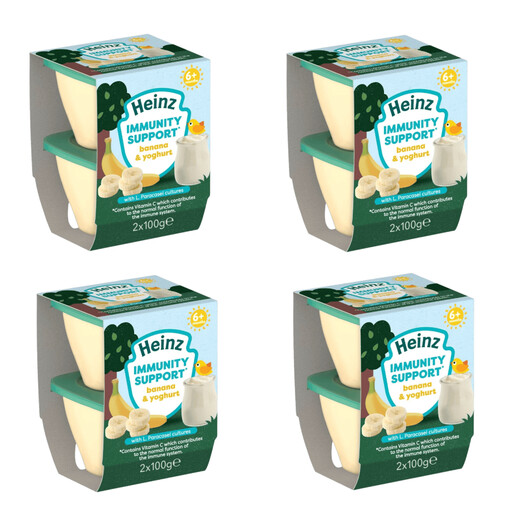 Image unavailable
Four twin packs provide eight individual 100g pots for planned snack occasions. This baby-focused product is not specifically presented as a school-age snack; its listed nutrition states 11.0g sugars per 100g. It contains milk, so check the current pack’s allergen information.
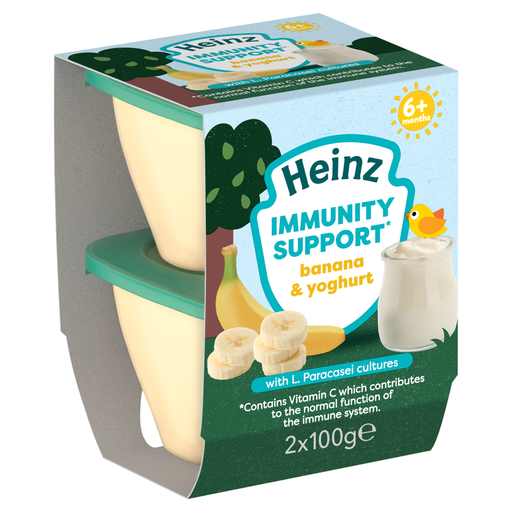 Image unavailable
The twin pack contains two individual 100g pots when only two planned servings are needed. It is described for babies rather than specifically for school-age children; its listed nutrition states 11.0g sugars per 100g. It contains milk, so check the current pack’s allergen information.
Start with the number of servings and grams per serving, then check the exact pack’s nutrition and ingredients. Listed formats include 6 × 42g mini pots and 4 × 100g multipacks, which may suit different appetites and snack plans.
No. The NHS advises checking packaging and nutrition labels, including traffic-light information where available. Compare the exact products rather than relying on a child-focused name or pack design.
Check the exact pack’s ingredients and allergen statement before serving it. The Food Standards Agency identifies milk as a common yoghurt ingredient, and Onken lists cow’s milk in its Raspberry & Banana yoghurt.
Follow the storage instructions and use-by date on the exact pack. The Food Standards Agency warns that food kept too long or at the wrong temperature can become unsafe.
A pouch can suit a snack occasion when its serving size and format work for the child. Compare its ingredients, nutrition, allergens and storage instructions with those of the pots you are considering; the pouch format alone does not establish those details.