Families packing school-week lunches
Deciding whether several children or several weekdays call for sealed, ready-to-eat pots, or whether a larger tub will be used mainly at home.


Choose sealed individual pots when yoghurt needs to travel as a ready portion; a larger pot makes more sense for use at home, or when you can portion it and follow its storage instructions. Compare nutrition per 100g as well as per serving. For a school lunch, check the current milk-allergen declaration against your child’s needs and the school’s allergy arrangements before choosing a pack.
Deciding whether several children or several weekdays call for sealed, ready-to-eat pots, or whether a larger tub will be used mainly at home.
Checking whether the exact dairy yoghurt fits a child’s needs and the school’s allergy policy before putting it in a lunchbox.
Comparing sugars, fat, saturates and portion sizes across plain, flavoured and topped yoghurts rather than assuming the formats have the same nutrition profile.
Start with where the yoghurt will be eaten, then compare the portion, label and school requirements for the exact product.
| Priority | What to check | Your needs |
|---|---|---|
| Milk and school arrangements | Read the current ingredient and allergen declaration. Check the individual school’s allergy policy and the child’s arrangements. | I need to know whether this dairy yoghurt is appropriate for my child and can be brought to school under its arrangements. The Department for Education’s school allergy guide says schools must publish an allergy safety policy. |
| Portions | Compare pot count and grams per pot, not pack count alone. Decide whether a sealed serving is needed away from home. | For several lunches, I want portions that match the number of school days and the amount each child will eat. Tesco’s UK listings show that child pots and standard multipacks come in different sizes. |
| Nutrition label | Compare products per 100g, then check the amount in each pot. Read sugars, fat and saturates alongside the ingredients and any traffic-light label. | If I’m comparing plain, flavoured or topped yoghurt, I want to use the same measurement basis before considering the serving size. The NHS explains that nutrition labels usually give values per 100g and may also give them per portion. |
| Where it will be eaten | Check the pack’s storage instructions and use-by date. For a large pot, consider how it will be portioned and stored. | A sharing pot works for our breakfasts or after-school snacks if we can portion it at home. For a lunchbox, I may prefer a sealed pot or need a suitable container and a way to follow its storage instructions. |
Dairy yoghurt contains milk. A convenient pack format does not settle whether it fits a child’s allergy needs or the school’s arrangements.
Check the exact current allergen declaration and the individual school’s allergy policy before choosing a multipack for lunches.
Packs with the same number of pots can contain different amounts per pot, changing how many suitable portions they provide.
Compare grams per pot and total pack weight, then use the per-100g nutrition declaration to compare different sizes.
Terms such as organic or fat-free do not tell you every ingredient or the full sugars and saturated-fat values. Rachel’s Organic lists organic sugar in its Luscious Fruits strawberry recipe, for example.
Compare the ingredient list and nutrition declaration for the exact flavour and pack you intend to buy.
Tesco cautions that ingredients, nutrition information and allergens can change when a food product is reformulated.
Read the current pack, particularly when an allergen affects the decision.
These ranges illustrate different pack formats; a brand name alone does not establish the ingredients or nutrition of a particular yoghurt.
Tesco lists six-pot Müller multipacks, while Müller describes Corner pots as yoghurt paired with fruit or a crunchy topping.
Tesco lists Onken Kids Raspberry & Banana 4 x 90g alongside larger Onken pots, giving households a portioned-pot or sharing-pot choice.
The range includes child-oriented multipacks and larger pots. Yeo Valley says its fruited four-packs and big pots use organic whole-milk yoghurt blended with organic fruit.
Rachel’s Organic offers a Luscious Fruits 4 x 110g multipack.
Tesco lists Activia multipacks in four- and eight-pot formats, including low-fat and fat-free varieties.
Tesco is a retailer reference here, not a single yoghurt formulation. Its UK listings show child pots, standard multipacks and larger tubs.
This option is an eight-pot, baby-focused yoghurt bundle. If you are shopping for a school-age child, check whether the product and its portions suit them before treating it as a school-week choice.
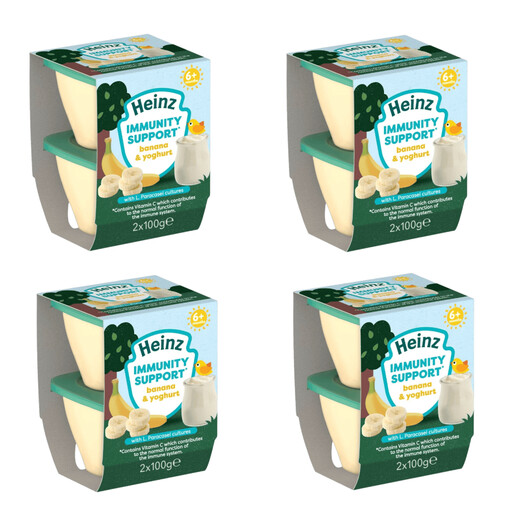 No image available
Four twin-packs provide eight individual 100g pots. The product is described for babies aged 6 months and over, so check whether it suits your school-age child. It contains milk; check the current allergen declaration and the school’s allergy arrangements before packing it for lunch.
Check your child’s needs, the exact product’s milk-allergen declaration and the individual school’s arrangements first. The Department for Education’s school allergy guide says schools must publish an allergy safety policy; it does not mean every dairy yoghurt is appropriate for every child.
Compare the nutrition declaration per 100g, then check grams per pot and how much will actually be eaten. The NHS says pre-packed food labels usually show nutrition per 100g and sometimes per portion.
Yes, if you can portion it into a suitable container and follow the product’s storage instructions. A sealed individual pot avoids transferring each lunch portion from a sharing tub.
No: organic status does not state a product’s sugar content. Rachel’s Organic lists organic sugar and 12.5g sugars per 100g for its Luscious Fruits strawberry variety, so compare the current nutrition panels of the products you are considering.
Use the label’s ingredients, allergens, nutrition and pot size to decide whether the exact product fits your household. A category description is not a substitute for those checks, particularly when milk allergy or school arrangements matter.