Hosts serving individual snacks
Count the children who will be offered yoghurt and choose a pot size that fits the ages attending. Plan where the products will be kept until serving.


Choose individually portioned pots when you want to count out one serving per child: check the number of pots, then the weight of each one. Larger pots may suit older children or a dessert table, but check every product’s label against guests’ dietary requirements and follow its storage instructions; a dairy-free alternative needs its own allergen check.
Count the children who will be offered yoghurt and choose a pot size that fits the ages attending. Plan where the products will be kept until serving.
Ask parents or carers about requirements before the party. Check the exact product labels and keep any separately chosen alternative identifiable when serving.
Compare the information on the particular pots under consideration, rather than assuming that a children’s range or a no-added-sugar description tells you everything about the product.
Start with the servings you need, then check portion size, dietary suitability and the storage instructions for the exact product.
| Priority | What to check | Your needs |
|---|---|---|
| Individual servings | Count the sealed pots in each pack; compare their stated weight per pot. Tesco Groceries lists children’s formats including 6 × 42g and 4 × 90g. | I want to offer each child a separate pot, with a portion size that makes sense alongside the other party food. |
| Allergens | Check the exact ingredient and allergen label, including on dairy-free alternatives. GOV.UK lists milk among the allergens that food businesses must declare when it is an ingredient. | A guest may need to avoid milk or another ingredient, so I need to confirm their requirements with a parent or carer before serving. |
| Nutrition information | Compare the nutrition information on the exact packs. Read traffic-light labels where provided; a no-added-sugar description applies to the named product, not an entire brand. | I want to compare the flavoured pots I’m considering without treating their packaging claims as a complete nutrition assessment. |
| Storage and timing | Read each pack’s storage and use-by instructions. For chilled food, GOV.UK food-business guidance recommends a fridge set to 5°C or below and says food left out for more than four hours must be thrown away. | There may be a gap between setting out the food and serving it, so I want a plan that fits the products’ storage instructions. |
Multipacks do not all provide the same number or size of individual servings.
Work from the number of children being offered yoghurt, then check both the pot count and grams per pot on the packs you are considering.
Milk is an allergen identified in GOV.UK guidance, and serving a product to a child with a milk allergy creates a serious risk.
Confirm requirements with parents or carers, check each exact label and follow any school, nursery or venue food policy.
A dairy-free alternative may contain another ingredient a guest needs to avoid; Tesco Groceries lists a soya-based children’s yoghurt alternative.
Check the alternative’s full ingredient and allergen declaration against that child’s requirements, and keep it separate at serving time.
Chilled yoghurt needs a serving plan that accounts for how long it will be out of the fridge.
Keep chilled packs refrigerated until needed and put out manageable batches. GOV.UK food-business guidance says chilled food left out for more than four hours must be thrown away.
Pots left out beyond that limit may need to be discarded rather than saved for later.
These Tesco Groceries listings illustrate different pot counts and sizes; check the particular product rather than assuming every item from a brand has the same formulation.
Tesco Groceries lists Little Yeos No Added Sugar Kids Yogurt in a 6 × 42g format.
Tesco Groceries lists Onken Kids Raspberry & Banana Yoghurt as 4 × 90g.
Tesco Groceries lists Müller Corner multipacks in 6 × 124g and 6 × 136g formats.
Tesco Groceries lists Activia strawberry and peach multipacks in 4 × 115g formats.
Tesco Groceries’ children’s yoghurt category lists individual-pot multipacks and dairy-free alternatives.
This eight-pot Heinz bundle is described for babies aged 6 months and over. Consider its age focus, 100g pots and pack-specific storage instructions rather than treating it as interchangeable with a chilled children’s yoghurt multipack.
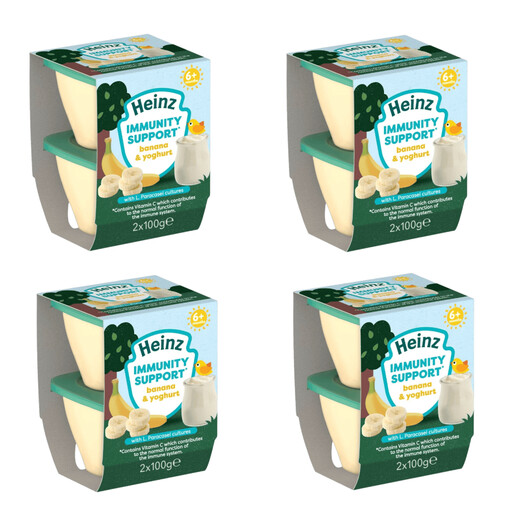 No image available
Eight separate 100g pots allow individual servings, but the product is described for babies aged 6 months and over, so check whether it suits the children attending. The listing identifies milk and instructs serving from the pot with a clean spoon while supervising eating. It says to keep unopened pots in a cool, dry place and refrigerate an opened pot for up to 24 hours; follow the purchased pack’s allergen and storage instructions.
Count the children who will be offered yoghurt, then divide that number by the pots in your chosen pack, rounding up to a whole pack. Check the pot weight as well: the number of servings alone does not tell you whether the portions fit your plans.
Confirm the setting’s food and allergy policy with the responsible staff before bringing it in, and check guests’ requirements with parents or carers. GOV.UK identifies milk as an allergen that food businesses must declare when it is an ingredient; check the exact product label before serving.
No. Check the exact alternative’s ingredients and allergen declaration against the child’s requirements: Tesco Groceries lists a soya-based dairy-free children’s option, which may not suit someone who needs to avoid soya.
GOV.UK food-business guidance says chilled food can be out of the fridge for up to four hours and must then be thrown away. Keep chilled pots refrigerated until serving and put out smaller batches; for a product with different stated storage instructions, follow its own pack.
No. That description applies to the named product, not every pot from the brand. Compare the exact products’ nutrition information and any traffic-light labels alongside portion size, ingredients and guests’ dietary requirements.