Families eating lunch at home
A large tub lets someone serve different amounts into bowls. Tesco Groceries lists 1kg Greek yoghurt tubs as examples of this format; allow for the serving utensils and follow the opened-pack storage instructions.


Choose individually sealed pots when you need ready-portioned yoghurt for a school-holiday lunch or outing; choose a larger tub when lunch is at home and someone can serve it into bowls. Children’s mini-pots offer smaller servings, so compare the grams in each pot with what the eater needs. Check the exact pack’s ingredients, allergens and storage instructions before serving.
Where lunch will be eaten changes how useful a shared tub or separate pots will be.
A large tub lets someone serve different amounts into bowls. Tesco Groceries lists 1kg Greek yoghurt tubs as examples of this format; allow for the serving utensils and follow the opened-pack storage instructions.
Sealed pots avoid spooning yoghurt from a shared tub when preparing lunches. Tesco Groceries lists children’s packs with 42g and 90g portions, so check the amount in each pot rather than relying on a children’s label alone.
A no-added-sugar claim belongs to the labelled product, not every yoghurt made by its brand. Yeo Valley identifies Little Yeos No Added Sugar as a distinct range; compare the ingredients and nutrition panel on the exact pack under consideration.
Start with the lunch location and serving size, then compare the recipe and label details of packs that fit.
| Priority | What to check | Your needs |
|---|---|---|
| Portion size | Compare grams per pot, pot count and total pack weight. Tesco Groceries lists examples ranging from Little Yeos 6 × 42g to Müller Corner 6 × 136g. | I want enough for each intended eater without opening several small pots to make one serving. |
| Serving format | Check whether lunch will be served at home or packed for an outing. A tub needs portioning; individual pots come separately sealed. Follow the chosen pack’s storage instructions. | For a packed lunch, I want separate portions; at home, I may prefer to serve different amounts from a tub. |
| Recipe | Read the exact variant’s ingredients and nutrition panel. Check which product carries any no-added-sugar claim and whether a flavour includes separate additions. | I want to compare what is actually in the flavours my family would eat, rather than assume every pot from one brand has the same recipe. |
| Lunch planning | Decide what will form the main part of lunch separately from the yoghurt. NHS lunchbox guidance gives bread, rice, pasta and potatoes as examples for the main item. | I’m choosing yoghurt to go alongside lunch, not to stand in for the main item. |
| Allergens | Read the current ingredients and allergen information on each exact pack, including when changing flavour or recipe. Do not assume a dairy-free alternative suits every allergy requirement. | If someone in the family has an allergy or intolerance, I need to check the product being served rather than rely on a familiar brand name. |
Six mini-pots can contain much less yoghurt per serving than six larger pots. Tesco Groceries lists Little Yeos at 6 × 42g and Müller Corner at 6 × 136g.
Compare the grams per pot, the number of pots and the total pack weight against the servings you plan to use.
A small pot is one possible part of lunch. NHS lunchbox guidance describes a separate main item, with bread, rice, pasta or potatoes among its examples.
Plan the main lunch food separately, then decide whether a yoghurt pot is a suitable accompaniment.
Recipes and labelled claims belong to particular products. A no-added-sugar range, for example, does not make that a claim about every yoghurt from the same brand.
Check the current pack’s ingredients, allergen information and nutrition panel for the flavour you intend to serve.
These named ranges illustrate different pack formats; the label on the individual product remains the basis for comparing recipes.
Tesco Groceries lists Müller Corner fruit yoghurts in a 6 × 136g format for individually portioned servings.
Tesco Groceries lists Little Yeos No Added Sugar in a 6 × 42g children’s pack. Yeo Valley identifies No Added Sugar as a particular Little Yeos range.
Tesco Groceries lists Onken Kids Raspberry & Banana Yoghurt as four 90g pots.
Tesco Groceries lists Tesco Finest Greek Yoghurt and Tesco Finest 0% Fat Greek Yoghurt in separate 1kg tub variants.
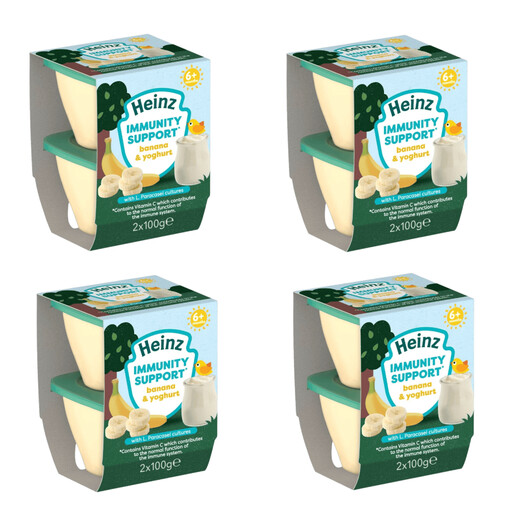
This Joybuy option is a bundle of individually portioned yoghurt-containing pots presented for babies aged 6 months and over. Its intended age group matters when choosing food for a school-holiday family lunch.
 No image available
Eight individual 100g pots offer separate servings, but this banana, yoghurt and apple product is presented for babies aged 6 months and over, not as a general family yoghurt. It contains milk, and its directions call for supervision while eating. Check the current ingredients and allergen information; once opened, the product description directs you to refrigerate unused, unheated food and use it within 24 hours.
Buy a multipack if separate, ready-portioned servings matter for packed lunches or outings. A tub is practical when lunch is at home and someone can portion it into bowls; Tesco Groceries lists 1kg Greek yoghurt tubs alongside smaller individual-pack formats.
Treat a mini-pot as a possible accompaniment, not the whole lunch. Tesco Groceries lists Little Yeos pots at 42g each, while NHS lunchbox guidance describes a separate main item based on foods such as bread, rice, pasta or potatoes.
No. Yeo Valley identifies Little Yeos No Added Sugar as a particular range. Read the ingredients and nutrition information on the exact product rather than applying that wording to its other ranges or flavours.
Read the current ingredients and allergen information on the exact pack before serving it, including when changing flavours or buying a product with a revised recipe. Do not assume that other products from the same brand, or a dairy-free alternative, meet the same requirements.