What should you check for a weekly shop?
Start with how the yoghurt will be used, then compare pack instructions and nutrition for the specific products you are considering.
| Priority | What to check | Your needs |
|---|
| Pack life |
Check the date and post-opening directions on the exact pack. Ocado’s Yeo Valley Organic Natural Yoghurt 950g listing says to eat it within three days of opening; that instruction should not be applied to other tubs. |
We use yoghurt regularly, but can we finish a large tub after opening it? |
| Nutrition |
Compare sugar, fat and saturates on the same per 100g basis, then consider the portion you would use. Rachel’s Organic lists 0.1g fat and 0.1g saturates per 100g for its 450g fat-free Greek-style natural yoghurt. |
I’m choosing between natural and flavoured recipes and want the label, rather than the style or brand name, to guide the comparison. |
| Portions and use |
Compare the number and size of pots with a shared tub. Onken lists 1kg natural formats, while Tesco lists an Activia strawberry multipack of four 115g pots. |
Separate pots would suit our snacks and packed lunches; for breakfasts and cooking, I would use a shared natural tub. |
| Ingredients and allergens |
Read the ingredients and allergen declaration for the exact recipe. The Food Standards Agency identifies milk as an ingredient commonly found in yoghurt. |
If someone needs to avoid milk, the word ‘natural’ or a lower-fat label does not answer the allergen question. |
Which brand ranges are relevant?
These ranges illustrate different formats to compare; a brand’s range does not establish the details of every individual product.
Onken
Onken’s UK range includes Natural Set 1kg and Natural 1kg yoghurt for shoppers considering a shared tub.
- The 1kg formats give households a large natural-pot option.
- Check the date, nutrition and post-opening directions for the one you buy.
Yeo Valley Organic
Yeo Valley Organic lists natural yoghurt in 450g and 950g formats, alongside other natural and fruit options.
- Ocado’s listing for its 950g natural yoghurt states that it contains organic whole milk and live cultures.
- That 950g listing says to eat the yoghurt within three days of opening; check the instructions on the pack you buy.
Rachel’s Organic
Rachel’s Organic has a 450g fat-free Greek-style natural yoghurt for shoppers comparing plain recipes in a smaller tub.
- Rachel’s Organic lists 0.1g fat and 0.1g saturates per 100g for this product.
- A 450g tub will not serve the same number of portions as a near-1kg shared pot.
Activia
Activia’s UK range includes natural big pots and individual portions. Tesco lists a strawberry multipack of four 115g pots.
- Separate pots offer a portioned alternative to a shared tub.
- Read claims on the exact product with their conditions; branding does not replace an ingredients and nutrition check.
Müller
Müller’s UK range includes Corner and Light products, with different flavours and individual-pot formats.
- The range gives shoppers several portioned formats to compare.
- Recipes differ, so check sugar, fat, allergens and date instructions on the specific pack.
Joybuy options for portioned snacks
This selection is for a narrower weekly-shop need: individual yoghurt-containing snacks for a baby aged 6+ months, rather than a shared natural yoghurt for household cooking.
 No image available
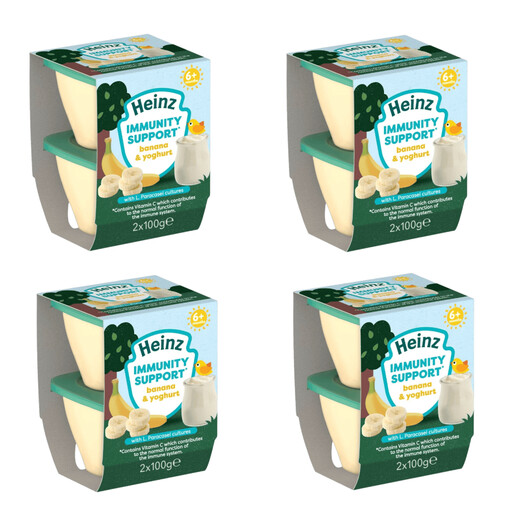
Heinz Banana & Yoghurt Pot 6+ Months, 4 Packs of 2 × 100g
For a shop that includes separate baby snacks, this bundle contains eight 100g pots. It is a baby-food option, not a plain yoghurt for cooking; check the pack date and allergen declaration before choosing it.
View on Joybuy
Questions about buying yoghurt for the week
How large a yoghurt tub should I buy for a weekly shop?
Choose a large tub if the household can use it within that product’s post-opening instructions. Ocado’s listing for Yeo Valley Organic Natural Yoghurt 950g specifies three days after opening, but another yoghurt may have different directions.
Should I buy natural or flavoured yoghurt?
Natural yoghurt is a flexible choice if you want to use the same tub for breakfasts and cooking; portioned flavoured pots suit separate snacks. Compare sugar, fat and saturates per 100g on the specific packs rather than assuming either style has a particular nutrition profile.
Will a yoghurt last until the end of the week?
Check both its date mark and its storage and post-opening directions. GOV.UK explains that use-by dates relate to safety, while best-before dates relate to quality; where the label instructs refrigeration after opening, its guidance specifies 5°C or below.
Does ‘gut health’ wording settle which yoghurt to choose?
No. Read any claim on the exact pack with its stated conditions, then check the ingredients and nutrition information for your buying decision. General branding should not be treated as a treatment promise.
Is ordinary dairy yoghurt suitable if milk must be avoided?
Ordinary dairy yoghurt contains milk. The Food Standards Agency identifies milk as a common yoghurt ingredient and an allergen, so check the exact product’s allergen declaration rather than relying on descriptions such as ‘natural’ or ‘low fat’.


