What should you check before taking cola with breakfast?
Start with the sugar and caffeine information for the exact variant, then check ingredients and whether its pack format works for the journey.
| Priority |
What to check |
Your needs |
| Sugar per can |
Compare sugars per 100ml and for the amount you will drink. Coca-Cola GB lists 10.6g per 100ml for Original Taste, or about 35g in 330ml; the NHS advises adults to have no more than 30g free sugars a day. |
I want fizz alongside breakfast without choosing a sugar-sweetened can by default. I will check the nutrition panel rather than rely on words such as “diet” or “zero”. |
| Caffeine |
Check the exact variant name and ingredients for caffeine. Coca-Cola GB identifies caffeine-free variants, but Coca-Cola Zero Sugar contains caffeine flavouring; NHS guidance says to count caffeine from all sources during pregnancy. |
If I am already having coffee or tea, I may want a clearly labelled caffeine-free cola instead of assuming that zero sugar also means zero caffeine. |
| Breakfast food |
Plan food as well as a drink. The NHS Eatwell Guide describes an overall diet containing different food groups; a cola can does not provide the range of foods in a breakfast. |
On a rushed morning, I need something to eat that I can take with me, not just a convenient drink. |
| Ingredients |
Read the current pack’s sweetener list and advisory statements. Pepsi UK lists sweeteners and a source-of-phenylalanine statement for both Pepsi Max and Pepsi Max No Caffeine. |
If a particular ingredient or phenylalanine statement matters to me, I need to check the specific recipe before buying. |
| Pack format |
Check whether you need a sealed individual can or a bottle to pour from before leaving. Tesco lists its Diet Cola in a 2L bottle and says to consume it within 3 days of opening. |
A can is straightforward to take with breakfast; a larger bottle makes more sense if I am pouring a serving at home or packing a drink separately. |
Brands and variants to compare
These brand labels illustrate why regular, zero-sugar and caffeine-free cola need separate checks; compare the exact product and serving size rather than treating every variant alike.
Coca-Cola
Coca-Cola GB provides label information for Original Taste and Zero Sugar and identifies separate caffeine-free variants.
- Original Taste lists 10.6g sugars and 42 kcal per 100ml; Zero Sugar lists 0g sugars and 0.3 kcal per 100ml.
- Standard Coca-Cola Zero Sugar includes caffeine flavouring. Choose a specifically labelled caffeine-free variant if caffeine avoidance is the point of the switch.
Pepsi
Pepsi UK lists both Pepsi Max and Pepsi Max No Caffeine as zero-sugar colas, with different caffeine information.
- Pepsi Max lists 0g sugars and 1 kcal per 330ml can; Pepsi Max No Caffeine lists 0g sugars and 2 kcal per 330ml can.
- Both variants list sweeteners and a source-of-phenylalanine statement. Pepsi Max includes caffeine, so check the variant name.
Tesco
Tesco Diet Cola is a bottled option to consider when pouring a drink at home or packing one separately.
- Tesco lists less than 0.1g sugars and 1 kcal per 250ml glass for its 2L Diet Cola.
- It contains caffeine and sweeteners. Tesco says to consume the bottle within 3 days of opening; a bottle also needs more planning than an individual sealed can.
Cola multipacks on Joybuy
These multipacks contain individual 330ml cans for a drink alongside breakfast food. They include caffeine-free and caffeinated zero-sugar colas, plus a regular sugar-sweetened option; check the exact pack if sugar, caffeine or sweeteners affect your choice.
 No image available
Pepsi Max Caffeine Free 24 × 330ml
An individual can can go alongside breakfast when you want a cola without sugar or caffeine. Pepsi UK lists 0g sugars and 2 kcal per 330ml can for this variant; it contains sweeteners and carries a source-of-phenylalanine statement, so check the current pack if those ingredients matter to you.
View on Joybuy
 No image available
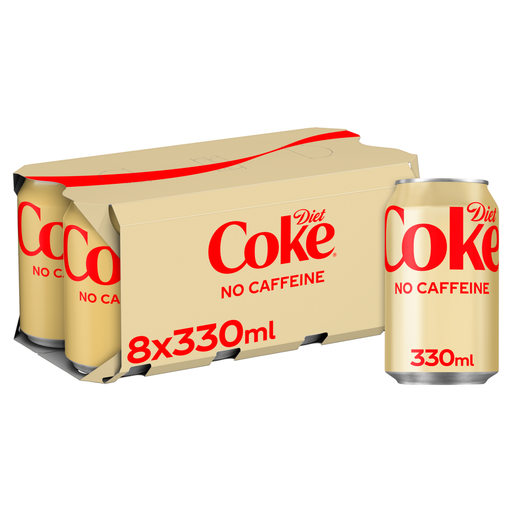
Diet Coke Caffeine Free 8 × 330ml
The 330ml cans offer another caffeine-free cola format to take with breakfast food. The product information lists 0g sugars per 100ml and identifies aspartame, acesulfame K and a source-of-phenylalanine statement; check the current can for ingredient-specific needs.
View on Joybuy
 No image available
Pepsi Max 24 × 330ml
This is a zero-sugar can for a portable breakfast drink if caffeine is acceptable to you. Pepsi UK lists 0g sugars and 1 kcal per 330ml can; the ingredients include caffeine and sweeteners, and the label carries a source-of-phenylalanine statement.
View on Joybuy
 No image available
Coca-Cola Zero Sugar 24 × 330ml
These individual cans offer a zero-sugar cola to take alongside breakfast, but not a caffeine-free one. The Joybuy product information lists 0g sugars per 330ml can; Coca-Cola GB lists caffeine flavouring, sweeteners and a source-of-phenylalanine statement for Coca-Cola Zero Sugar.
View on Joybuy
 No image available
Coca-Cola Original Taste 24 × 330ml
The individual cans suit an occasional choice of regular, sugar-sweetened cola alongside food. The product information lists 35g sugars per 330ml can and includes caffeine; the NHS advises adults to have no more than 30g free sugars a day and to keep sugary drinks to smaller amounts less often.
View on Joybuy
Questions about breakfast cola
Can a can of cola be breakfast on its own?
No. Cola can be a drink alongside breakfast food, but it does not replace the different food groups described in the NHS Eatwell Guide. If you are leaving in a hurry, plan something to eat as well as the drink.
Is zero-sugar cola also caffeine free?
Not necessarily. Pepsi Max and Coca-Cola Zero Sugar list caffeine, while separately named caffeine-free variants are available. Check the exact product name and current ingredients when avoiding caffeine.
How much sugar is in a regular 330ml cola?
It depends on the product. Coca-Cola GB lists 10.6g sugars per 100ml for Original Taste, which is about 35g in a 330ml can. Its ingredients include added sugar; for context, the NHS recommends that adults have no more than 30g free sugars a day.
What should I check if I am pregnant and considering morning cola?
Check whether the exact cola contains caffeine and count it alongside other sources. NHS guidance says not to have more than 200mg caffeine a day during pregnancy; a caffeine-free cola does not add cola caffeine, but it is still a drink rather than breakfast food.
Why do some zero-sugar colas mention phenylalanine?
Pepsi UK lists aspartame in Pepsi Max and Pepsi Max No Caffeine, and both carry a statement that they contain a source of phenylalanine. If you follow a medically prescribed low-phenylalanine diet, check the current label and consult your clinical team about products that fit your requirements.


