Students swapping from regular cola
If reducing sugar is the reason for switching, compare sugars per 100ml on the exact diet or zero-sugar pack rather than relying on the product name alone.


If you want cola while cutting sugar, compare diet, zero-sugar and no-added-sugar options with regular sugary cola, then check the nutrition panel on the exact pack. Choose a version explicitly labelled caffeine-free if you avoid caffeine; sweeteners, phenylalanine warnings and how quickly a shared household will finish an opened bottle can also change the choice. The NHS notes that carbonated drinks can contribute to dental erosion regardless of sugar content.
If reducing sugar is the reason for switching, compare sugars per 100ml on the exact diet or zero-sugar pack rather than relying on the product name alone.
A zero-sugar label does not establish that a cola is caffeine-free. Look for an explicitly caffeine-free variant and check its ingredients.
Consider whether individual cans or a larger bottle fit the space in your shared fridge and how soon an opened bottle will be finished.
Start with the label attributes that matter to you, then choose a pack format that fits how the cola will be stored and shared.
| Priority | What to check | Your needs |
|---|---|---|
| Sugars | Read sugars per 100ml and per serving on the nutrition panel. Check the exact product even when its name says diet, zero sugar or no added sugar. | I want a cola option with no or very little sugar in place of regular sugary cola. |
| Caffeine | Check the variant name and ingredients. Standard Coca-Cola Zero Sugar and Pepsi Max list caffeine; their separately labelled caffeine-free variants serve a different need. | For my caffeine-avoidance routine, I need a pack that explicitly says caffeine-free, not just zero sugar. |
| Sweeteners | Read the sweetener list and any phenylalanine statement. The NHS says aspartame is unsuitable for people with phenylketonuria (PKU). | If I need to avoid a particular sweetener or have PKU, the ingredients on the current pack matter more than the cola's product family. |
| Acidity | Do not treat a zero-sugar label as removing the dental consideration: the NHS associates carbonated drinks with dental erosion because of their acid content. | I want to cut sugar without assuming that zero-sugar fizzy cola is free of dental trade-offs. |
| Pack format | Compare can and bottle sizes with how the household will use them. ASDA and Sainsbury's instruct buyers of their listed 2-litre colas to refrigerate after opening and use within 3 days. | Will we share and finish a large bottle within its labelled opened-life period, or would individual cans fit our routine? |
Standard Coca-Cola Zero Sugar and Pepsi Max list caffeine, even though they contain no sugar.
If you avoid caffeine, choose a variant explicitly labelled Zero Caffeine or Caffeine Free and check the ingredients on that pack.
Some zero-sugar colas contain aspartame. The NHS says aspartame is unsuitable for people with PKU.
Check the current ingredients and warning if PKU or a specific sweetener restriction affects your choice.
The NHS associates carbonated drinks with dental erosion due to their acid content, whether or not they contain sugar.
Choose zero-sugar cola for the sugar difference, not on the assumption that it removes every dental consideration.
ASDA and Sainsbury's say to refrigerate their listed 2-litre colas after opening and use them within 3 days.
Check the bottle's storage instructions before choosing a large format; cans may fit better if the household drinks cola infrequently.
Coca-Cola Zero Sugar and Coca-Cola Zero Sugar Zero Caffeine address different caffeine preferences.
Pepsi Max contains caffeine, while Pepsi Max Caffeine Free is a separate zero-sugar variant.
Tesco Diet Cola offers a no-added-sugar own-label option in an 8 x 330ml can pack.
Sainsbury's Cola Zero is a sweetener-containing own-label cola sold in a 2-litre bottle.
ASDA Cola Zero is a no-added-sugar own-label option in a 2-litre bottle.
These can multipacks include caffeine-free and caffeinated diet or zero-sugar colas for stocking a student home. Check the exact pack label against your sugar, caffeine and sweetener requirements.
 No image available
A caffeine-free Diet Coke option in individual cans for a shared move-in. Its listed limitations include aspartame and a phenylalanine statement; check the pack if PKU or a sweetener restriction applies.
 No image available
A zero-sugar, caffeine-free Pepsi Max variant in individual cans. Pepsi UK lists 0g sugars per 100ml for Pepsi Max Caffeine-Free; this selected pack's limitations include aspartame and a phenylalanine statement.
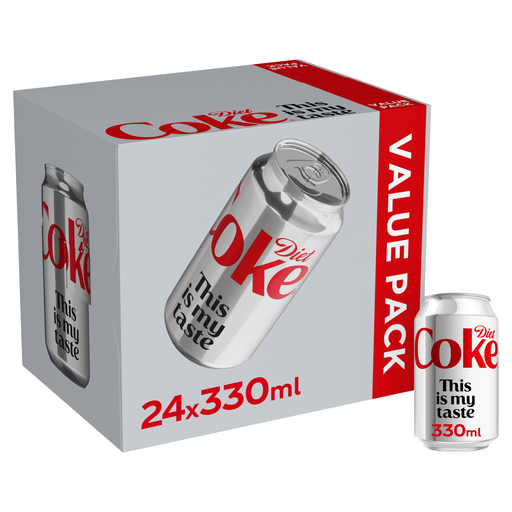 No image available
A diet cola can multipack for a shared home where caffeine is acceptable. This selection lists caffeine, aspartame and a phenylalanine statement, so check the ingredients if either affects your choice.
 No image available
A zero-sugar cola can multipack for households where caffeine is acceptable. Pepsi UK lists 0g sugars per 100ml for Pepsi Max; its ingredients include caffeine and aspartame, with a phenylalanine statement.
 No image available
A zero-sugar can multipack for a shared move-in where caffeine is acceptable. Coca-Cola Great Britain lists 0g sugars per 100ml for Coca-Cola Zero Sugar; the standard version lists caffeine and carries a phenylalanine statement.
No. Standard Coca-Cola Zero Sugar and Pepsi Max list caffeine. If you avoid it, choose a separately labelled caffeine-free variant and check that pack's ingredients.
Some colas contain aspartame, which is relevant to people with phenylketonuria (PKU). The NHS says aspartame is unsuitable for people with PKU; check the current ingredients and phenylalanine statement when choosing a pack.
No. The NHS associates carbonated drinks with dental erosion because of their acid content, regardless of whether they contain sugar or sweeteners.
Choose according to how quickly the household will use an opened bottle and whether individual servings are useful. ASDA and Sainsbury's instruct buyers of their listed 2-litre colas to refrigerate after opening and use within 3 days; follow the instructions on the exact pack.