Organisers checking sugar content
If the meeting brief calls for zero-sugar cola, check the sugars figure on the nutrition panel rather than treating “no added sugar” as the same thing.


For a work meeting that calls for zero-sugar cola, check the nutrition panel for 0 g sugars rather than relying on a “no added sugar” claim. Choose between standard and explicitly caffeine-free varieties according to the meeting’s needs, then match cans or bottles to the serving setup. Check ingredients and warning statements on the final pack when phenylalanine is relevant to an attendee.
If the meeting brief calls for zero-sugar cola, check the sugars figure on the nutrition panel rather than treating “no added sugar” as the same thing.
For a later meeting or a group with differing preferences, consider an explicitly caffeine-free zero-sugar cola alongside a standard variety.
If an attendee has a phenylketonuria (PKU)-related dietary requirement, check the final pack’s ingredients and warning statement. The Coca-Cola and Pepsi examples discussed here contain aspartame and state that they contain a source of phenylalanine.
Set the sugar and caffeine requirements before choosing a serving format; a familiar brand name or a “diet” label does not settle every requirement.
| Priority | What to check | Your needs |
|---|---|---|
| Sugars | Read the sugars figure per 100 ml and, if useful, per serving. The Advertising Standards Authority and Committee of Advertising Practice explain that “no added sugars” concerns ingredients added for sweetening; it does not replace the nutrition declaration. | I’m looking for 0 g sugars, not just a no-added-sugar claim. Coca-Cola GB and Pepsi UK list 0 g sugars per 100 ml for Coca-Cola Zero Sugar and Pepsi MAX respectively. |
| Caffeine | Check for an explicit caffeine-free designation. Coca-Cola GB and Pepsi UK list caffeine flavouring in their standard Zero Sugar and MAX varieties; Pepsi UK identifies Pepsi MAX No Caffeine as caffeine-free. | For a later meeting, or when someone avoids caffeine, I want a clearly labelled caffeine-free choice rather than assuming zero sugar means no caffeine. |
| Ingredients | Read the sweetener list and any phenylalanine statement on the final pack. GOV.UK’s food-labelling guidance specifies the warning wording where aspartame is named in the ingredients. | If PKU-related requirements matter to someone attending, I need to check the actual product label, including on a caffeine-free variety. |
| Serving format | Match the number of servings to attendance and fridge space. Tesco Groceries lists zero-sugar cola in can multipacks and 2-litre bottles; bottles also call for cups and a way to serve them. | Individual cans would make distribution simpler, while bottles could work for a self-serve table if cups and chilling space are available. |
A no-added-sugars claim describes what has been added for sweetening, not the sugars figure needed for a zero-sugar meeting brief.
Check the nutrition declaration for the required sugars value per 100 ml.
Coca-Cola Zero Sugar and Pepsi MAX list caffeine flavouring, according to their respective brands.
When caffeine avoidance matters, choose a variety explicitly identified as caffeine-free and check its final label.
The Coca-Cola and Pepsi zero-sugar examples discussed here list aspartame and carry a source-of-phenylalanine statement, including Pepsi MAX No Caffeine.
Check the ingredients and warning on the pack when an attendee has a PKU-related requirement; do not infer sweetener content from caffeine status.
Can multipacks and large bottles call for different serving arrangements at a meeting.
Use attendance, fridge space and the availability of cups to choose the format.
Bottles require cups and a plan for serving the drink after opening.
These examples help distinguish product types; their inclusion does not indicate which items are available from Joybuy.
Coca-Cola GB lists standard Coca-Cola Zero Sugar separately from Coca-Cola Zero Sugar Zero Caffeine.
Pepsi UK identifies Pepsi MAX and Pepsi MAX No Caffeine as distinct zero-sugar choices.
Tesco Groceries lists own-label and branded diet or zero-sugar colas in cans and bottles.
These standard and caffeine-free cola packs offer bottle service or individual cans for a work meeting. Check each final pack against the meeting’s sugar, caffeine and ingredient requirements.
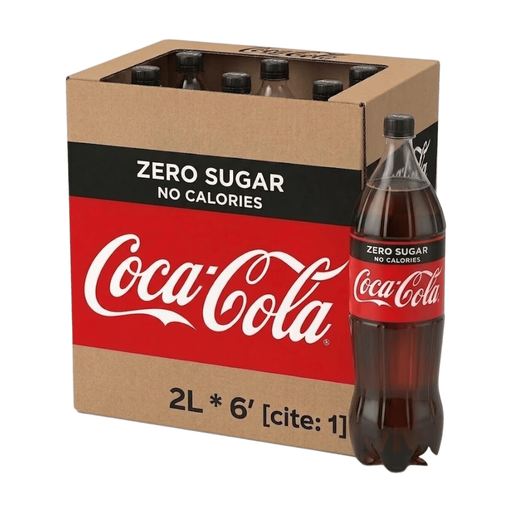 No image available
Six 2-litre bottles suit a shared serving setup when cups and chilling space are available. This is the standard, caffeinated variety; check the final pack’s ingredients and phenylalanine statement.
 No image available
The caffeine-free designation and 24 individual 330 ml cans make this a format to consider when caffeine avoidance and portioned service matter. Confirm the sugars figure, ingredients and any warning statement on the final pack.
 No image available
For individual servings where caffeine avoidance matters, this pack contains 24 cans of 330 ml. Pepsi UK identifies the No Caffeine variety as zero-sugar and caffeine-free; check the pack’s sweeteners and phenylalanine statement.
 No image available
The 24-can format allows individual servings when standard caffeinated cola is suitable. Pepsi UK lists 0 g sugars per 100 ml for Pepsi MAX and identifies caffeine flavouring and a source-of-phenylalanine statement.
 No image available
These 24 individual 330 ml cans suit a meeting where standard caffeinated cola is acceptable. Joybuy’s product information lists 0 g sugars per 100 ml, caffeine and sweeteners; check the final pack’s phenylalanine statement.
No. The Advertising Standards Authority and Committee of Advertising Practice explain that “no added sugars” concerns ingredients added for sweetening. If the meeting requires zero sugar, check the nutrition panel for the sugars figure.
Not necessarily. Coca-Cola GB and Pepsi UK list caffeine flavouring in standard Coca-Cola Zero Sugar and Pepsi MAX. When caffeine avoidance matters, choose a variety explicitly identified as caffeine-free and confirm its final label.
The statement matters when an attendee has a PKU-related dietary requirement. GOV.UK specifies phenylalanine warning wording for products listing aspartame; the Coca-Cola and Pepsi zero-sugar examples discussed here list aspartame and carry that statement. Check the pack being served.
Choose cans for individual servings or bottles for a self-serve setup with cups. Tesco Groceries lists both zero-sugar cola multipacks and 2-litre bottles; use the expected attendance, fridge space and serving arrangements to decide.