Households buying several packs at once
If cola is for meals or gatherings, check the number and size of cans as well as whether an offer requires a loyalty card. A smaller case and a 24-can case place different demands on storage.


For a large family shop, choose the recipe before the pack size: a no-sugar cola suits a household avoiding sugar in its cola, while avoiding caffeine requires a product explicitly labelled caffeine-free. Regular cola remains an option when its recipe is the preference, but check the sugar label and intended portions; then compare pack volumes and any loyalty-offer conditions.
If cola is for meals or gatherings, check the number and size of cans as well as whether an offer requires a loyalty card. A smaller case and a 24-can case place different demands on storage.
Look for the exact no-sugar variant rather than relying on the brand name. Coca-Cola and Pepsi each sell distinct regular and no-sugar recipes, so a larger case is worth choosing only after the household has settled on the flavour.
Check for the words ‘caffeine-free’ on the product itself. Coca-Cola Zero Sugar Zero Caffeine and Pepsi Max Caffeine-Free are separately named variants; a no-sugar label alone does not identify them.
Settle the sugar and caffeine requirements first, then choose a recipe and pack size that the household will use.
| Priority | What to check | Your needs |
|---|---|---|
| Pack format | Check can count, can size and total volume. Tesco listings include 24 × 330 ml cases and an 8 × 330 ml Tesco Classic Cola pack; check any loyalty-offer conditions before deciding. | For a gathering, I may want more cans in one case; for a smaller household shop, I may have less room to store them. |
| Sugar | Read sugars per 100 ml on the exact variant. Pepsi UK lists 0 g for Pepsi Max and 4.5 g for Pepsi Classic per 100 ml; Coca-Cola identifies Zero Sugar and Diet Coke as sugar-free recipes. | If cola is a regular household purchase, I want to distinguish the no-sugar recipe from the regular one before buying a large quantity. |
| Caffeine | Look for an explicit caffeine-free label. Pepsi Max Caffeine-Free and Coca-Cola Zero Sugar Zero Caffeine are distinct products, not alternative names for their standard no-sugar variants. | Someone in my household avoids caffeine, so a ‘zero sugar’ label on its own does not answer the question. |
| Flavour | Check the full variant name rather than the brand alone. Coca-Cola describes Zero Sugar as closer in flavour to Original Taste and Diet Coke as having a different, lighter flavour blend. | Different people may prefer different recipes; I would rather settle on one before committing to a larger case. |
A displayed offer may require a loyalty card and may end before the household shops.
Check the conditions and end date at the retailer before choosing between packs.
A standard no-sugar cola and its caffeine-free counterpart can be separate products. The wrong variant will not meet a caffeine-avoidance requirement.
Use ‘caffeine-free’ on the exact pack or product page as the deciding check.
Pack size does not tell you how much sugar the drink contains. NHS guidance advises cutting down on sugary fizzy drinks.
Read the nutrition panel and decide whether the regular or no-sugar recipe matches the household’s intended use and portions.
American Fizz lists an RC Cola case of 12 × 355 ml, while the Tesco listings discussed here include 330 ml cans. Can count alone therefore does not describe how much cola is in a case.
Check the seller, can size, total volume and label for the particular case you are considering.
Its UK range distinguishes Original Taste, Zero Sugar, Diet Coke and Coca-Cola Zero Sugar Zero Caffeine.
Pepsi UK lists regular Pepsi, Pepsi Max, Diet Pepsi and Pepsi Max Caffeine-Free as distinct options.
Tesco lists own-label Classic Cola alongside a separately named Classic Diet Caffeine Free Cola.
American Fizz lists RC Cola as a 12 × 355 ml case through a specialist retailer.
These 24 × 330 ml cases cover regular, no-sugar and explicitly caffeine-free cola choices for a household shop. Select the recipe first; a shared pack format does not make the drinks interchangeable.
 No image available
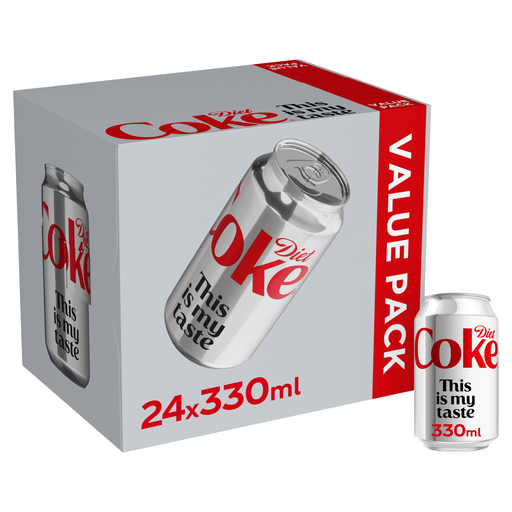
A 24-can option for households choosing Diet Coke’s sugar-free recipe. Diet Coke is a different flavour blend from Coca-Cola Zero Sugar; check the exact label if caffeine avoidance matters.
 No image available
This named caffeine-free, no-sugar variant suits a household seeking both distinctions in a 24-can case. Check that the pack says Caffeine Free rather than standard Pepsi Max.
 No image available
A 24-can case of standard Pepsi Max for a household choosing its no-sugar recipe; Pepsi UK lists 0 g sugars per 100 ml. This is not the separately named Pepsi Max Caffeine-Free variant.
 No image available
A 24-can case for households that specifically prefer the regular Original Taste recipe. It is not Coca-Cola Zero Sugar; read the sugar information and consider the intended portions before choosing the larger pack.
 No image available
A 24-can no-sugar choice. Coca-Cola describes this recipe as closer in flavour to Original Taste; it is not the separately named Zero Sugar Zero Caffeine variant. Coca-Cola’s product information also states that Zero Sugar contains a source of phenylalanine, so check the pack label if relevant.
No. Choose an explicitly labelled caffeine-free variant if someone in the household avoids caffeine. Pepsi Max Caffeine-Free and Coca-Cola Zero Sugar Zero Caffeine are separately named products.
Check both the number of cans and the volume per can. Tesco lists 24 × 330 ml branded cases and an 8 × 330 ml Classic Cola pack, so the cases contain different total amounts. Check any loyalty-offer conditions at the retailer too.
Check the sugar label and how often the household intends to drink it, rather than choosing on case size alone. NHS guidance advises cutting down on sugary fizzy drinks; regular and no-sugar cola are distinct recipe choices.
Yes. Coca-Cola’s product information states that Zero Sugar contains a source of phenylalanine. Read the label on the exact variant when ingredients matter to someone in the household.