Adults avoiding sugar
If sugar content is your reason for choosing a different drink, compare the declaration on each can. A zero-sugar label does not tell you how much caffeine the whole can contains.


If you want to avoid sugar during revision, check the can’s sugar declaration and its caffeine content separately: “zero sugar” does not mean low caffeine. Red Bull UK states that a 250 ml Sugarfree can contains 80 mg caffeine, while Monster Energy UK states that a 500 ml Absolutely Zero can contains 160 mg. Consider caffeine from other drinks, the time you plan to drink it and any on-pack warnings before choosing.
If sugar content is your reason for choosing a different drink, compare the declaration on each can. A zero-sugar label does not tell you how much caffeine the whole can contains.
Compare caffeine per complete can, especially when choosing between 250 ml and 500 ml formats. Remember caffeine you have also had from tea, coffee, cola or other products.
Age, pregnancy or breastfeeding, caffeine sensitivity and relevant health conditions can change whether a high-caffeine drink is appropriate. Read the particular can’s warning before buying; a sugar-free label does not override it.
Start with the sugar declaration, then compare caffeine for the amount you would actually drink and check when you plan to drink it.
| Priority | What to check | Your needs |
|---|---|---|
| Sugar declaration | Read the sugar figure and ingredients on the exact can. “Zero sugar” and “no added sugar” are different declarations; neither describes its caffeine dose. | I want to avoid sugar in this drink without mistaking its sugar label for a caffeine label. |
| Caffeine per can | Compare the full-can amount, not just mg per 100 ml. Red Bull UK states 80 mg per 250 ml Sugarfree can; Monster Energy UK states 160 mg per 500 ml Absolutely Zero can. Also count caffeine from other sources. | A smaller single-can caffeine amount matters to me, particularly if I have already had tea or coffee. The figures for those two named products should not be applied to other variants. |
| Revision time | Consider how close the drink would be to bedtime. NHS Borders advises avoiding caffeinated drinks close to bed because caffeine can make people feel more awake and disrupt sleep. | For evening revision, I would rather choose a non-caffeinated drink than add caffeine close to bedtime. |
| Suitability warnings | Read the exact product label. Sainsbury’s Blue Bolt Zero warns against use by under-16s, pregnant or breastfeeding people, people with heart disease and those sensitive to caffeine. Check the seller’s age policy separately. | Before putting a can in my revision shop, I need to know whether its warnings or the retailer’s age policy apply. |
Sugar and caffeine are separate parts of the choice. Red Bull UK lists 80 mg caffeine in a 250 ml Sugarfree can, while Monster Energy UK lists 160 mg in a 500 ml Absolutely Zero can.
Check caffeine for the whole can and include other caffeinated drinks or products when considering your intake.
NHS Borders says caffeinated drinks can make people feel more awake and disrupt sleep. A zero-sugar formulation does not remove that consideration.
If you are studying close to bedtime, choose a non-caffeinated drink instead.
Sainsbury’s Blue Bolt Zero, for example, warns against use by under-16s, pregnant or breastfeeding people, people with heart disease and those sensitive to caffeine.
Read the warning on the specific product you intend to buy rather than relying on its sugar description.
Sainsbury’s states that it does not sell high-caffeine energy drinks to under-16s. Separately, the Department of Health and Social Care announced a future sales ban for under-16s in England; that announcement should not be treated as a rule already in force throughout the UK.
Check the current retailer policy and the rules applicable where the drink is being bought.
Red Bull Sugarfree is a 250 ml sugar-free option for comparing caffeine by can.
Monster Energy Absolutely Zero provides a named 500 ml zero-sugar comparison point.
Blue Bolt Zero is a supermarket own-label option sold as a 6 × 250 ml pack.
Relentless Energy lists retailers for its range.
These options are a Red Bull Sugarfree 250 ml four-pack and a Monster Energy Green Zero Sugar 12-can pack. Check each can’s own caffeine declaration when comparing servings; the figure for Monster Absolutely Zero should not be assumed to apply to Green Zero Sugar.
 Image unavailable
The 250 ml can gives revision shoppers a defined serving for tracking caffeine. Red Bull UK states 80 mg caffeine per 250 ml Sugarfree can; this pack contains four cans. Consider other caffeine consumed that day and avoid caffeinated drinks close to bedtime if sleep is the priority.
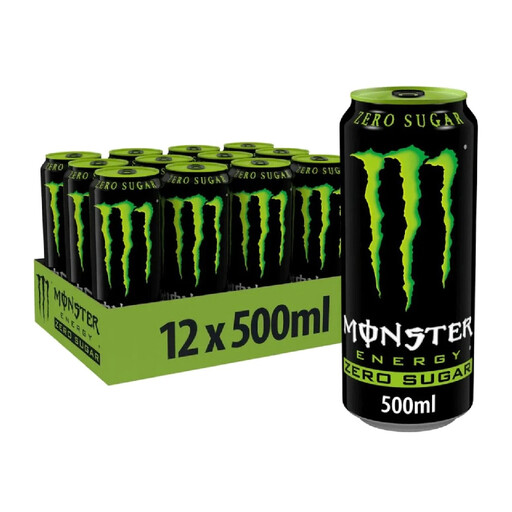 Image unavailable
This 12-can zero-sugar pack is an option for shoppers who want several cans for separate revision sessions. Check the Green Zero Sugar can’s own volume, caffeine per can and warnings before deciding on a serving; do not apply the stated figures for Monster Absolutely Zero to this variant. NHS Borders advises avoiding caffeinated drinks close to bedtime.
No. Sugar content does not establish caffeine content. Red Bull UK states 80 mg caffeine per 250 ml Sugarfree can, while Monster Energy UK states 160 mg per 500 ml Absolutely Zero can, so compare the full-can figure on the product you are buying.
Use the caffeine amount for the complete can and account for other sources, including tea and coffee. The European Food Safety Authority’s 2015 assessment found that single doses up to 200 mg and daily intake up to 400 mg from all sources did not raise safety concerns for general healthy adults; these figures are not targets or a substitute for product warnings.
If bedtime is approaching, choose a non-caffeinated drink instead. NHS Borders advises avoiding caffeinated drinks close to bed because they can make people feel more awake and disrupt sleep.
No. Sainsbury’s Blue Bolt Zero label says it is not recommended for pregnant or breastfeeding people despite its sugar declaration. Check the warning on the exact can and discuss individual caffeine questions with your maternity care team.
Check the seller’s current policy and the rules where the purchase takes place rather than assuming one UK-wide answer. Sainsbury’s says it does not sell high-caffeine energy drinks to under-16s. In July 2026, the Department of Health and Social Care announced a future ban on sales to under-16s in England; that announcement is distinct from the retailer’s policy.