Adults watching their sugar intake
A zero-sugar can may fit a road-trip snack plan, but its caffeine still counts alongside coffee, tea and other sources consumed that day.


For a road trip, choose a zero-sugar energy drink by the caffeine in the whole can and the amount you have already had from other sources. Red Bull states 80 mg for a 250 ml Sugarfree can, while Monster states 150 mg for a 500 ml Ultra can; check the exact Monster pack’s label before relying on that figure. If you feel drowsy while driving, stop and rest rather than using a drink to keep going.
The useful choice depends on your sugar preference, your total caffeine intake and whether the driver needs a rest break.
A zero-sugar can may fit a road-trip snack plan, but its caffeine still counts alongside coffee, tea and other sources consumed that day.
Compare caffeine for the entire 250 ml or 500 ml can, not just its sugar claim or volume. The stated caffeine amounts differ between the specific Red Bull Sugarfree and Monster Ultra examples.
Someone who is pregnant or sensitive to caffeine needs to consider caffeine separately from sugar. A drowsy driver needs to stop and rest, not choose a drink as a way to continue.
Start with the whole-can caffeine figure, then check the formulation and size; a drink cannot take the place of a rest stop.
| Priority | What to check | Your needs |
|---|---|---|
| Caffeine intake | Read the amount for the whole can. Red Bull states 80 mg per 250 ml Sugarfree can; Monster states 150 mg per 500 ml Ultra can. Include caffeine from other drinks, foods and supplements. | I want to know how much caffeine one can adds to everything else I have that day. The European Food Safety Authority’s assessment for healthy adults in the general population covers up to 200 mg in a single dose and 400 mg a day from all sources; these are not intake targets. |
| Sugar and ingredients | Check the exact flavour and pack for sugar, sweeteners and caffeine. Sugar-free does not mean caffeine-free, and formulations can differ within a range. | A zero-sugar drink fits what I am looking for, but I also want to check its ingredients rather than choosing by the brand name alone. |
| Can size | Compare caffeine per whole can as well as volume. Confirm the exact pack label when the stated caffeine figures for a listing and a brand’s product information differ. | A smaller can may suit a brief stop; for a 500 ml can, I want to establish its caffeine contribution before packing it for the journey. |
| Driver fatigue | Plan stops and rest separately from drinks. UK government road-safety guidance warns that attempts to fight drowsiness do not work for long. | If I am getting drowsy at the wheel, I need to stop and rest rather than rely on an energy drink to carry on driving. |
| Pregnancy | Count caffeine from the can alongside other sources. NHS guidance says not to have more than 200 mg of caffeine a day during pregnancy. | During pregnancy, I need to consider the day’s total caffeine before deciding whether to have a caffeinated drink. |
Red Bull states 80 mg caffeine in a 250 ml Sugarfree can, while Monster states 150 mg in a 500 ml Ultra can. Their sugar claims do not make their whole-can caffeine amounts interchangeable.
Check the exact can and add its caffeine to what you have from other sources that day.
UK government road-safety guidance warns that attempts to fight drowsiness do not work for long.
Make room for breaks in the journey. If you are drowsy while driving, stop and rest instead of relying on a drink.
Relentless White Citrus lists sucrose as well as the sweetener sucralose, so it is not interchangeable with the stated zero-sugar examples.
Read the ingredients and caffeine information for the exact flavour and can size you intend to buy.
In July 2026, the Department of Health and Social Care announced a planned England ban from April 2027 on sales to under-16s of drinks, other than tea or coffee, containing more than 150 mg caffeine per litre. Sainsbury’s separately states that it does not sell high-caffeine energy drinks to under-16s.
Check the rule applicable where you are buying and the retailer’s current age-verification policy.
Compare specific drinks rather than treating a brand name as a sugar or caffeine specification.
The 250 ml Sugarfree can is a smaller zero-sugar example with a stated whole-can caffeine amount.
Monster describes its 500 ml Ultra can as having 0 g sugar and 150 mg caffeine, with figures that may vary by region.
Lucozade describes Alert as a high-caffeine drink containing vitamin B3.
White Citrus illustrates why flavour and formulation matter when choosing a road-trip drink.
These four-packs offer a smaller 250 ml can or a larger 500 ml can for a zero-sugar road-trip drink. Check the caffeine amount on the exact pack, particularly for the Monster listing, before choosing between them.
 No image available
For a stop where you want a smaller zero-sugar can, this pack contains four 250 ml cans. Red Bull states 80 mg caffeine per can; count it alongside other caffeine consumed that day. Check the pack’s ingredients if particular sweeteners matter to you.
 No image available
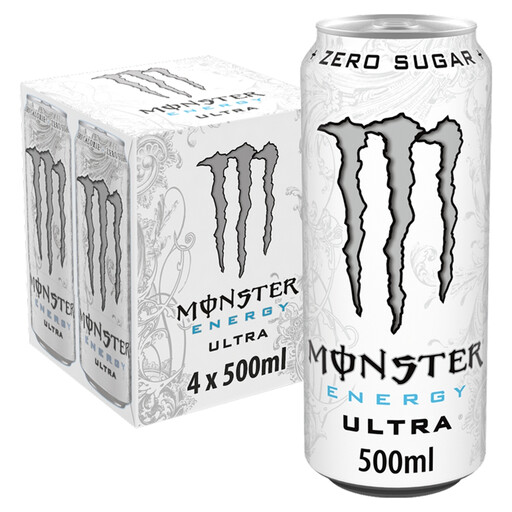
For a larger zero-sugar can, this pack contains four 500 ml cans. Monster states 150 mg caffeine per 500 ml Ultra can, whereas this listing describes approximately 32 mg per 100 ml; check the caffeine amount on the exact can before planning your intake. Check its sweeteners if they matter to you.
No. Red Bull states 80 mg caffeine per 250 ml Sugarfree can, and Monster states 150 mg per 500 ml Ultra can despite its 0 g sugar claim. Read the caffeine amount on the exact can as well as its sugar information.
Count caffeine from every source, including energy drinks, coffee, tea, cola, chocolate and supplements. The European Food Safety Authority’s assessment for healthy adults in the general population says single doses up to 200 mg and daily intake up to 400 mg from all sources do not raise safety concerns; those figures are not targets to aim for.
NHS guidance says not to have more than 200 mg of caffeine a day during pregnancy. Energy drinks count towards that total, so check the exact can and include other sources consumed that day.
No. UK government road-safety guidance warns that attempts to fight drowsiness do not work for long. If you feel drowsy while driving, stop and rest rather than rely on a drink to continue.
Do not assume one rule applies across the UK. In July 2026, the Department of Health and Social Care announced a planned England ban from April 2027 on sales to under-16s of drinks, other than tea or coffee, containing more than 150 mg caffeine per litre. Separately, Sainsbury’s says it does not sell high-caffeine energy drinks to under-16s and may ask for proof of age on delivery. Check the applicable local rule and retailer policy before purchase.