If you are replacing sugary fizzy drinks, the NHS suggests sugar-free, diet or no-added-sugar drinks as ways to reduce free-sugar intake. For a weekly shop, choose a flavour the household likes, then check the exact variant for caffeine and sweeteners before committing to a large pack. The NHS also notes that carbonated drinks can contribute to dental erosion because they are acidic, whether or not they contain sugar.
Who is this choice for?
Households replacing sugary fizz
If fizzy drinks are part of your weekly shop, a diet or zero-sugar version offers a way to keep a familiar type of drink while reducing free sugar. The NHS also suggests water and lower-fat milk as alternatives to sugary fizzy drinks.
Cola drinkers avoiding caffeine
Check the full variant name rather than assuming that ‘diet’ or ‘zero sugar’ means caffeine-free. Pepsi UK lists caffeine in Diet Pepsi and Pepsi Max, while Pepsi Max Caffeine Free is a separate variant.
Households checking ingredients and acidity
Ingredients matter when someone needs to avoid aspartame, including a person with phenylketonuria (PKU). Sugar-free fizz can still be acidic: the NHS associates carbonated drinks with dental erosion regardless of their sugar content.
What should you check?
Start with the drink your household is likely to enjoy, then check the nutrition, ingredients and pack format of that exact variant.
| Priority | What to check | Your needs |
|---|
| Sugar |
Read the sugars figure on the nutrition panel, comparing drinks on the same per 100ml or serving basis. Check the exact variant rather than relying on the brand name. |
I’m swapping a sugary fizzy drink for one with less sugar. The NHS suggests sugar-free, diet or no-added-sugar drinks as alternatives to sugary fizz. |
| Flavour |
Compare the stated flavour style, then try a smaller format before choosing a large case. Coca-Cola describes Zero Sugar as closer to Coca-Cola Original Taste and Diet Coke as lighter; these are the manufacturer’s descriptions. |
Our household wants a cola we’ll enjoy drinking, or a lemon-lime or orange option instead. |
| Caffeine |
Look for an explicit caffeine-free variant name and read its ingredients. Pepsi UK lists caffeine in regular Diet Pepsi and Pepsi Max, but labels Pepsi Max Caffeine Free separately. |
Someone at home wants fizzy drinks without caffeine, so a general ‘zero sugar’ label is not enough for us. |
| Sweeteners |
Check each variant’s ingredients for aspartame or E951 and any phenylalanine statement. Diet Pepsi and Pepsi Max list aspartame; a caffeine-free variant can contain it too. |
I need to check ingredients for a household member with PKU rather than assume all diet drinks have the same recipe. |
| Acidity |
Do not treat a zero-sugar label as a claim that a carbonated drink is tooth-neutral. The NHS associates carbonated drinks with dental erosion because of their acid content, regardless of sugar or sweeteners. |
I want a lower-sugar swap without making fizzy drinks our routine between-meal drink. |
| Pack format |
Check the can or bottle size and the number in the pack. A large multipack is more useful after you know the household likes that specific flavour and variant. |
For a weekly shop, I want enough of a drink we’ll use, rather than a large case chosen on its label alone. |
Mistakes to avoid
-
Taking ‘zero sugar’ to mean tooth-friendly
The NHS associates carbonated drinks with dental erosion due to their acid content, including drinks without sugar.
Use a diet or zero-sugar drink as a swap for sugary fizz, not as a reason to replace water between meals.
-
Buying a large case before trying the flavour
Diet Coke and Coca-Cola Zero Sugar have different flavour profiles according to Coca-Cola. Liking one does not establish that your household will like the other.
Try the intended variant in a smaller format before adding a large multipack to the weekly shop.
-
Assuming diet and zero-sugar drinks are caffeine-free
Pepsi UK lists caffeine and aspartame in Diet Pepsi and Pepsi Max. A caffeine-free label also does not mean a drink is free from aspartame.
Read the exact variant name and ingredients. If someone has PKU, check for aspartame or E951 and the phenylalanine statement.
Brand and flavour references
These examples illustrate flavour and ingredient routes to check; they do not describe every product made by each brand.
Coca-Cola
Diet Coke and Coca-Cola Zero Sugar offer different cola flavour styles.
- Coca-Cola describes Zero Sugar as closer to Coca-Cola Original Taste and Diet Coke as lighter.
- Check the exact variant for caffeine and ingredients; the flavour distinction is Coca-Cola’s own description.
Pepsi
Diet Pepsi, Pepsi Max and Pepsi Max Caffeine Free give cola shoppers distinct variants to compare.
- Pepsi UK lists 0g sugars per 330ml for Diet Pepsi and Pepsi Max and identifies Pepsi Max Caffeine Free separately.
- The listed recipes include aspartame; regular Diet Pepsi and Pepsi Max also list caffeine.
Fanta
Fanta Zero Orange and Fanta Zero Fruit Twist offer fruit-flavoured alternatives to cola.
- Tesco Groceries listed Fanta Zero Orange in cans and a sharing bottle format.
- Check the exact pack’s nutrition and ingredients rather than transferring details between flavours.
Sprite
Sprite Zero Sugar is a lemon-lime option for shoppers who do not want cola.
- Tesco Groceries listed an 8 × 330ml Sprite Zero Sugar pack.
- Read the exact pack’s ingredients; zero sugar does not remove the acidity consideration for carbonated drinks.
Dr Pepper
Dr Pepper Zero offers a different flavour route in a zero-sugar format.
- Tesco Groceries listed Dr Pepper Zero in a 2L bottle.
- Check the selected variant and pack rather than assuming details apply across the Dr Pepper range.
Tesco
Tesco own-label diet and zero fizzy drinks offer further flavour and pack-format choices.
- Tesco Groceries listed options including Diet Lemonade, Orange Zero and Xero Cola.
- Check each item’s flavour, sweeteners, caffeine status and nutrition individually.
Diet and zero-sugar multipacks on Joybuy
These 24-can packs cover lighter-style and zero-sugar colas, a caffeine-free cola and a lemon-lime option for a weekly shop. Check the exact variant before choosing a case.
 No image available
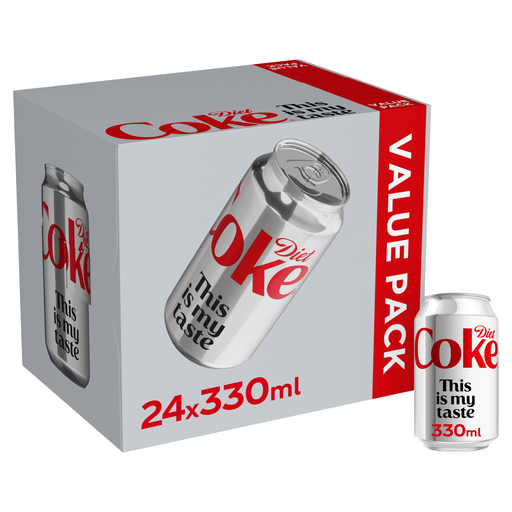
Coca-Cola Diet Coke, 24 × 330ml
A multipack for households that prefer Diet Coke’s lighter flavour profile, as described by Coca-Cola. The listed nutrition states 0g sugars per 330ml; this variant contains caffeine and aspartame. Check the label for its phenylalanine statement if someone has PKU.
 No image available
Pepsi Max Caffeine Free, 24 × 330ml
An explicitly caffeine-free cola variant in a 24-can pack. Pepsi UK lists 0g sugars per 330ml and the sweeteners aspartame and acesulfame K; caffeine-free does not mean sweetener-free. Check the phenylalanine statement if someone has PKU.
 No image available
Pepsi Max, 24 × 330ml
A zero-sugar cola multipack for households choosing regular Pepsi Max rather than its caffeine-free variant. Pepsi UK lists 0g sugars per 330ml; the ingredients include caffeine, aspartame and acesulfame K. Check the exact label where phenylalanine is relevant.
 No image available
Coca-Cola Zero Sugar, 24 × 330ml
A 24-can option if you prefer the flavour Coca-Cola describes as closer to Coca-Cola Original Taste than Diet Coke. The listed nutrition states 0g sugars per 330ml; this variant contains caffeine and aspartame. Check its ingredients and phenylalanine statement on the pack.
 No image available
7UP Zero, 24 × 330ml
A lemon-lime alternative to the cola multipacks, with 24 cans for a weekly shop. The listed nutrition states 0g sugars per 330ml, and this variant is described as caffeine-free. Its ingredients include aspartame and acesulfame K; check the phenylalanine statement if someone has PKU.
Common questions
Is diet or zero-sugar fizz a useful swap for sugary fizz?
It can be if reducing free sugar is the aim: the NHS suggests sugar-free, diet and no-added-sugar drinks instead of sugary fizzy drinks. Water is another option, and a sugar-free label does not make fizzy drinks tooth-neutral.
How do Diet Coke and Coca-Cola Zero Sugar differ?
Coca-Cola describes both as sugar-free and calorie-free, but says Zero Sugar is closer to Coca-Cola Original Taste while Diet Coke has a lighter flavour. That is the manufacturer’s flavour description; trying the variant matters more than assuming the two taste alike.
How can I identify a caffeine-free cola?
Choose a variant explicitly labelled caffeine-free and check its ingredients. Pepsi UK lists caffeine in regular Diet Pepsi and Pepsi Max but identifies Pepsi Max Caffeine Free as a separate product; Tesco Groceries also listed Diet Coke No Caffeine.
What should someone with PKU check on a diet drink?
Check the exact variant for aspartame or E951 and a phenylalanine statement. Aspartame-containing drinks are unsuitable for someone with phenylketonuria (PKU); do not assume a caffeine-free or zero-sugar label means the drink contains no aspartame.
Does zero sugar mean fizzy drinks are harmless to teeth?
No. The NHS associates carbonated drinks with dental erosion due to acidity, whether they contain sugar or sweeteners. Choosing a zero-sugar drink can reduce sugar intake when it replaces sugary fizz, but it does not remove that acidity consideration.


