Map-and-interface clarity seekers
If unit labels and dense strategy interfaces are your main reason for going larger, a 32-inch 4K 16:9 monitor is a useful starting point. LG UK’s 32GR93U-B is one documented example of that format.


Start with a 32-inch 4K monitor if reading maps and interface text on a conventional 16:9 screen is your priority. Consider a high-refresh OLED model if you also value its display characteristics and can follow its panel-care guidance; choose a 34-inch ultrawide if horizontal space matters more than retaining 4K resolution. Before buying, check your games’ ultrawide handling, your PC’s connection capabilities and the space available on your desk.
If unit labels and dense strategy interfaces are your main reason for going larger, a 32-inch 4K 16:9 monitor is a useful starting point. LG UK’s 32GR93U-B is one documented example of that format.
If you play faster-paced games alongside RTS, you may want to compare 4K OLED models rated at 240Hz with other 4K options. ASUS ROG and Samsung list such models, but check the exact model’s connections and OLED-care guidance.
If horizontal game space and room for desktop panels matter more to you than 4K resolution, consider a 34-inch 21:9 display. Check how your RTS titles handle ultrawide interfaces before committing to the format.
Choose it when: You want detailed maps and text on a conventional 16:9 screen; LG UK lists its 32GR93U-B at 3840×2160 and 144Hz.
Allow for: The cited LG model needs a compatible DisplayPort 1.4 connection with DSC or HDMI 2.1 to run at 4K and 144Hz.
Choose it when: You want 4K detail alongside the 240Hz refresh rate listed for models such as the ASUS ROG PG32UCDM.
Allow for: Long sessions with a static RTS interface make the exact model’s panel-care instructions and warranty terms worth checking; protection features are not a guarantee against burn-in.
Choose it when: Extra horizontal space is your priority; LG UK lists the 34GX900A-B at 3440×1440.
Allow for: Its resolution is not 4K, and individual games may handle ultrawide interfaces and cinematics differently.
For a large monitor used mainly for RTS, decide which of these needs comes first, then check the connection and desk requirements of the format you prefer.
| Concern | What to check | Who this matters to |
|---|---|---|
| Map and interface detail | Compare native resolution and screen size; for the 32-inch 4K route, look for 3840×2160. | If I regularly scan dense maps and read small unit labels, screen detail comes before a wider shape. Around 36% of consumers would put map and interface clarity first. |
| Motion during battles | Check refresh rate at native resolution and the required graphics output, port and cable. | When I pan quickly across battles or switch to faster games, I care about how the display handles motion. Roughly 22% of consumers would make fluid motion their primary concern. |
| Horizontal view | For a 21:9 monitor, check how your games present the interface and cinematics. | I would accept 3440×1440 instead of 4K if a wider layout worked well in the strategy games I play. Around 21% of consumers would prioritise that wider view. |
| Desk and PC fit | Measure usable desk space and check stand positioning, graphics output and connection requirements. | If I cannot position a large screen comfortably or run my chosen display mode, its specifications will not settle the choice. Approximately 21% of consumers would put setup compatibility first. |
A monitor’s refresh-rate listing does not establish what your complete connection can deliver. LG UK specifies DisplayPort 1.4 with DSC or HDMI 2.1 for 4K at 144Hz on the 32GR93U-B.
Check your graphics-card output, the monitor’s input requirements and the cable you intend to use for the exact mode you want.
A 3440×1440 ultrawide changes both resolution and aspect ratio from a 3840×2160 16:9 display. Whether the extra width helps also depends on each game’s presentation.
Check your most-played RTS titles’ 21:9 interface and cinematic behaviour before choosing width over 4K detail.
ASUS and Samsung describe protection features for particular OLED models, but those manufacturer features do not guarantee that every pattern of prolonged static-interface use is risk-free.
For long RTS sessions, follow the exact model’s panel-care instructions and read its warranty terms.
A larger screen still needs a workable viewing position. The Health and Safety Executive advises placing a screen centrally, with its top around eye level and the screen about an arm’s length away.
Measure usable desk depth and width, including keyboard space, and check the stand’s adjustments before ordering.
If the stand cannot provide the position you need, an arm or a change to your workspace may be necessary.
LG UK documents both a conventional 32-inch 4K IPS model and a 34-inch 21:9 OLED model, making these particular UltraGear displays useful format references.
The ROG Swift OLED PG32UCDM is a reference point for the 32-inch-class 4K QD-OLED route.
Samsung UK lists the 32-inch Odyssey OLED G8 G80SD as a 4K QD-OLED gaming monitor rated at 240Hz.
Dell UK’s Alienware AW3225QF is a reference for buyers considering a curved 32-inch-class 4K QD-OLED screen.
These choices include conventional 4K screens and wider ultrawide monitors for large-screen RTS play. Compare the format with your games, PC connections and desk before choosing a model.
 No image available
Consider this 21:9 option if you prioritise horizontal space and your RTS games handle ultrawide displays well.
LG UK lists the 34GX900A-B with a 3440×1440 OLED panel and a 240Hz refresh rate. Check the model’s OLED-care guidance for long sessions with static interface elements.
 No image available
Consider this model if you want a large 4K screen for RTS maps while keeping a conventional display shape.
The product title specifies 3840×2160, 165Hz and a 0.03ms GtG rating. Check the required PC, port and cable combination for the display mode you intend to use, and confirm adaptive-sync support if you need it.
 No image available
This is a wider-format choice if horizontal space matters more to you than a 4K 16:9 screen.
The product title specifies 3440×1440, a VA panel, 200Hz and 1ms MPRT. Check your games’ ultrawide presentation and confirm adaptive-sync support if it matters to your setup.
 No image available
Consider this curved ultrawide if a broader game view is your main reason for moving to a large monitor.
Check how your RTS titles present their interfaces on an ultrawide screen, and confirm the connection needed for your intended resolution and refresh rate.
 No image available
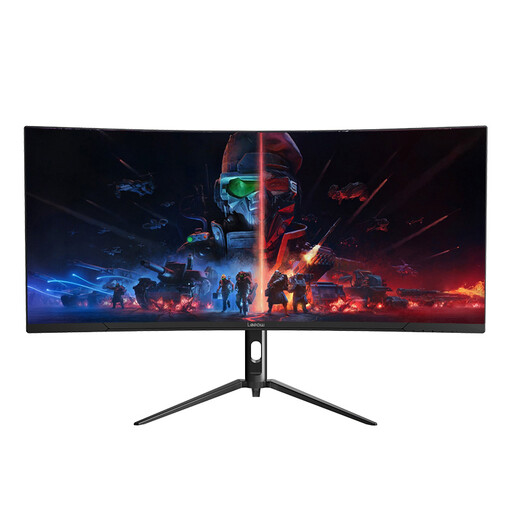
Consider this model if you want a wider desktop and game view rather than 4K resolution.
The product title specifies 3440×1440 and 165Hz. Confirm which input supports the mode you want, whether the stand offers the positioning you need and how your games handle ultrawide display.
You need a compatible monitor mode, graphics-card output and connection. For LG’s 32GR93U-B specifically, LG UK says 4K at 144Hz requires a graphics card supporting DisplayPort 1.4 with DSC or HDMI 2.1; check the requirements of any other model separately.
Allow enough depth and width to position the screen centrally without crowding your keyboard. The Health and Safety Executive advises having the top of the screen around eye level and the display about an arm’s length away; check the stand’s footprint and adjustments against your own desk.
No, there is no universal UKCA-only rule for Great Britain. UK government guidance dated 31 March 2026 says CE marking continues to be recognised alongside or in place of UKCA under the applicable product-marking requirements in England, Scotland and Wales. Northern Ireland follows different processes, so check the requirements that apply to the product and where it will be sold.
Use an appropriate electrical-waste collection or recycling route rather than putting it in ordinary household waste. GOV.UK explains that waste electrical and electronic equipment rules support recovery, reuse and recycling; check the options offered locally or by your retailer.