What to check before choosing
For texture-seam review on a small desk, establish whether the screen can sit comfortably in front of you, then decide how much native resolution and colour-workflow support your work calls for.
| Concern |
What to check |
Who this matters to |
| Desk fit and placement |
Measure usable width and depth against the monitor’s dimensions with its stand. Allow room to centre the screen and position the keyboard. |
If desk space is tight, I need the screen directly in front of me rather than pushed to one side. Around 40% of consumers put desk fit and comfortable placement first. |
| Fine-detail workspace |
Compare native resolutions and confirm that your computer and connection can output the chosen resolution. |
When I inspect small seam details alongside reference material and editing tools, available screen pixels are my priority. Roughly 30% of consumers put the fine-detail workspace first. |
| Colour continuity |
Match the exact model’s stated colour modes and calibration provisions to your working and delivery colour spaces. |
If I judge whether colour changes across a seam, I need to know how the display fits my colour-managed workflow. About 30% of consumers place colour continuity first. |
Relevant brands to consider
These manufacturer models illustrate specifications worth comparing; features of one model should not be assumed across the brand’s range.
Dell
Dell’s 34-inch-class business and professional ultrawides are relevant when you want to compare desk fit with display and hub connections.
- Dell UK specifies the UltraSharp U3425WE as a 34.1-inch 3440 × 1440 IPS Black curved monitor; the P3425WE is another 34.1-inch 3440 × 1440 model with USB-C power delivery of up to 90 W and RJ45 Ethernet.
- Check colour specifications, ports and power delivery for the exact Dell model rather than treating these examples as interchangeable.
LG
LG’s 40-inch-class 5K2K models are relevant if a wider, higher-resolution workspace matters more to you than keeping the monitor footprint small.
- LG UK specifies the 40WP95CP-W as a 39.7-inch 5120 × 2160 Nano IPS display with typical DCI-P3 coverage of 98%, Thunderbolt 4 and charging of up to 96 W.
- Confirm that your desk, viewing position and computer connection suit the particular 40-inch-class model before choosing it for a constrained workstation.
BenQ
BenQ’s PD3420Q provides a 34-inch creative-workflow example for comparing dimensions and stated colour provisions.
- BenQ specifies 3440 × 1440 resolution, 825.8 mm width with the stand, a calibration report and uniformity technology for the PD3420Q.
- The PD3420Q is a 60 Hz model; if refresh rate matters to work beyond still-image review, check whether that meets your needs.
34-inch ultrawides on Joybuy
These 34-inch options relate to the desk-conscious ultrawide route. Their OLED and VA panels differ from the IPS manufacturer examples above, so choose by the exact model’s footprint, connections and colour-workflow requirements rather than assuming the same specifications.
 Image unavailable
LG UltraGear 34GX900A-B 34-inch OLED WQHD monitor
Consider this model if you want a 34-inch ultrawide format and are willing to assess OLED’s suitability for a workflow with persistent toolbars and other static content.
The product name specifies an OLED panel and 240 Hz refresh rate. Its listing warns of burn-in susceptibility; check its screen-protection guidance, full footprint, computer connection and colour-workflow requirements before buying.
Joybuy
 Image unavailable
Dahua 34-inch 3440 × 1440 curved VA monitor
This is a 34-inch option to consider when a 3440 × 1440 workspace meets your review needs, provided the complete monitor and stand fit your desk.
The product name specifies a VA panel, 200 Hz refresh rate and 85% DCI-P3 coverage. Check the with-stand footprint and the colour and computer-connection requirements of your workflow.
Joybuy
 Image unavailable
Lenovo R34w-30 34-inch UWQHD monitor
Consider the R34w-30 if a 34-inch UWQHD format is your starting point for fitting an ultrawide workspace onto the desk.
Measure the available space and confirm the complete footprint before ordering. For colour-sensitive seam review, also check the model’s colour modes and calibration provisions against your workflow.
Joybuy
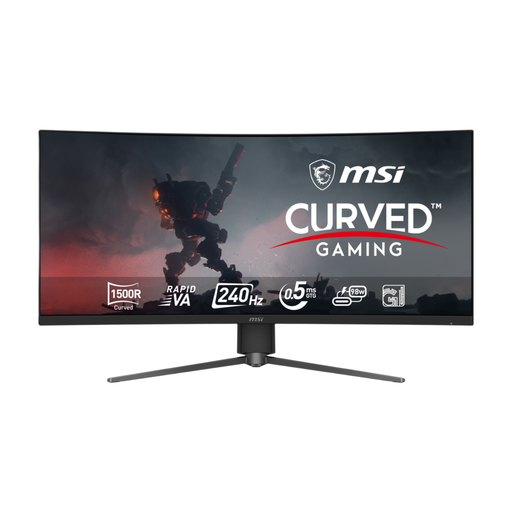 Image unavailable
MSI MPG 346CQRF X24 34-inch UWQHD Rapid VA monitor
This 34-inch curved option is relevant if you are comparing UWQHD screens for a constrained desk and can verify that its complete footprint fits.
The product name identifies a Rapid VA panel. Confirm dimensions with the stand, your computer’s display-output compatibility and any colour-space or calibration requirements for seam review.
Joybuy
Common questions
What should I measure before buying an ultrawide for a small desk?
Measure usable desk width and depth against the monitor’s dimensions with its stand, including room for the keyboard and cables. The Health and Safety Executive advises placing the screen directly in front of you, about an arm’s length away, with its top near eye level.
Should I choose 34-inch 3440 × 1440 or 40-inch 5120 × 2160 for texture seams?
Choose between them by balancing desk fit against the pixels you need for inspection. Dell, BenQ and LG specify examples of these resolutions, but a 40-inch-class 5120 × 2160 display is a practical choice only if you can position it comfortably and your computer can drive it at the intended resolution.
Will one USB-C cable always run the display and charge my laptop?
No: the result depends on the exact monitor, computer port and cable. Check supported video output and the laptop’s charging requirement against the monitor’s input and power-delivery specifications before relying on a one-cable setup.
Do I need calibration to review colour across texture seams?
If you judge colour continuity for a defined delivery space, use an appropriate monitor colour mode and check how the display fits the rest of your colour-managed workflow. BenQ specifies a calibration report for the PD3420Q; LG describes the 40WP95CP-W as hardware-calibration ready but says a calibrator is not included.


