Colour-critical animation creators
If you judge colours in artwork, backgrounds or assets while arranging frames, look for documented colour modes and calibration information relevant to your output, rather than choosing by refresh rate alone.


A 34-inch ultrawide with 3440 × 1440 resolution is a useful starting point for keeping an animation timeline, frame references and tools on one screen, provided the monitor and a comfortable viewing position fit your desk. For colour-sensitive work, prioritise documented colour modes and calibration; consider USB-C docking, computer switching or higher refresh rates according to your actual setup.
If you judge colours in artwork, backgrounds or assets while arranging frames, look for documented colour modes and calibration information relevant to your output, rather than choosing by refresh rate alone.
If you want a timeline, references and tool panels visible together, check whether the screen, stand and keyboard leave room for a comfortable viewing position on your desk.
If you work from a USB-C laptop or switch between computers, compare charging power, ports and keyboard-and-mouse switching against the connections your equipment needs.
Measure the usable desk area and plan where the screen will sit before comparing colour and connection features. The Health and Safety Executive advises placing a display directly in front of you, with its top around eye level and the screen roughly an arm's length away.
| Concern | What to check | Who this matters to |
|---|---|---|
| Desk fit and placement | Compare usable desk width and depth with dimensions including the stand. For an arm or clamp, check the mounting pattern, load capacity and desk edge. | If the base crowds my keyboard or pushes the screen too close, the wider workspace will be awkward to use; around 36% of consumers put desk fit first. |
| Colour confidence | Match documented colour modes and calibration information to the colour space your artwork or delivery requires. | When I review colours in animation assets, I need a display setup that suits that work rather than a wide screen alone; colour confidence comes first for around 29% of consumers. |
| Workflow connections | Check the laptop's video output and charging demand against the monitor's USB-C capabilities; consider KVM switching if you use two computers. | If I move between a laptop and another computer, fewer separate cables and peripherals matter most; roughly 21% of consumers prioritise workflow connections. |
| Motion smoothness | Check the refresh rate at the monitor's native resolution and whether your computer, cable and chosen port support that mode. | For frequent playback and movement around the timeline, I would put smoother screen motion ahead of extra docking features; it is the primary concern for around 14% of consumers. |
A monitor may fit across a desk yet leave too little depth for the keyboard or a comfortable screen distance. BenQ and ASUS list stand depths of about 24 cm for the PD3420Q and PA348CGV respectively.
Measure the usable surface, then compare it with the chosen monitor's dimensions including its stand. Consider an arm or clamp only after checking compatibility.
Monitor charging limits vary, and some display modes depend on the connection. ViewSonic specifies DisplayPort or USB-C for the VG3419C's 3440 × 1440 mode at 120 Hz.
Check your computer's USB-C video capability, charging requirement and cable against the monitor's stated power delivery and supported display modes.
A higher refresh rate does not establish that a monitor has the colour-space coverage, modes or calibration documentation needed for reviewing animation assets.
If you judge colour on screen, identify the required output space and compare the manufacturer's documented colour features first. Treat smoother motion as a separate requirement.
A mounting pattern describes the monitor's interface, not an arm's load capacity or whether a desk edge can safely take a clamp.
Check the monitor's weight and mounting pattern, the arm's rating and the desk's material and edge clearance before relying on a mounted setup.
The Creative Pro PD3420Q is a reference point for a colour-focused animation setup.
The ProArt PA348CGV is relevant if colour specifications and an alternative to a conventional stand both matter.
LG's UltraWide models offer conventional 34-inch workspace options with features that vary by model.
The VG3419C is relevant when laptop docking and switching between computers shape the desk setup.
The P3424WE illustrates a connectivity-focused USB-C hub configuration for laptop-based work.
These 34-inch ultrawides are options for arranging frames and tools across a wide screen. Check each model's full footprint before choosing it for a small desk, and look for colour-workflow documentation if you will judge artwork on the display.
 No image available
Consider this 34-inch ultrawide if you want space to arrange animation frames and tools together. Check its dimensions with the stand against your usable desk depth, and confirm the colour documentation you need for artwork review.
 No image available
Its 34-inch, 3440 × 1440 curved VA screen offers a wide area for a timeline and reference windows. The product name specifies 200 Hz and two HDMI and two DisplayPort 1.4 connections; confirm the supported mode for your computer, the footprint including its base and the colour information required by your workflow.
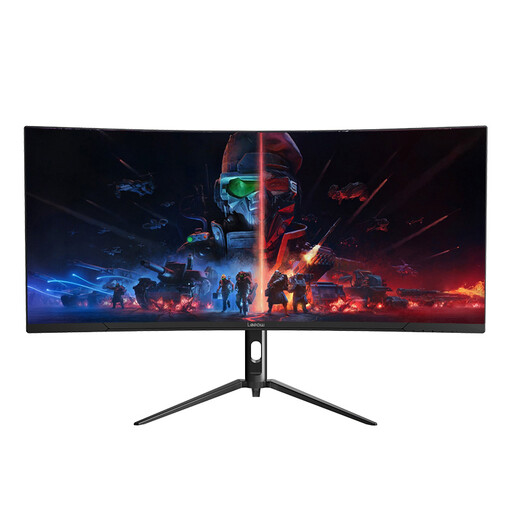 No image available
Its 3440 × 1440 resolution makes it an option for keeping frame arrangements and tools on one wide screen; the product name also specifies a 165 Hz refresh rate. Check the dimensions with its stand before choosing it for a shallow desk, and confirm colour-space coverage and calibration information if artwork review is central to your work.
A 34-inch ultrawide at 3440 × 1440 is a practical starting point for placing a timeline, frame references and tools on one continuous screen. That specification alone does not settle desk fit or colour suitability, so check those separately.
Measure the usable width and depth, leaving space for your keyboard and a comfortable viewing distance, then compare them with the monitor's dimensions including its stand. BenQ lists the PD3420Q at 825.8 mm wide and 244.3 mm deep with its stand; ASUS lists the PA348CGV at 81.76 cm wide and 24.50 cm deep with its stand. An arm or clamp also needs a suitable monitor, mount and desk.
USB-C can do both only when the computer, cable and monitor support the required video connection and the monitor supplies enough power for your laptop. LG specifies up to 65 W for the 34WR55QK-B, while ASUS specifies 90 W for the PA348CGV. Check the display mode too: ViewSonic says the VG3419C needs DisplayPort or USB-C for 120 Hz at 3440 × 1440.
Choose according to how you inspect artwork and how the monitor fits your desk; neither panel shape alone establishes colour accuracy. BenQ presents the flat PD3420Q as a creative-work option, while curved models offer a different viewing geometry. Compare the actual screen and colour features against your workflow before deciding.