Side-by-side academic editors
Students who regularly compare drafts, feedback, sources or two versions of a document and want both windows visible without repeatedly switching between them.


A 34-inch, 3440 × 1440 ultrawide is worth considering if you regularly need two document versions visible on one screen. In a student room, measure the usable desk space and check whether the stand allows a comfortable viewing position before choosing connection extras. USB-C charging depends on your laptop and the monitor’s power rating; KVM and picture-by-picture matter mainly when you use two computers.
Students who regularly compare drafts, feedback, sources or two versions of a document and want both windows visible without repeatedly switching between them.
Students who connect a laptop at a fixed study desk and would use a monitor’s USB-C connection or charging, provided the laptop, cable and power rating are compatible.
Students for whom usable desk width, stand depth and screen position matter more than gaming or colour-workflow extras.
For students considering an ultrawide primarily to compare document versions, start with the visible workspace and the space available on the desk. Treat connections and specialist features as choices driven by the devices and coursework you actually use.
| Concern | What to check | Who this matters to |
|---|---|---|
| Side-by-side documents | Check for native 3440 × 1440 resolution on a 34-inch 21:9 model, then consider how you will arrange the windows. | If I compare drafts and feedback regularly, I want both documents readable without hiding one. Around 40% of consumers put that workspace need first. |
| Desk fit and position | Compare the width and depth including the stand with your usable desk space; check height adjustment. | When my desk also holds a laptop, keyboard and notes, the screen must fit without forcing an awkward position. Desk fit comes first for around 30% of consumers. |
| Laptop connection | Check the laptop’s USB-C video support and charging requirement against the monitor and cable. Consider KVM only for two source devices. | I would use fewer cables at a fixed desk, but only if my laptop works with the connection. Around 20% of consumers prioritise that device setup. |
| Features beyond document work | Decide whether you will use colour-workflow tools, high refresh rates or two-device controls; check the exact seller terms before checkout. | If my main task is comparing text, I would rather choose features I will use than pay for extras that do not help that task. Around 10% of consumers make feature restraint their primary concern. |
A 34-inch ultrawide needs substantial desk width as well as space for its stand. Dell lists the P3424WE at 81.57 cm wide and 23.74 cm deep with its stand; those dimensions do not include your study materials or cable clearance.
Measure the usable surface, then compare it with the exact model’s dimensions including its stand.
USB-C power delivery varies by model: Dell and LG list up to 90 W on the P3424WE and 34WQ75C-B, while BenQ lists 65 W on the PD3420Q. A USB-C socket alone does not establish that your laptop can send video through it or receive enough power.
Check the laptop’s video-output capability, charging requirement and cable requirements before relying on a single-cable setup.
A curved panel cannot make a shallow desk or unsuitable screen height comfortable. The Health and Safety Executive advises placing the top of the screen around eye level and the display about an arm’s length away.
Check that the stand, desk and chair let you position the screen and keyboard without twisting or reaching awkwardly.
KVM and picture-by-picture are relevant when two source devices are in use. Comparing two files on one laptop does not itself call for two video inputs or a shared keyboard-and-mouse switch.
List the devices you actually connect; consider colour-workflow features separately if your coursework also involves visual work.
These examples illustrate different features on specific 34-inch models, not a judgement about every monitor from each brand.
Dell’s P3424WE is a 34-inch 3440 × 1440 curved USB-C hub monitor for a desk with connected devices.
LG’s 34WQ75C-B is a 34-inch, 3440 × 1440 productivity ultrawide with workspace-splitting controls.
Samsung’s 34-inch ViewFinity S65VC adds two-device controls and built-in peripherals to an ultrawide workspace.
BenQ’s 34-inch PD3420Q combines a 3440 × 1440 display with features aimed at colour-sensitive creative work.
These 34-inch ultrawide and gaming monitors are options to assess for a student-room document workspace. Compare each model’s native resolution, stand footprint and connection requirements with your desk and computer rather than choosing by refresh rate alone.
 No image available
For comparing documents, check that its native resolution gives you the window layout you want and that its stand fits your desk. Take the risk of OLED burn-in into account if static documents will remain on screen for long periods.
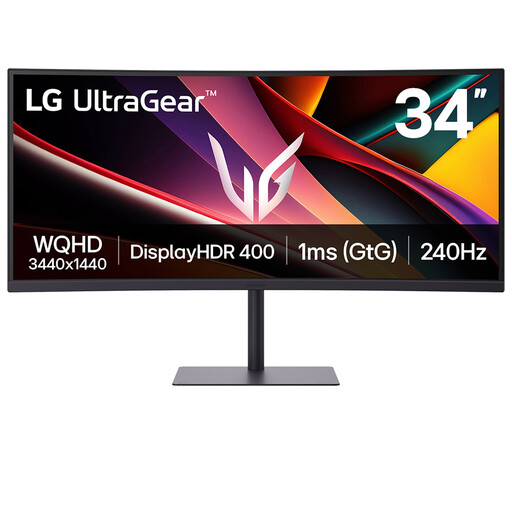 No image available
For a two-document layout, confirm the native resolution and leave enough room for the assembled stand. If you want the monitor to charge a laptop, check its USB-C output against the laptop’s power requirement.
 No image available
Its stated 3440 × 1440 resolution is relevant to placing two documents side by side; check the stand-inclusive footprint for your desk. The title lists a VA panel, two HDMI inputs and two DisplayPort 1.4 inputs.
 No image available
Its listed 3440 × 1440 resolution makes it a candidate for two document windows; check the stand footprint before allocating desk space. The stated refresh rates differ by connection: 175 Hz through DisplayPort and 100 Hz through HDMI.
 No image available
For a document-comparison desk, confirm that your computer can output the monitor’s native resolution and that the assembled stand leaves room for your other materials.
Yes, if you want two substantial document windows on a 34-inch ultrawide. Dell, LG and BenQ list that resolution on the productivity models discussed here, and LG describes its 21:9 display as suitable for showing multiple programs. Check the exact model’s native resolution rather than relying on the word ‘ultrawide’.
Measure the usable width and depth, then compare them with dimensions that include the stand. Dell lists the P3424WE at 81.57 cm wide and 23.74 cm deep with its stand. Allow space for your keyboard, notes, cables and a viewing position that does not force you too close to the screen.
It can when the laptop supports the required USB-C video connection and the monitor supplies enough charging power. Dell and LG list up to 90 W on the P3424WE and 34WQ75C-B; BenQ lists 65 W on the PD3420Q. Check the laptop’s port, power requirement and cable before depending on one cable.
Not when both documents are open on one computer. KVM and picture-by-picture are worth considering if you regularly use two active source devices: Samsung lists both types of functionality on the S65VC, while Dell and BenQ list KVM on the models discussed here.