Players seeking a wide bridge view
If you want forward windows, side scenery and navigation panels on one centrally placed screen, investigate a 34-inch 21:9 ultrawide. Check how your particular simulator displays its interface at that aspect ratio.


Choose a 34-inch 21:9 ultrawide if a broad, continuous bridge view matters most and your simulator supports the format. Choose a 32-inch 4K screen if reading instruments and charts matters more than extra horizontal space. Either way, check your graphics output and plan where the screen will sit before buying.
If you want forward windows, side scenery and navigation panels on one centrally placed screen, investigate a 34-inch 21:9 ultrawide. Check how your particular simulator displays its interface at that aspect ratio.
If small labels, maps and controls take priority over horizontal span, compare a 32-inch 4K screen. Its conventional 16:9 layout is a different choice from an ultrawide, not a wider cockpit view.
For longer sessions at a desk-mounted cockpit, make room for central placement and a suitable viewing distance. Stand or mount adjustment and the room's lighting matter alongside the image specifications.
Choose it when: you want one uninterrupted horizontal view from a central seated position and your simulator handles 21:9 well.
Accept that: the broad, curved screen needs suitable desk space and does not compensate for poor positioning.
Choose it when: fine instrument and chart detail matters more to you than a wider field of view.
Accept that: the 16:9 layout gives less lateral screen space, and you must check the graphics hardware for your intended 4K settings.
| Concern | What to check | Who this matters to |
|---|---|---|
| Continuous cockpit view | Check native 21:9 support in the simulator and whether a 34-inch screen fits your desk. | I want the bridge and surrounding view across one screen without relying on a layout the game cannot display properly. Around 33% of consumers put that continuous view first. |
| Seated screen placement | Check stand or compatible mount adjustment, desk depth and the position of nearby light sources. | For a fixed cockpit, I need to place the screen directly ahead without sitting too close or stretching to read it. Around 27% of consumers prioritise a workable seated position. |
| Instrument detail and reflections | Compare 32-inch 4K detail with the intended text size; assess reflections in your room. | Small chart labels and controls need to remain readable where I sit, particularly when room lighting is distracting. Around 20% of consumers make detail and glare their primary concern. |
| Fixed interface elements | Check the exact OLED model's panel-care guidance and consider how long its HUD stays unchanged. | My speed, heading or navigation display may remain in the same place through a long session, so I want to account for fixed-image care. Around 20% of consumers put that concern first. |
An ultrawide gives the game more horizontal screen space, but the visible cockpit and interface depend on how that game handles the aspect ratio.
Check the simulator's stated support and look at examples of its interface at 21:9 before choosing a 3440 × 1440 display.
A monitor's maximum refresh rate does not establish what your graphics device, chosen port and cable can deliver together at the resolution you want.
Check the monitor's per-port modes against your PC or console output and cable, including HDR if you intend to use it.
Speed, heading and navigation elements can stay fixed during play. Samsung's OLED guidance warns that images left in place for a long time can contribute to burn-in.
Read the exact monitor's care instructions, use its supported panel-care features as directed and avoid leaving a fixed, paused interface displayed for extended periods.
A curved panel still needs to be centred and positioned at a usable height and distance. The UK Health and Safety Executive advises placing a display directly ahead, with its top about level with the eyes and the screen roughly an arm's length away.
Plan the desk depth and stand or mount adjustment from your intended seat before deciding on screen size or curve.
LG UK lists the 34GS95QE-B and 34GX900A-B as 34-inch, 3440 × 1440 curved OLED ultrawides with 240Hz refresh rates. They are reference points for a single-screen, wide-view cockpit.
Samsung UK lists the 32-inch Odyssey OLED G8 G80SH as a 4K QD-OLED, 240Hz option for buyers comparing detailed instruments in a 16:9 layout.
Dell UK lists the AW3425DW as a 34-inch, 3440 × 1440 curved QD-OLED ultrawide with a 240Hz refresh rate.
These monitors cover both choices in this article: wider screens to consider for a single-screen cockpit and 32-inch 4K options for instrument detail. Match the game's display support, your graphics connections and your seated setup to the individual model.
 No image available
Consider this ultrawide for a broad seated cockpit view, provided your simulator displays its interface well at the intended format.
The product name specifies 3440 × 1440 resolution, a VA panel, 200Hz refresh rate, two HDMI inputs and two DisplayPort 1.4 inputs. Check desk space and the output mode available from your equipment.
 No image available
This 21:9 option suits a centrally viewed cockpit if the simulator supports an ultrawide layout.
LG UK lists 3440 × 1440 resolution, 800R curvature and a 240Hz refresh rate for the 34GX900A-B. Confirm the intended connection and read the model's OLED care guidance if the game keeps its HUD fixed.
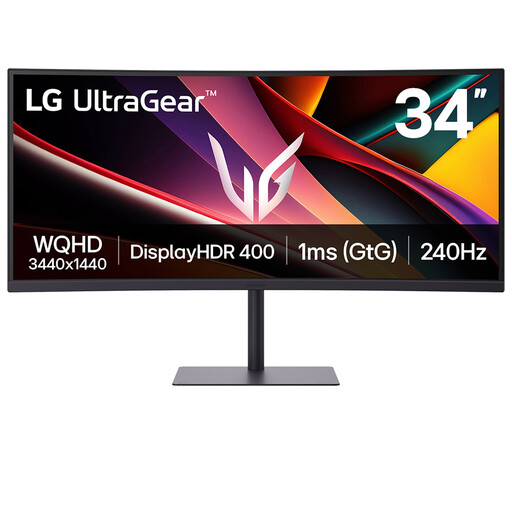 No image available
Consider this 34-inch model if you are planning a wider cockpit view and can position the screen centrally.
Its product name specifies a VA panel and 240Hz refresh rate. Check the exact display mode your equipment can deliver and assess reflections in the room where you will play.
 No image available
Compare this 4K option when instrument and chart detail is more important to you than an ultrawide layout.
The product name specifies 3840 × 2160 resolution and a 165Hz refresh rate. Check your intended 4K output, room reflections and this model's OLED care instructions for long sessions with a fixed HUD.
 No image available
This 32-inch Ultra HD model is an option to consider when you favour instrument detail over extra horizontal screen space.
Before choosing it for a fixed cockpit, check its stand adjustment, the display modes supported through your intended connection and its exact-model OLED care guidance.
Choose a 34-inch 21:9 ultrawide for a broader continuous view if your simulator handles that format well; choose a 32-inch 4K screen if fine instrument text and charts are the priority. Check your graphics output for the resolution and refresh rate you intend to use.
Place it directly in front of your seat and adjust it to a comfortable reading position. The UK Health and Safety Executive advises a screen top about level with your eyes and a viewing distance of roughly an arm's length; plan the stand or mount and desk depth accordingly.
Not necessarily: a 240Hz specification alone does not tell you what your game and graphics setup will deliver. Check the modes available through your intended port and cable, then weigh refresh rate against the screen format, readable interface and seated placement you need.
Take the fixed interface into account before choosing OLED. Samsung's OLED guidance warns that images left in place for a long time can contribute to burn-in; follow the exact monitor's panel-care instructions and avoid leaving a paused HUD on screen for extended periods.