
24/7 Customer Support

Free returns

Same-day & Next-day Delivery

Quality Guaranteed

Unlock Your Welcome Offers: FREE Delivery | Up to 80% OFF | Free 30-day JoyPlus trial
Download the APP
Choosing between A5 notebooks can seem straightforward until the pages start showing ink through, the binding becomes awkward to use or the cover fails to protect your notes. Product listings often focus on attractive designs and vague terms such as “premium” without explaining the specifications that affect everyday use.
As the Joybuy Product Recommendation Officer, I focus on practical details that help shoppers avoid paying for features they will not use. Whether you need a lined A5 notebook for lectures, an A5 journal for personal writing or stationery for school and office tasks, these are the points worth checking before you buy.
A notebook may advertise a large number of pages, but the actual format can vary. Some listings count individual pages, while others count sheets, with one sheet providing two sides. Margins, dividers and storage pockets can also reduce the space available for regular notes.
Check whether the listing specifies pages or sheets and consider how often you write. A 50-sheet notebook provides 100 writable pages, while a notebook described as having 196 ruled pages offers a different amount of usable space.
Paper colour and cover design are easy to assess online, but writing performance depends more on paper weight and finish. GSM, or grams per square metre, indicates the paper’s weight. It does not guarantee that every pen will perform identically, but it provides a useful comparison.
For regular note-taking, 80gsm paper is common and keeps notebooks lightweight. 100gsm paper generally feels more substantial and may reduce ink show-through compared with lighter paper. If you use gel pens, markers or wetter inks, review the paper specification rather than relying on the word “premium”.
A notebook that looks attractive may be inconvenient if it will not stay open in a small footprint. A standard glued or stitched spine can suit structured writing, while a spiral notebook or wirebound notebook may open flatter.
Also check whether pages are perforated, removable or punched for filing. These features are useful for assignments and meetings, but they may not be necessary for a private writing journal.
A5 measures approximately 148 × 210mm, making it a practical middle ground between a pocket notebook and a larger writing pad. It can usually fit into a handbag, backpack, work bag or briefcase while still providing enough room for meeting notes and daily planning.
For commuters and students moving between classrooms, libraries and cafés, consider the total thickness and cover construction as well as the page size. A hardcover notebook offers more protection, while a softcover notebook is usually easier to carry in multiples.
A lined A5 notebook or A5 ruled notebook is suitable for essays, lists, revision notes and meeting records. Margins can help separate annotations from the main text and create a more organised layout.
For drawing, mind-mapping or mixed media, unlined pages provide greater flexibility. A project book with repositionable dividers may be more suitable when notes need to be separated by module, client or task.
Look for clear information about:
The right combination depends on your routine. A portable notebook for quick lists may not need a heavy cover, whereas a writing journal carried daily may benefit from additional protection.
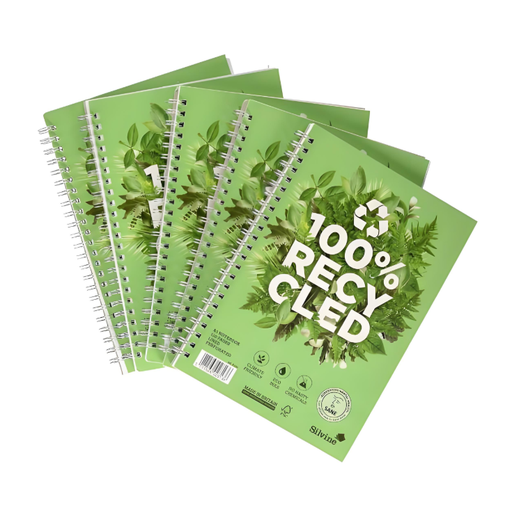
Why This Fits Their Persona: A five-notebook pack suits students, shared home offices and anyone who needs separate books for different subjects or tasks.
The listing states the quantity, paper weight and page count clearly, rather than relying only on cover styling. Four punched holes and perforated pages add practical flexibility.
Five A5 notebooks, 120 pages per notebook, 80gsm recycled paper, 360° wirebound opening and UK manufacture.
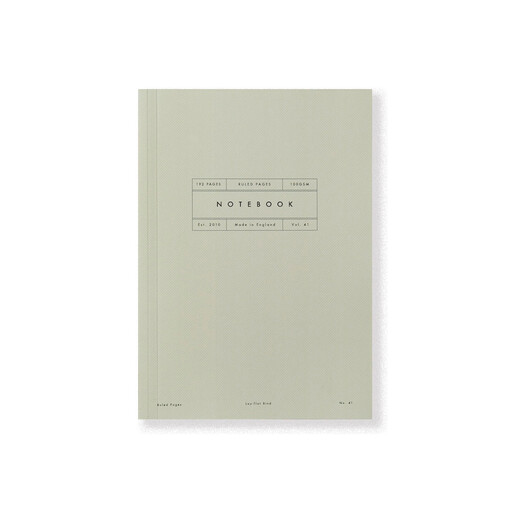
Why This Fits Their Persona: This option suits professionals, journal writers and stationery enthusiasts who want a portable book with a more substantial cover and paper specification.
The specification identifies 196 ruled pages with margins, 100gsm ivory paper and a textured 300gsm cover, making the construction easier to compare.
196 ruled pages, margin layout, 100gsm ivory paper and a textured 300gsm cover in a compact A5 format.
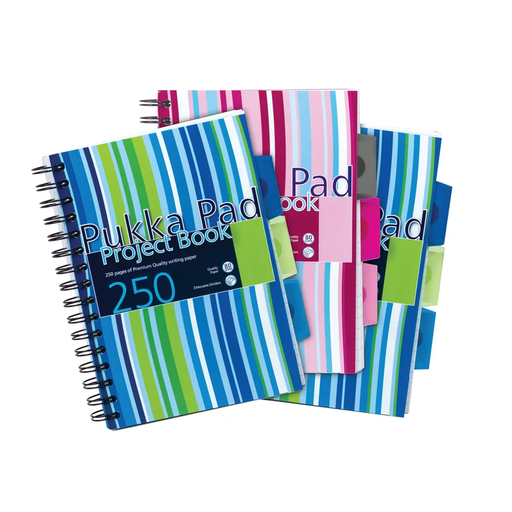
Why This Fits Their Persona: Its divided layout is useful for teachers, university students, project workers and professionals managing several subjects or workstreams.
The three repositionable dividers and storage pockets provide visible organisation, rather than leaving the user to manage loose pages separately.
250 pages of 80gsm lined paper, three repositionable dividers, storage pockets and FSC Certified paper.
A hardcover spiral notebook can provide a firmer writing surface and often includes an elastic band for keeping pages closed. The Jubiluu A5 Hardcover Spiral Lined Notebook has 96 sheets of 100g cream offset paper and twin-wire binding.
For lighter everyday carrying, a softcover notebook multipack can be useful. The Jubiluu A5 Softcover 3-Pack Stitch Notebook contains three books, each with 50 sheets of ruled 80g cream-coloured paper. Stitch binding supports a lay-flat format without adding the weight of a rigid cover.
Creative users may prefer an unlined portable notebook. The Tinc Mallo Heart Padded A5 Notebook uses unlined paper and spiral binding for writing, doodling and sketching, while its padded cover gives it a decorative gift-ready appearance.
For more lined A5 notebooks and practical stationery options, browse the notepad A5 lined range.
We have compiled a complete, real-time list of products that fully satisfy these strict selection criteria and UK safety regulations.
Yes. The format is compact enough for backpacks while providing room for lecture notes, revision and assignments. Choose an A5 ruled notebook for ordinary writing or a project book if you need dividers and pockets.
It can be useful if you prefer a smoother, more substantial page or use pens that show through lighter paper. However, 80gsm paper remains suitable for many everyday pens and helps keep a notebook lighter. Match the GSM to your writing tools and carrying needs.
Lifespan depends on page count, binding, handling and how frequently it is used. A 196-page notebook may suit regular journalling, while a 50-sheet book can work well for a short project or rotating subjects. Keep notebooks dry and avoid excessive bending to help protect the pages and binding.