
24/7 Customer Support

Free returns

Same-day & Next-day Delivery

Quality Guaranteed

Unlock Your Welcome Offers: FREE Delivery | Up to 80% OFF | Free 30-day JoyPlus trial
Download the APP
An adjustable weight bench is the cornerstone of any serious home gym. It unlocks hundreds of exercises, from chest presses to shoulder work and core training. Yet, the market is flooded with options that look impressive online but fail to deliver in practice. Many UK fitness enthusiasts invest in a bench only to find it wobbly, uncomfortable or not as versatile as advertised.
As a Joybuy Product Recommendation Officer, my role is to help you see past the marketing clutter. Before you commit, let's look at the three most common pitfalls that lead to buyer's remorse and how you can sidestep them to find a reliable strength training bench that will support your fitness goals for years to come.
To ensure your new utility bench for home gym is a long-term asset, focus on these non-negotiable technical specifications.
The stability of a bench comes down to its materials and design. Look for a frame constructed from heavy-gauge steel (14-gauge or lower is a good indicator). The overall footprint is also critical; a wider base at the rear provides better lateral stability, preventing rocking during uneven movements like single-arm dumbbell presses. Pay attention to the difference between static and dynamic load capacity.
A true incline decline bench (often called a FID bench) offers positions for flat, incline and decline exercises, which is essential for targeting different muscle groups. The mechanism for changing these positions is just as important.
A quality adjustable weight bench will have smooth transitions between angles and minimal space between the seat and back pads to provide a solid, continuous surface for your body.
The surface you lie on directly impacts your comfort and performance. Look for padding that is at least 5cm (2 inches) thick and made from high-density foam that provides support without being excessively hard. The covering should be a durable, tear-resistant and preferably breathable material that offers some grip, preventing you from sliding during a heavy set. Some modern benches use materials like synthetic 'leathaire' which balances durability with improved breathability over traditional vinyl.
We've analysed the specifications of various models to find options that address the common pitfalls. Here are our recommendations, matched to different types of UK home gym users.
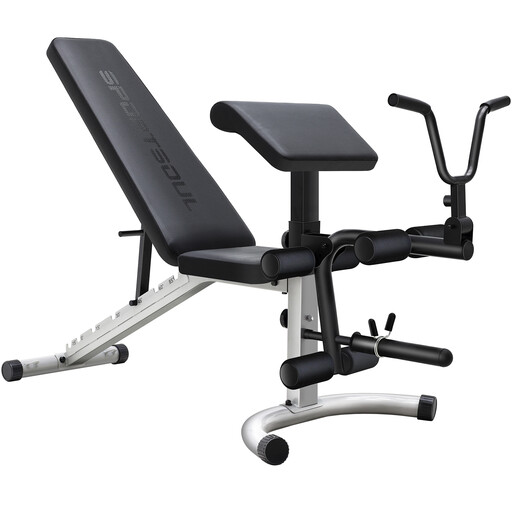
Why This Fits Their Persona: Ideal for the user who wants to move beyond basic presses and incorporate isolated movements. This is a true weight bench with leg extension and preacher curl functions, turning a single piece of equipment into a multi-station gym.
Its alloy steel frame provides a high dynamic weight capacity (277 kg), directly countering the wobble issue. The upgraded breathable leathaire and thickened cushion address the comfort pitfall, while the 7+4 angle adjustment system ensures true versatility.
Includes removable preacher curl and leg developer attachments. The frame is also a foldable workout bench, offering a degree of space-saving storage despite its robust build.
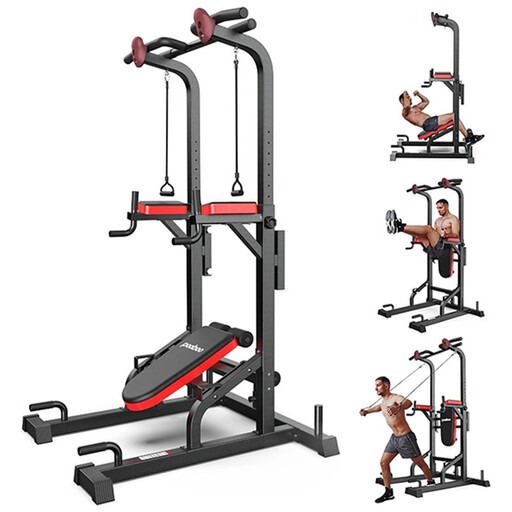
Why This Fits Their Persona: Perfect for those wanting to create a complete workout station in a limited space. This unit combines a bench with a power tower for pull-ups, dips and leg raises, offering a full-body workout from a single footprint.
The integrated design means the bench is part of a larger, stable structure, eliminating the wobble associated with standalone, poorly designed benches. It's built as a cohesive unit for strength training, not just a bench with add-ons.
Maximises workout potential per square metre. It combines multiple pieces of essential gym equipment into one, saving both space and money compared to buying each item separately.
We have compiled a complete, real-time list of products that fully satisfy these strict selection criteria and UK safety regulations.
For many, yes. If your goal is to build a well-rounded physique at home, a weight bench with leg extension is an excellent investment. It allows you to effectively isolate your quadriceps (with leg extensions) and hamstrings (with leg curls), exercises that are difficult to replicate with free weights alone. It provides a space-efficient and cost-effective alternative to purchasing separate, dedicated leg machines.
You need to consider two measurements: the operational footprint and the storage footprint. For safe use, you should have at least a 2m x 2m clear area around the bench to accommodate your body, the weights and a full range of motion. When it comes to storage, a good foldable workout bench can significantly reduce its size. Always check the manufacturer's listed "folded dimensions" to ensure it will fit in your intended storage space, such as under a bed or upright in a wardrobe.
Beyond the frame's stability, the most critical safety feature is the adjustment locking mechanism. Before every single use, you must physically check that the adjustment pins or ladder catches are fully engaged and secure. A partially engaged pin can slip mid-lift, which could lead to serious injury. Always choose a bench with a robust, simple and reliable locking system.