
24/7 Customer Support

Free returns

Same-day & Next-day Delivery

Quality Guaranteed

Unlock Your Welcome Offers: FREE Delivery | Up to 80% OFF | Free 30-day JoyPlus trial
Download the APP
Navigating the world of automated home cleaning can feel like a minefield of technical jargon and ambitious marketing claims. If you're considering a bagless self-emptying robot vacuum, you're already on the right track to achieving a truly hands-off cleaning routine while minimising long-term costs and environmental impact.
However, not all automated vacuums are created equal. Many UK households invest in a new device only to be disappointed by poor performance or surprised by hidden running costs. Before you commit, it's crucial to understand the common pitfalls that can lead to buyer's remorse.
The 3 Traps to Avoid When Buying a Robot Vacuum:
To make a confident purchase, focus on the underlying technology rather than just the headline features. Here are the three non-negotiable specifications to check.
For homes with multiple rooms, furniture and mixed flooring, a LiDAR navigation robot vacuum is essential. LiDAR (Light Detection and Ranging) uses a spinning laser sensor to create a highly accurate, 360-degree map of your home.
The main appeal of a self-emptying system is convenience. A bagless design takes this a step further by eliminating ongoing costs. These systems typically use multi-cyclone separation technology within the docking station to pull debris from the robot's small internal bin into a larger, permanent dust container. You simply empty this main container every few weeks or months, with no bags to buy or throw away.
A good robot vacuum for pet hair and mixed flooring needs more than just power. Look for:
We've analysed the market to find models that align with these critical features, matching them to the needs of different UK households.
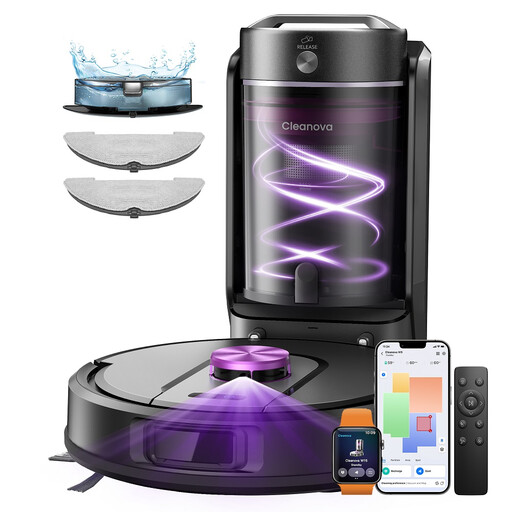
Why This Fits Their Persona: This model is ideal for those who want maximum automation without the recurring costs or environmental waste of disposable bags. Its quiet operation is perfect for families and those working from home.
It directly addresses the hidden cost trap with its 4L bagless self-emptying station, which uses a multi-cyclone system to collect dust in a reusable bin for up to 90 days.
Features advanced LiDAR navigation for efficient mapping and a very low noise level of 60dB in quiet mode. The 3-in-1 vacuum, sweep and mop function covers all floor types.
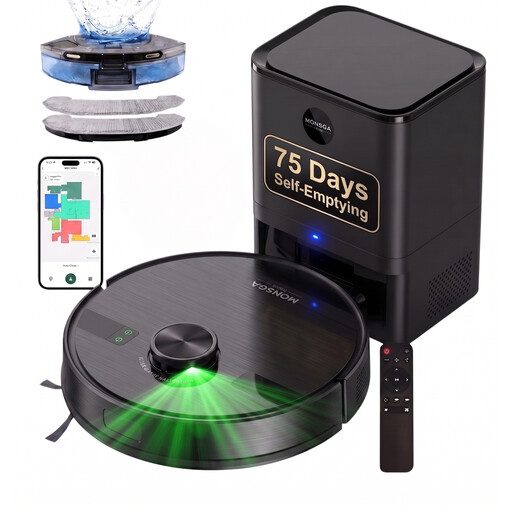
Why This Fits Their Persona: This model is built for challenging environments. Its high suction power is excellent for homes with pets shedding on carpets, and its ability to store up to five maps makes it perfect for multi-storey houses.
While its station uses disposable bags (a trade-off against the bagless ideal), it offers a different benefit: a fully sealed system that contains dust and allergens during disposal, which can be a priority for allergy sufferers.
Features powerful 9000Pa suction for deep cleaning and advanced LiDAR navigation that can store up to 5 floor maps. It also offers multiple control methods, including a physical remote control.
We have compiled a complete, real-time list of products that fully satisfy these strict selection criteria and UK safety regulations.
This depends on the size of your home, whether you have pets and how often you run the vacuum. For an average-sized home, a 4-litre bagless station like the one on the Vactidy W15 can hold up to 90 days of debris before it needs to be emptied. You simply remove the container, empty it into your household bin and place it back in the dock.
For daily maintenance, a high-performance robot vacuum can significantly reduce the need for manual vacuuming. They excel at keeping floors consistently free of dust, crumbs and pet hair. However, for deep cleaning tasks like stairs, upholstery or car interiors, you will likely still want to have a traditional corded or cordless vacuum on hand.