Families who want voice-requested stories
Your child wants to ask for a story or sleep audio without you choosing every title. You are willing to set up the child account and manage what the speaker can play.


Choose a voice-controlled speaker if your child needs to ask for stories and you can set up and manage its child controls. Amazon's Echo Dot Kids supports voice-requested stories, while a Google speaker calls for a check of the child features available to your household. Choose Yoto when avoiding a bedroom microphone matters most, or consider Toniebox 2 when your child would rather select familiar audio using physical characters.
Your child wants to ask for a story or sleep audio without you choosing every title. You are willing to set up the child account and manage what the speaker can play.
You want a predictable bedtime routine without a microphone in the child's room. Yoto describes its Player 3rd Generation as having no microphone or camera, though stories must be selected rather than requested by voice.
Your child may find selecting a familiar card or character easier than giving voice commands. Check the player's age guidance and any warnings on the physical content you intend to use.
Start with how your child will choose a story: by asking for it or picking from a collection you provide. Then check the bedtime controls and whether the way the device operates suits a child's bedroom.
| Concern | What to check | Who this matters to |
|---|---|---|
| Story choice | Check that a voice speaker can access the stories your family wants, or that a tactile player accepts the cards or characters you plan to use. | If my child wants to ask for a different story, I need to know those titles are available through the service we use; around 33% of consumers put story choice first. |
| Parent controls | Set up and test the child profile, content filters and bedtime limits. Check when any included content subscription renews. | Before my child uses a speaker independently, I want to control what plays and when it stops; around 27% of consumers make parent-managed controls their primary concern. |
| Bedroom privacy | Decide whether voice requests are needed in the bedroom. For an Echo device, switching the microphone off also stops Alexa responding to spoken requests. | I would rather choose bedtime audio without an active voice-listening function in the room; around 20% of consumers put microphone exposure first. |
| Independent use | Check age guidance, how a child starts playback, bedtime settings and warnings on physical story characters. | My child wants to replay a familiar story without navigating a screen or remembering commands; around 20% of consumers prioritise simple tactile operation. |
Age filters, media filters and bedtime limits depend on the relevant child profile or supervised account being configured.
Complete the account setup, choose the restrictions you need and test a story request and playback stop time before independent bedroom use.
Amazon says the Amazon Kids+ subscription included for one year with a qualifying device renews monthly afterwards unless cancelled.
Check the terms when activating it, record the renewal date and decide whether to keep the service before the included year ends.
Amazon says Alexa will not respond to voice commands while an Echo device's microphone is switched off.
If you expect to leave the microphone off at bedtime, consider whether selecting stories on a player without voice requests would suit your child better.
A character-based player offers a chosen collection rather than on-demand voice search. Tonies also warns that its characters contain magnets.
Check age guidance, the warning on each character and whether the bedtime stories your child wants are available in the compatible format.
As your child's interests change, maintaining that collection may mean obtaining additional characters or cards.
Amazon positions Echo Dot Kids, marketed for ages 3–12, for children who want to request stories and other audio by voice.
A route to consider if your household already uses Google Home and wants to manage bedtime audio through that setup.
A card-based audio route for families who prefer a selected collection of stories and a bedtime routine without voice requests.
A character-based audio route for a younger child who wants to choose and replay familiar content.
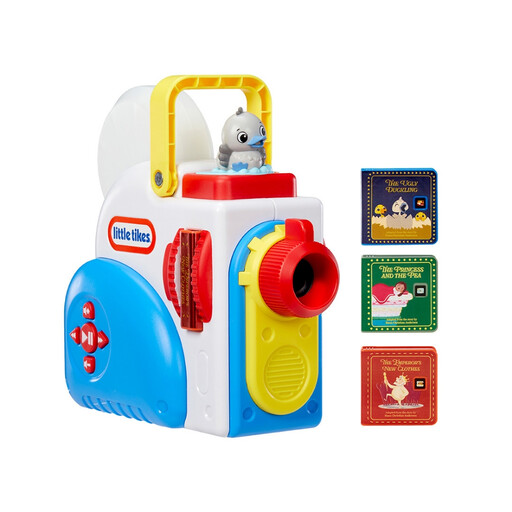
This story machine offers a selected fairy-tale collection for a child who likes familiar bedtime stories. Check its controls against your routine rather than assuming it has the voice features of a smart speaker.
 No image available
For children aged 3 and over who enjoy familiar fairy tales, this machine plays a selected story collection using simple controls.
If your bedtime routine depends on a sleep timer, volume limits or spoken requests, check those functions before buying. The product warning mentions small parts and battery-ingestion hazards and recommends direct adult supervision.
Set up Amazon Kids and apply the child's age filter and bedtime settings before independent use. If you switch off the microphone, Amazon says Alexa will not respond to spoken requests until it is switched back on.
Check the particular controls available to your household before buying for that purpose. Google describes a setup involving a supervised child account, family group and Google Home household, but warns that some child-related features vary by country, region or language.
It can, especially if your child uses it in a private space. The UK Information Commissioner's Office identifies voice-activated speakers among connected devices that can process children's data; review the provider's privacy settings and consider whether your family needs voice requests in the bedroom.
Yes. Check the age guidance and warnings for the particular player and content: tonies warns that its Tonies contain magnets and should be kept away from specified medical devices and magnet-sensitive items.