
24/7 Customer Support

Free returns

Same-day & Next-day Delivery

Quality Guaranteed

Unlock Your Welcome Offers: FREE Delivery | Up to 80% OFF | Free 30-day JoyPlus trial
Download the APP
A car dash cam can provide useful video evidence after a collision, help document parking damage and record unexpected incidents on the road. However, a high price or a long feature list does not automatically make a camera suitable for your vehicle.
Three buying pitfalls appear frequently:
The right choice depends on where you drive, whether you need cabin coverage and how much installation work you are prepared to undertake.
A 4K dash cam records more pixels than a 1080P model, which can help retain detail when viewing road signs or number plates. Yet resolution is only one part of image quality. Check the lens aperture, sensor specification and whether the camera includes night vision, WDR or low-light processing.
A very wide lens can capture more of the road, but excessive coverage may introduce edge distortion. A wide-angle camera around 140–170 degrees can suit general driving, while multi-camera systems provide additional views rather than simply widening the front image.
For taxi drivers, delivery workers and families, an interior camera with IR night vision may be more useful than a high-resolution front-only camera.
A front camera is compact and generally simpler to install. A front and rear dash cam adds evidence for rear-end incidents and parking impacts, but the rear cable must be routed through the vehicle trim or hatchback grommet.
A 3-channel dash cam normally records the front, rear and cabin. This can be suitable for private-hire drivers, taxi operators and motorists who want interior coverage. A 360-degree dash cam with four cameras can record the front, rear, left and right sides, although the extra hardware may require more storage and a more involved installation.
Before ordering, confirm that the rear camera cable is long enough and that your vehicle has a suitable route through the boot or tailgate.
Loop recording automatically overwrites older unlocked files when the memory card is full. This is convenient for daily use, but an unsuitable or poorly maintained card can cause recording errors. Format the card through the camera as recommended and check the supported capacity.
A G-Sensor detects sudden movement or impact and locks relevant footage against automatic deletion. It may also trigger during pothole impacts, so check locked files regularly and remove unnecessary ones.
For parking monitoring, determine whether the hardwire kit is included. Several products require a separate kit connected to ACC, battery and ground terminals. Professional installation may be sensible, particularly for newer vehicles, hybrids and electric cars.
Other useful features include:
Check the camera’s mounting position carefully. It should not obstruct your view, interfere with controls or encourage handling while driving. Also review privacy considerations when recording passengers, pedestrians or private property.
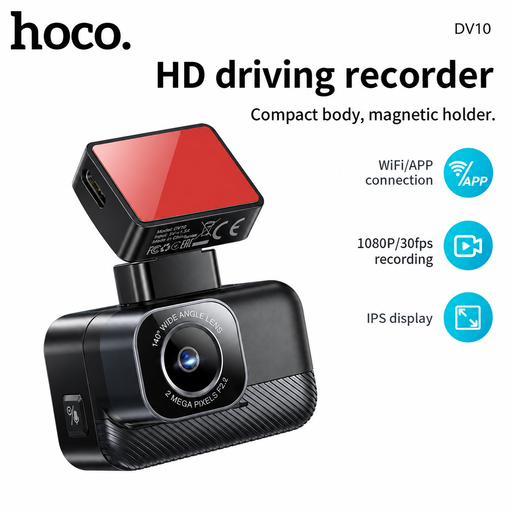
Why This Fits Their Persona: Its compact 40g body and built-in screen suit drivers who want straightforward front recording without a large display or complex installation.
It states a defined 1920×1080 resolution, 30fps recording and 140° lens angle rather than relying only on broad image-quality wording.
1080P video, Wi-Fi app access, 128GB memory-card support and a 1.47-inch IPS display.
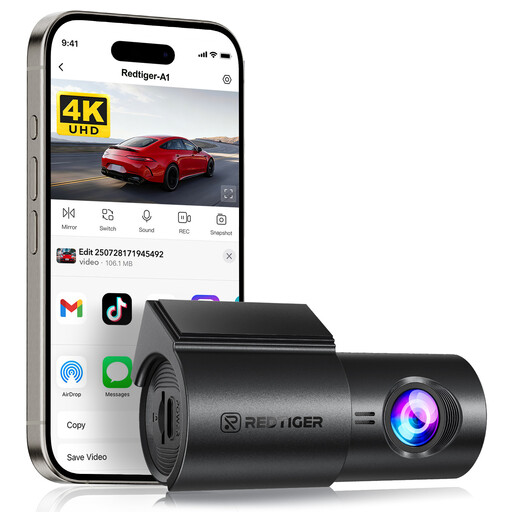
Why This Fits Their Persona: A discreet front camera with high-resolution recording suits motorists who prioritise image detail while keeping the windscreen installation compact.
It combines its stated 4K front recording with Wi-Fi control, G-Sensor support and loop recording, so core daily-use functions are clearly identified.
Compact format, app control and 24-hour parking mode support with the required hardwire connection.
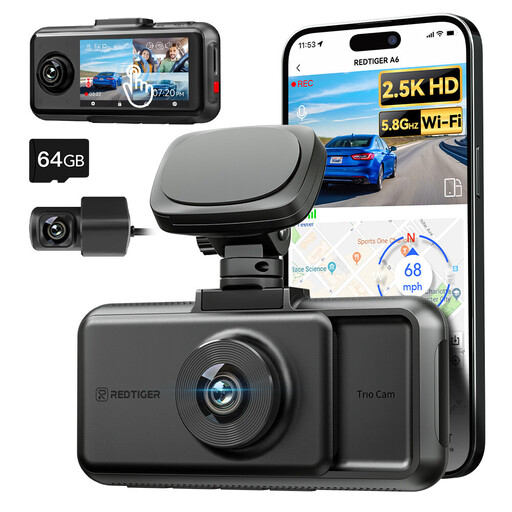
Why This Fits Their Persona: Taxi, delivery and private-hire drivers can benefit from simultaneous front, rear and interior coverage during frequent daily journeys.
The recording modes are specified separately: 4K front plus 1080P rear, or 2.5K front with 1080P interior and rear channels.
Adjustable front and rear cameras, a rotating rear camera, touchscreen, Wi-Fi and GPS support.
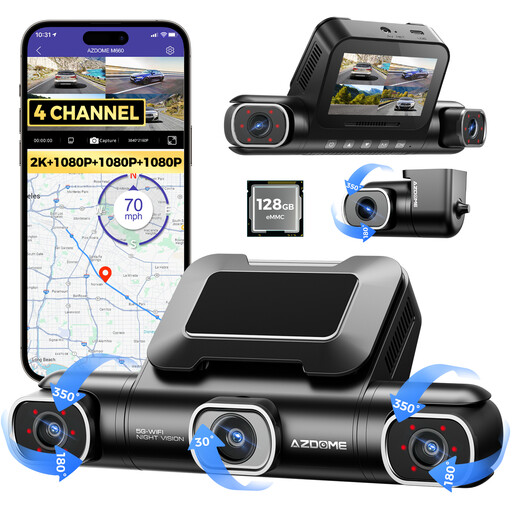
Why This Fits Their Persona: Drivers concerned about vandalism, side impacts and incidents while parked may prefer four-camera coverage over a front-only system.
Its four-channel design addresses side coverage directly, while the stated parking modes distinguish collision detection, motion detection and time-lapse operation.
2.5K front recording, additional 1K channels, 128GB eMMC storage, GPS, 5G Wi-Fi and a 3-inch IPS screen.
We have compiled a complete, real-time list of products that fully satisfy these strict selection criteria and UK safety regulations.
A front-only camera can usually connect to the vehicle’s 12V accessory socket. Rear cameras require cable routing, while parking mode normally needs a hardwire kit. Professional installation is worth considering if you are unfamiliar with fuse-box connections or drive a hybrid or electric vehicle.
Lifespan depends on heat exposure, power quality, memory-card condition and how frequently the camera records. Supercapacitor models can be suitable for environments with temperature changes, but every dash cam should be kept clean, checked periodically and paired with a compatible high-endurance memory card.
The main ongoing cost is usually memory-card replacement. Parking monitoring can also place additional demand on the vehicle battery, particularly when hardwired incorrectly or used for extended periods. Choose a camera with adjustable parking settings and check the hardwire kit’s low-voltage protection before installation.