
24/7 Customer Support

Free returns

Same-day & Next-day Delivery

Quality Guaranteed

Unlock Your Welcome Offers: FREE Delivery | Up to 80% OFF | Free 30-day JoyPlus trial
Download the APP
Adding custom lighting to your car's interior is one of the most effective ways to modernise and personalise your vehicle. However, the market is flooded with options, and it's easy to end up with a kit that looks cheap or fails within months. As the Joybuy Product Recommendation Officer, my role is to help you navigate the choices and find a solution that delivers a premium look without the premium price tag.
Before you buy, let's look at the common traps that many UK drivers fall into when choosing a car interior ambient lighting kit.
To ensure you get a quality kit that's right for your car and your DIY skills, focus on these key parameters.
The technology used to distribute light is critical for achieving a uniform, high-end look.
A good control system is what transforms a simple light into a dynamic atmosphere.
A universal car atmosphere light kit should be truly universal. The contents of the box will determine how easy and successful your installation is.
We've filtered the options to match different types of car enthusiasts. Instead of a one-size-fits-all approach, find the profile that best describes you.
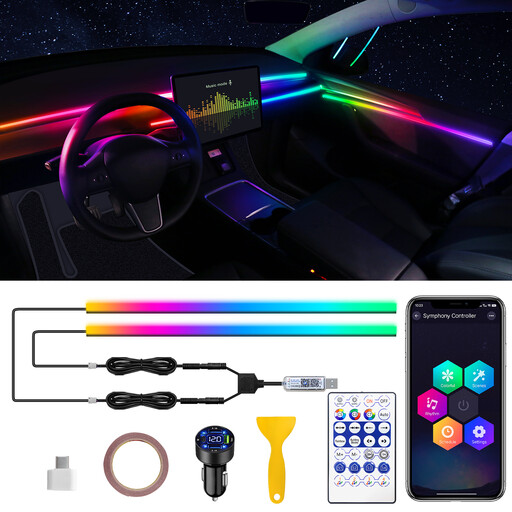
Why This Fits Their Persona: Perfect for someone new to car mods in the UK. This kit provides the core lighting for the dashboard and doors, offering a significant visual upgrade without the complexity or cost of more extensive systems. It's an ideal first DIY project.
The acrylic light strips with numerous LEDs provide a much more uniform and softer light than basic fibre optics, directly addressing the "hotspot" problem.
A straightforward 6-in-1 system that is easy to install. It offers full RGB customisation and music sync via a dedicated app, covering all the essential modern features.
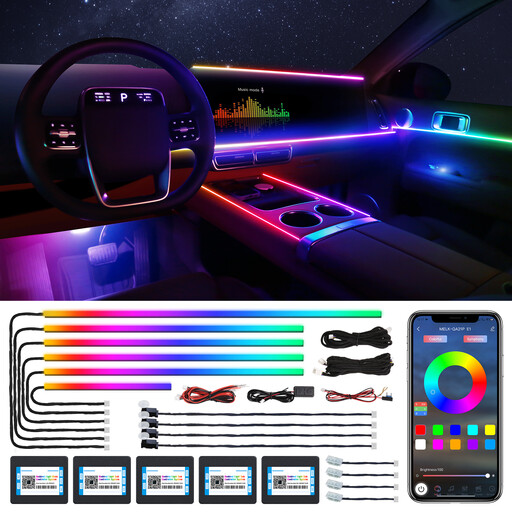
Why This Fits Their Persona: This user wants more than just a simple glow. The 14-in-1 kit adds footwell and door handle lights to the mix, providing a more comprehensive and immersive lighting environment. It's for the driver who loves tech and deep customisation.
It uses a modular system with a main controller and sub-controllers, plus a dedicated app ("LotusLamp X"), which provides more stable and feature-rich control than unreliable, generic software.
Features dual-zone control, allowing separate customisation of the main strips and the accent lights (footwells, handles). The Smart IC enables dynamic "dreamcolour" chasing effects.
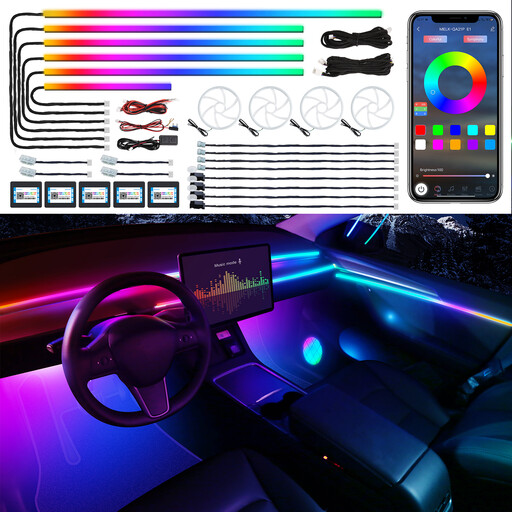
Why This Fits Their Persona: This is for the enthusiast who wants a lighting setup that looks like a top-tier factory option. The 22-in-1 kit provides total interior integration, with lights for the dash, doors, footwells, handles, storage boxes and even speaker surrounds.
The ultra-thin acrylic strips are designed to be hidden discreetly in panel gaps, avoiding the bulky, tacked-on look of inferior kits and ensuring a professional, integrated finish.
The most comprehensive kit for a seamless, all-encompassing ambient lighting experience. The modular controller system ensures all 22 light points work in perfect synchronisation.
We have compiled a complete, real-time list of products that fully satisfy these strict selection criteria and UK safety regulations.
The lifespan of a good quality LED lighting kit is determined by the LEDs themselves, which typically have a rated life of 30,000 to 50,000 hours. In real-world terms, this means they should last for many years. The key to longevity is ensuring the kit is powered correctly. All the kits recommended here are designed for a standard 12V vehicle system and include short-circuit protection for safety and durability.
Most modern kits are designed with the DIY enthusiast in mind. Installation does not typically require removing entire door panels or the dashboard. Instead, you use an included plastic pry tool to gently create a small gap in the existing trim, then push the thin flange of the acrylic strip into it. The most time-consuming part is often just hiding the wires neatly for a clean finish. Powering the kit is usually as simple as plugging it into the 12V cigarette lighter socket.
LEDs are extremely energy-efficient and draw very little power. When your car is running, the power is supplied by the alternator, so there is no impact on the battery. When the car is off, these kits are designed to power down as well, as they are connected to a circuit (like the 12V socket) that is only active when the ignition is on or in accessory mode. Therefore, they will not drain your battery when the car is parked.