Single-screen bridge-view seekers
A 34-inch ultrawide is worth considering if you want more horizontal room for the bridge view and can confirm that your exact simulator presents its view and controls properly at 21:9.


Choose a 34-inch 21:9 ultrawide if your cargo-ship simulator handles that format well and a wider bridge layout matters most. Choose a 32-inch 4K screen if instrument and chart detail, or a conventional 16:9 layout, matters more. Whichever route you take, check the game, source-device output and available desk space before relying on a monitor’s headline specifications.
A 34-inch ultrawide is worth considering if you want more horizontal room for the bridge view and can confirm that your exact simulator presents its view and controls properly at 21:9.
A 32-inch 4K screen suits players who prioritise instrument and chart detail and want a conventional 16:9 layout for other PC or console games.
If windows or lamps cause distracting reflections, compare glare handling alongside aspect ratio, resolution and the ways you can position the screen.
Start with the view your simulator can display properly, then check whether your source device and physical setup can make use of the monitor you choose.
| Concern | What to check | Who this matters to |
|---|---|---|
| Wider bridge view | Check the exact simulator’s 21:9 view and on-screen controls; measure the space available for a 34-inch screen. | With room for one screen, I want a wider bridge layout without losing access to its controls. Around 45% of consumers put that wider view first. |
| 4K detail and familiar format | Check the intended 4K output mode against the source device, cable and chosen monitor input. | If I read instruments and charts as well as play other games, I want image detail in a conventional layout. Roughly 33% of consumers prioritise detail and standard-format use. |
| Room and setup fit | Measure desk width and depth; compare glare treatment, stand adjustment and mounting requirements. | When light falls across my simulation station, I need a screen I can position without distracting reflections. About 22% of consumers put room and setup fit first. |
A 3440 × 1440 panel cannot make a game display its interface or field of view correctly at an ultrawide aspect ratio.
Check support for your exact simulator and version, including its on-screen controls, before choosing a 34-inch ultrawide. If support is uncertain, compare a 32-inch 4K 16:9 screen.
The mode available in use also depends on the PC or console output, cable and monitor input. A monitor’s maximum refresh rate alone does not establish what your system will deliver.
Identify the resolution and refresh rate you intend to use, then check that combination for both the source device and the selected input.
A 34-inch ultrawide needs more desk width than a 32-inch 16:9 screen, while stand adjustment and mounting arrangements vary by model.
Measure usable desk width and depth, and check the stand dimensions or the monitor’s VESA pattern against your arm and its load rating.
If the existing mount or desk cannot accommodate the screen, changing the arm or station may add work to the setup.
Seller return terms and statutory rights are different considerations. Under section 9 of the Consumer Rights Act 2015, goods supplied under a consumer contract must be of satisfactory quality; an unwanted change-of-mind return is a separate question. Replacing a monitor also leaves an electrical item to dispose of appropriately.
Keep the listing and order record, read the seller’s current return terms, and ask about electrical-waste take-back or local recycling before replacing your screen.
The LG 34GX900A-B is a 34-inch 21:9 OLED option for a single ultrawide screen.
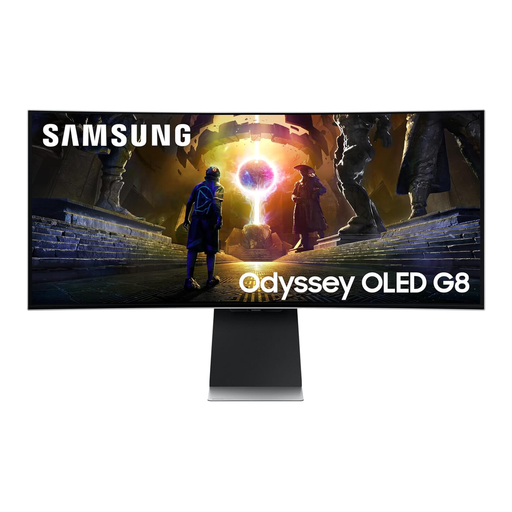
The 34-inch Odyssey OLED G8 G85SD offers an ultrawide option for players comparing reflection handling.
The ROG Strix XG32UCG is a 32-inch 4K Fast IPS option for players considering a conventional screen format.
The EX3210U is a 32-inch 4K IPS option for a fixed station where connections and positioning matter.
These models cover both ultrawide screens for a simulator that handles 21:9 well and 4K screens for players prioritising detail. Compare each model’s format and connection requirements with your own game and source device.
 No image available
Consider this for a single screen when 4K instrument or chart detail matters more to you than an ultrawide layout.
The product name specifies 3840 × 2160 resolution, a 165Hz refresh rate and USB-C 65W power delivery. Check the resolution and refresh mode available through your chosen source and input, and confirm mount compatibility if you plan to use an arm.
 No image available
Consider this ultrawide if your simulator handles 21:9 well and reflections are a concern in your room.
Samsung specifies 3440 × 1440 resolution, 175Hz and its OLED Glare Free feature for this model. Check the game’s interface at 21:9 and the output mode available from your source.
 No image available
This is a 21:9 option if your simulator displays its bridge and controls properly across an ultrawide screen.
LG specifies 3440 × 1440 resolution, 240Hz and HDMI 2.1 for the 34GX900A-B. Confirm the mode your source can deliver. The product information also warns about burn-in from prolonged static images, so review its screen-protection guidance if your simulation keeps instruments on screen for long periods.
 No image available
Consider this wider single-screen format only after checking that your simulator handles 21:9 acceptably.
The product name specifies 3440 × 1440 resolution, a 200Hz refresh rate, a VA panel and two DisplayPort 1.4 inputs. Check the refresh mode available through the particular input and source you intend to use.
 No image available
Consider this 32-inch Ultra HD model if image detail is your priority rather than choosing a screen for extra horizontal width.
Before treating it as a conventional-format option, confirm its aspect ratio. Also check which input and source settings provide the resolution and refresh mode you want.
Choose a 34-inch ultrawide if your exact simulator presents its bridge view and on-screen controls well at 21:9 and you value the wider layout. Check the game and version before buying: the monitor’s aspect ratio alone cannot establish how a particular game will display.
Not necessarily: the available mode depends on the source device, cable, selected input and resolution. Samsung says input-source performance can affect refresh rate and response time on its Odyssey OLED G8 G85SD; check your chosen monitor’s input modes against your PC or console settings.
Match the monitor’s VESA pattern and weight to the arm’s fittings and load rating, then check how the arm attaches to your desk or wall. BenQ specifies a 100 × 100mm VESA mount for the EX3210U, but that model-specific detail does not establish compatibility with every arm.
A faulty monitor should be assessed under the applicable statutory rights, separately from a seller’s change-of-mind return policy. Section 9 of the Consumer Rights Act 2015 requires goods supplied under a consumer contract to be of satisfactory quality; keep the listing, order record and details of the fault when contacting the seller.