Colour newsletter coordinators
Groups regularly producing A4 issues with colour logos, event photographs or coloured headings, where ink supply, two-sided printing and paper capacity all affect the work involved.


For recurring newsletters with colour headings, photographs or graphics, consider a refillable colour multifunction printer and check how its stated ink yields relate to the group’s page layout. If every page printed in-house is black-and-white, a mono laser multifunction printer is another route; a colour A3 model is more relevant when the group also produces larger notices or posters. Whichever route fits, check paper capacity, automatic two-sided printing and the scanning workflow volunteers need.
Groups regularly producing A4 issues with colour logos, event photographs or coloured headings, where ink supply, two-sided printing and paper capacity all affect the work involved.
Groups whose newsletters are entirely monochrome and who also copy or scan multi-page source material.
Committees sharing newsletter production across several volunteers while also preparing notices, forms or occasional larger-format materials.
For recurring community newsletters, decide whether colour is essential before choosing a print workflow; then weigh the paper run and the originals volunteers need to scan.
Consider it when: Colour logos, photographs or headings appear in recurring A4 issues.
Bear in mind: Stated ink yields will not necessarily match a newsletter with extensive photographs or coloured backgrounds.
Consider it when: Every newsletter page printed in-house can be black-and-white.
Bear in mind: Colour graphics would need a separate printing arrangement.
Consider it when: The group also prints larger posters or notices.
Bear in mind: Check the space available for the printer and for storing the different paper sizes.
| Concern | What to check | Who this matters to |
|---|---|---|
| Recurring colour output | Check the exact replacement inks and their stated yields against a representative newsletter layout; confirm A4 two-sided printing. | If our issues use colour photographs or graphics, we need a way to plan repeat runs without treating a bottle-yield figure as a copy count. Around 39% of consumers put recurring colour output first. |
| Black-and-white batches | Confirm that all pages printed in-house can be monochrome, then check stated print speed, toner options and paper capacity. | When our newsletter is entirely text-led, getting a batch printed takes priority over colour capability; roughly 23% of consumers chiefly need black-and-white batch output. |
| Volunteer scanning and access | Check automatic document feeder capacity, the workflow for two-sided originals and the connection options volunteers require. | If several volunteers collect multi-page contributions, we want to scan and share them without handling every sheet separately. Around 23% of consumers put that scanning and access need first. |
| Uninterrupted paper runs | Check plain-paper tray capacity and automatic two-sided printing for the intended paper size. | For a large distribution run, we want fewer pauses to reload paper or turn printed pages; approximately 15% of consumers primarily need a less interrupted print run. |
A mono printer cannot produce the colour logos, photographs or graphics the group may want to print in-house.
Review a representative issue before shortlisting: if any essential pages need colour, start with colour-capable models.
Page yield varies with the type of pages printed; a layout with substantial colour coverage may not match a stated yield.
Use a representative issue when comparing the exact consumables and their stated yields.
Automatic duplex printing does not establish how a printer handles double-sided originals.
If volunteers regularly scan both sides of forms, confirm the exact model’s automatic scanning or copying workflow.
Otherwise, volunteers may have to turn multi-page originals by hand.
A tray that holds enough paper for one newsletter may still need repeated refilling during distribution printing.
Multiply pages per copy by the planned number of copies, then compare that run with the usable tray capacity and two-sided print options.
Canon’s MAXIFY GX4050 is a refillable colour A4 multifunction option for recurring newsletter printing.
Epson’s EcoTank ET-4950 is a refillable colour A4 multifunction option when double-sided document handling matters.
Brother has distinct models relevant to monochrome A4 batches and to colour printing with A3 paper handling.
These printer choices relate to recurring colour newsletters and, for some groups, occasional larger-format material. Match each model’s paper and scanning workflow to the work your volunteers actually do.
 No image available
For recurring colour newsletters, check this model’s A4 two-sided printing, usable paper capacity and exact replacement inks against the planned issue; confirm the scanning workflow if originals have two sides.
 No image available
If the group also produces A3 material, check this inkjet model’s supported paper sizes and the included tray arrangement before relying on it for both jobs.
 No image available
For newsletters alongside occasional A3 work, confirm the supported paper sizes and whether the optional second tray is included; check two-sided scanning separately if volunteers need it.
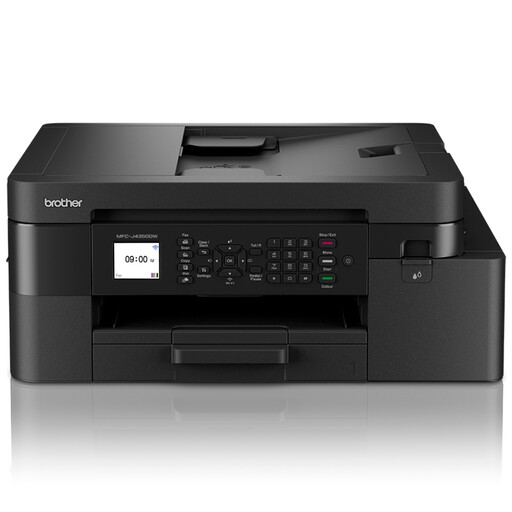 No image available
For a colour newsletter run, confirm support for the intended plain A4 paper before choosing this model. High-yield cartridges are options, so check the exact consumables needed for repeat issues.
 No image available
For colour newsletters using a wireless LED printer, compare replacement toner with the group’s expected colour coverage and confirm how double-sided originals are scanned.
Choose a mono model only if every page printed in-house can be black-and-white or the group has another arrangement for colour pages. Brother UK identifies the MFC-L2800DW as a mono printer, so it cannot print colour graphics itself.
Check automatic two-sided printing for the intended paper, usable tray capacity and the automatic document feeder if contributors supply paper originals. Work out the full run size rather than judging capacity from a single copy.
No: printing and scanning are separate functions. Epson United Kingdom states that the EcoTank ET-4950 supports double-sided printing, copying and scanning; confirm the equivalent workflow for any other exact model before relying on it.
Compare the exact consumables and their stated yields using a representative newsletter layout. Page yield varies with the type of pages printed, so a text-only figure may not reflect issues containing photographs.
Check an appropriate recycling route when replacing it, including any take-back arrangement offered by the retailer. GOV.UK describes the UK Waste Electrical and Electronic Equipment regulations as covering electrical and electronic equipment; ask the retailer or local recycling service how to hand over the old printer.