
24/7 全天候客户支持

免费退货

当日/次日达

品质保障

开启新人专享福利: 全场免邮 | 低至 2 折 | 免费试用 30 天 JoyPlus 会员
下载 Joybuy
Navigating the world of cordless vacuum cleaners can feel like a minefield of exaggerated claims and confusing technical jargon. Many of us have been tempted by a sleek design and a promise of "powerful suction," only to find our new gadget struggles with pet hair or runs out of battery halfway through cleaning the living room. As the Joybuy Product Recommendation Officer, my role is to help you sidestep these common purchasing pitfalls.
Before you add any model to your basket, let's look at the three most common traps that catch out UK shoppers and how to avoid them.
To make an informed choice, focus on the practical specifications that directly impact day-to-day performance. Here are the core parameters to check before you buy.
Instead of just looking at the headline number, consider the technology behind it. A brushless motor is generally more efficient, quieter and has a longer lifespan than older brushed motors. For suction, look for a measurement in Pascals (Pa) or kiloPascals (kPa). A powerful stick vacuum suitable for mixed flooring, including carpets, should ideally offer at least 25,000 Pa (25 kPa) at its maximum setting. This provides enough force to lift embedded dirt and pet hair rather than just surface-level dust.
A good rechargeable vacuum cleaner should offer transparency about its battery life. Look for the stated runtime on both low and high power modes. For most UK homes, a runtime of at least 15-25 minutes on high power is a practical benchmark for deep cleaning tasks. Also, consider models with a removable battery. This allows you to have a spare charged and ready to go, effectively doubling your cleaning time for larger homes without interruption. Wall-mounted charging docks also provide a neat storage and charging solution.
The filtration system is crucial, especially for households with pets or allergy sufferers. A multi-stage system with a HEPA filter (High-Efficiency Particulate Air) is designed to capture at least 99.97% of microscopic particles like dust mites, pollen and pet dander. This prevents them from being recirculated back into the air you breathe. Check if the filters are washable, as this can significantly reduce long-term running costs. A good system ensures your lightweight vacuum cleaner not only cleans your floors but also helps improve your indoor air quality.
Here are a few models that align with different household needs, keeping our key performance indicators in mind.
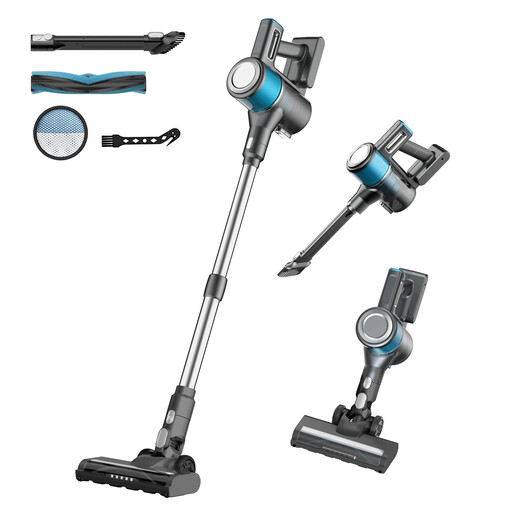
Why This Fits Their Persona: Ideal for those in smaller flats or as a secondary vacuum for quick clean-ups. Its lightweight frame and 4-in-1 design make it a versatile tool for handling daily dust and crumbs on hard floors and in tight spaces without a large initial investment.
It avoids the power trap by being positioned for lighter duties. With 18 kPa suction, it's suited for hard floors and quick spills, setting realistic expectations for its performance class.
Its main advantage is its lightweight, multi-functional nature. It easily converts to a handheld vacuum cleaner for cars or upholstery and includes LED headlights for visibility.
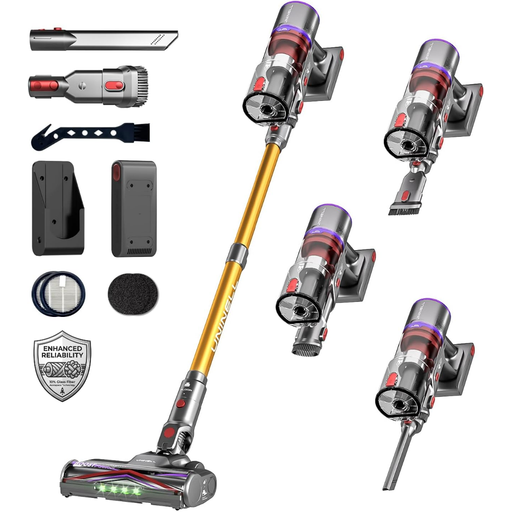
Why This Fits Their Persona: Built for the challenges of a busy home with pets. It combines high suction power for deep cleaning carpets with a specialised roller designed to handle hair, making it a reliable tool for keeping floors free of fur and dander.
It directly counters the "anti-tangle" trap with a V-shaped roller made from durable materials and a scraper strip, a design focused on actively preventing hair wrap rather than just claiming it.
Features a powerful 550W brushless motor delivering 48kPa suction. The self-standing design is a practical bonus, allowing you to pause cleaning without leaning it against a wall.
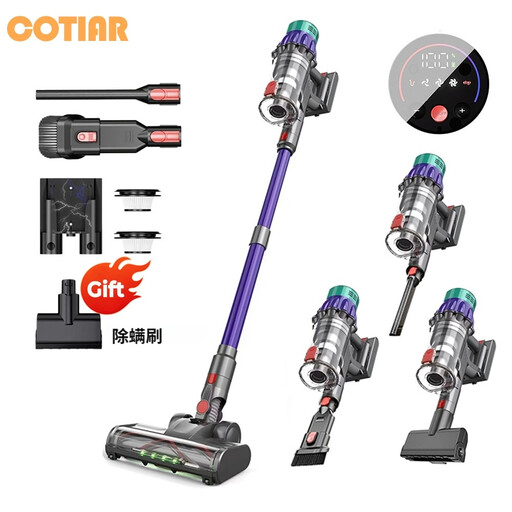
Why This Fits Their Persona: For those needing to clean larger spaces without compromising on power. This model's combination of very high suction, a long-running battery on its low setting and a large dustbin is geared towards whole-house cleaning in one session.
It sidesteps the battery runtime trap by offering a substantial 60-minute runtime on its low gear, which is sufficient for hard floors, and a clear LED display to monitor power levels across its three modes.
Its standout features are the 650W brushless motor providing up to 55kPa suction and a generous 1.2L dust cup, which is larger than many competitors and reduces the frequency of emptying.
We have compiled a complete, real-time list of products that fully satisfy these strict selection criteria and UK safety regulations.
For optimal performance and to prevent loss of suction, it's good practice to check your vacuum's filters regularly. Non-washable filters should be tapped clean after every few uses. For washable filters, including HEPA filters, rinsing them under cold water every 2-4 weeks is recommended. It is critical to ensure they are completely air-dried for at least 24 hours before reinstalling, as a damp filter can damage the motor.
For many households, especially those with mostly hard floors or smaller living spaces, a modern, powerful stick vacuum can absolutely serve as the primary cleaning tool. However, for very large homes with extensive deep-pile carpeting, a high-end corded model may still offer more sustained, deep-cleaning power. Many people find a combination works well: a cordless model for daily convenience and a corded one for less frequent, intensive cleaning sessions.
kPa, or kiloPascals, is a unit of pressure used to measure the suction strength of a vacuum cleaner. It indicates the difference in air pressure between the inside of the vacuum and the outside air. A higher kPa number generally signifies stronger suction force, which is particularly important for lifting heavy debris and pulling embedded dirt from hard floors and carpet fibres.