
24/7 Customer Support

Free returns

Same-day & Next-day Delivery

Quality Guaranteed

Unlock Your Welcome Offers: FREE Delivery | Up to 80% OFF | Free 30-day JoyPlus trial
Download the APP
A dish drainer seems like a straightforward purchase, but the wrong choice can lead to a cluttered, unhygienic kitchen and a frustrating daily chore. Many products promise organisation but deliver rust, pooling water and impractical designs. As the Joybuy Product Recommendation Officer, my role is to help you see past the marketing and choose a dish drainer that genuinely works for your UK home.
Before you buy, be aware of these common pitfalls that lead to disappointment:
To avoid these issues, focus on a few core parameters. Getting these right is the key to finding a durable and practical kitchen sink organiser.
The material of your dish drainer dictates its lifespan and maintenance needs.
How a dish rack manages water is its most important function.
Measure your available space before you start browsing. Consider whether you need a compact dish drainer for a small flat or a larger, two-tier model for a busy family. Check the layout: are the plate slots wide enough for your dinner plates? Is the cutlery drainer deep enough to hold utensils securely? A well-designed layout makes a huge difference in daily use.
Here are a few options that address the common pitfalls, matched to different household needs.
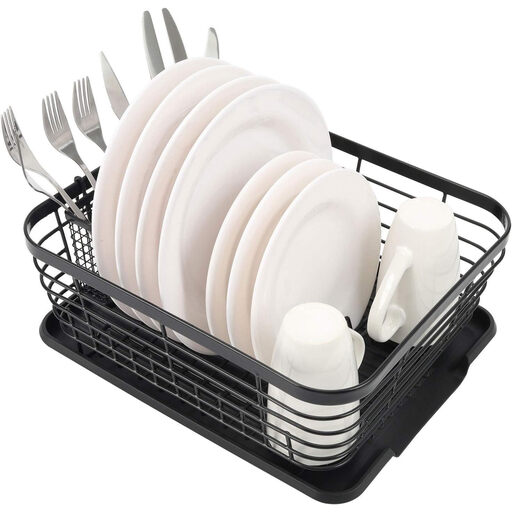
Why This Fits Their Persona: Ideal for renters, students or anyone with a small kitchen. Its compact footprint and ability to sit directly in the sink frees up precious countertop space for food preparation.
By sitting in the sink, it completely eliminates the "Drainage Disaster" of wet countertops. The powder-coated metal also offers good protection against the "Rust Trap".
Versatile placement (in-sink or countertop) and a full-mesh utensil basket that prevents smaller items from falling through.
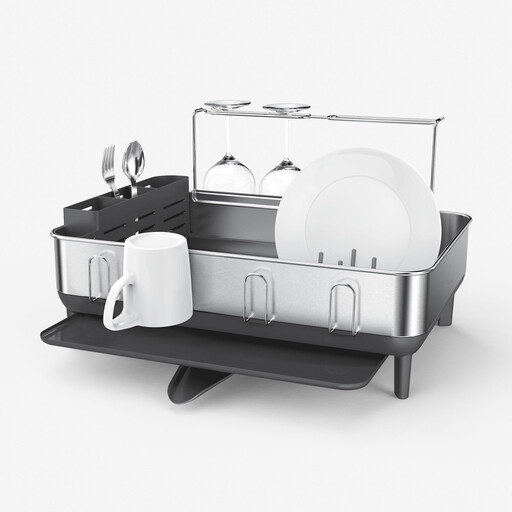
Why This Fits Their Persona: For households that generate a lot of washing-up, this large-capacity rack handles it all. It includes thoughtful features like a dedicated wine glass holder, making it suitable for daily meals and entertaining.
It uses durable, rustproof materials to avoid the "Rust Trap". Its innovative drainage system, featuring a swivel spout and a hydrophilic coating on the tray to help water evaporate, is a direct solution to the "Drainage Disaster".
Exceptional water management and a very large capacity. The fingerprint-proof coating keeps the stainless steel looking clean.
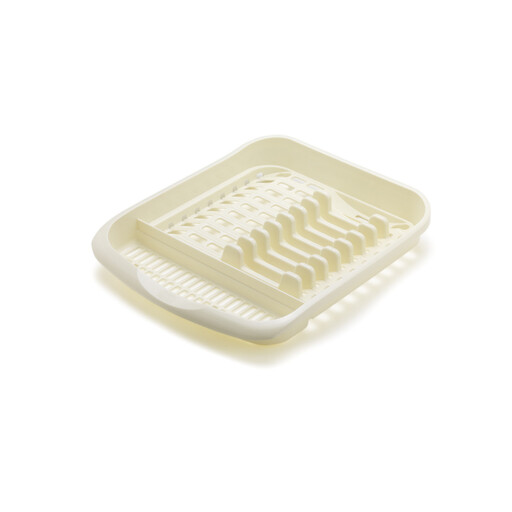
Why This Fits Their Persona: A simple, no-frills solution for those on a tight budget or who only need a basic plate rack. It's a classic design that does one job—holding plates while they dry—without a significant financial outlay.
As it's made entirely of plastic, it completely sidesteps the "Rust Trap". It's designed to be placed on a sink's built-in draining board, so it doesn't require its own complex drainage system.
Highly affordable and easy to clean. Its minimalist profile is unobtrusive and works well in any kitchen with an existing draining board.
A tidy sink area goes beyond just a dish rack. We have compiled a complete, real-time list of sink-side organisation solutions that satisfy these strict selection criteria and UK regulations.
The most effective step is to choose a rack made from 304-grade stainless steel from the outset. To maintain it, wipe it down regularly to prevent mineral deposits from hard water, which can accelerate corrosion. Avoid using harsh, abrasive scouring pads that can scratch the protective surface.
Hygiene comes down to two factors: material and drainage. Smooth, non-porous materials like high-grade stainless steel and quality plastic are easy to clean and less likely to harbour bacteria. Crucially, any model that promotes fast drying and prevents standing water—such as an in-sink dish drainer or one with an efficient drainage spout—will be more hygienic.
For general hygiene, it's good practice to give your dish rack a quick rinse and wipe-down once a week. A more thorough clean is recommended every two to four weeks. If your model can be disassembled, take it apart to clean the drainboard and cutlery drainer, where soap scum and limescale tend to build up.