
24/7 Customer Support

Free returns

Same-day & Next-day Delivery

Quality Guaranteed

Unlock Your Welcome Offers: FREE Delivery | Up to 80% OFF | Free 30-day JoyPlus trial
Download the APP
A divided hot pot can make shared meals more flexible, allowing two broths, sauces or cooking styles in one pan. However, product listings often focus on appearance while leaving out details that affect everyday use. A low-quality divider may be difficult to clean, a base may not heat evenly on an induction hob and a large pan can become awkward to lift when full.
Before choosing a yin-yang hot pot or multifunctional stew pot, watch for these common buying pitfalls.
Induction hobs require a suitable magnetic base with good contact across the cooking zone. A product may state that it is induction compatible but provide little information about the base construction or supported hob types.
Check whether the pan is suitable for your specific hob size and whether the base is flat. If you use more than one type of cooker, look for clearly stated compatibility with induction, gas, electric and ceramic glass hobs.
A 304 stainless steel hot pot is made from a widely used stainless-steel grade, but the label alone does not tell you the thickness, base design, handle attachment or divider construction. Stainless steel is also not naturally non-stick, so food residue may appear if the pan is overheated or not cleaned promptly.
A tri-ply hotpot usually refers to a multi-layer construction designed to distribute heat through the base and/or body. Still, buyers should check the actual product description rather than relying on the phrase alone.
A removable divider may seem convenient, but gaps and joints can trap soup residue. A fixed divider can offer a simpler structure but may require more careful washing around the seam.
For frequent use, a dishwasher-safe hot pot can reduce cleaning time. Nevertheless, stainless steel may remain brighter when washed by hand with a soft sponge and dried thoroughly. Also check the pan’s diameter, lid storage and weight before buying a large family hot pot pan.
For buyers seeking a non-stick-free hot pot, stainless steel and enamelled cast iron are two practical options. Stainless steel offers a hard-wearing cooking surface without a non-stick coating and is suitable for boiling and simmering. It can show water spots or rainbow-coloured discolouration after heating, but these marks are generally surface deposits or heat-related staining that can often be treated with vinegar or lemon.
An enamelled cast iron stew pot retains heat effectively and can move from the hob to the table. It is heavier than stainless steel, so consider how comfortably you can lift it when filled. Enamel may also require gentler handling to avoid chips from knocks.
A 22cm 3.3L stew pot may suit one to three diners, compact kitchens or smaller portions. For a group meal, a 26cm or 28cm divided pan provides more room for ingredients. A 30cm pan is useful for larger gatherings, but it needs sufficient hob space and a stable place to serve.
Remember that a divided pan does not provide the full internal volume of one open pot for either broth. Two sections share the available space, so portion planning matters.
A dual-compartment hot pot should have a divider that is firmly secured and easy to clean. A non-removable divider has fewer detachable parts, while a removable design may be easier to wash if its seals and fittings are robust.
Dual handles can make a full pan easier to carry, but they also require enough clearance around the hob. A glass lid helps you monitor simmering without lifting the lid repeatedly, although steam and condensation can reduce visibility during cooking.
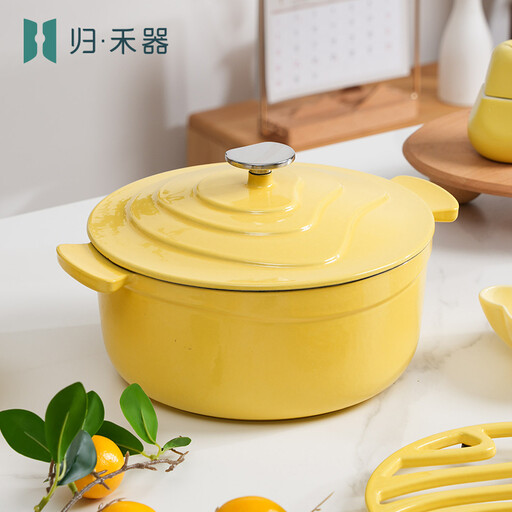
Why This Fits Their Persona: Its 22cm diameter and 3.3L capacity are practical for smaller households, compact kitchens and cooks who want one pot for soups, stews and simmered dishes.
The flat-bottom design and stated induction compatibility address the risk of buying a rounded pan that sits poorly on a UK hob.
Enamelled cast-iron construction; multifunctional micro-pressure stew-pot design; induction-compatible flat base.
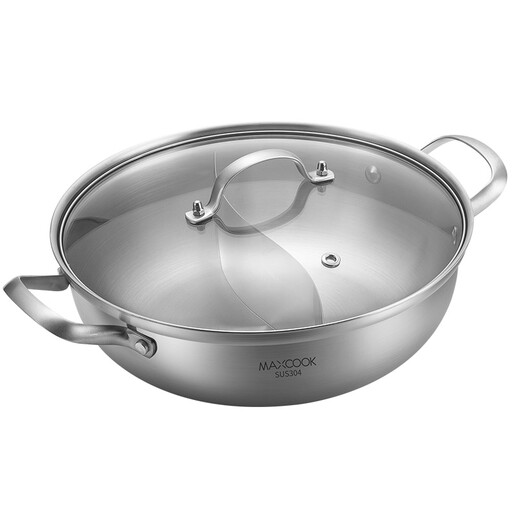
Why This Fits Their Persona: This is suited to households wanting a larger yin-yang hot pot for shared meals, with two cooking sections and a lid for monitoring simmering.
Its stated compatibility covers induction, gas, electric and ceramic glass hobs, avoiding the limitation of a single-hob pan. The divider is part of the dual-broth format.
304 stainless steel; tri-ply construction; glass lid; dishwasher-safe specification; no non-stick coating.
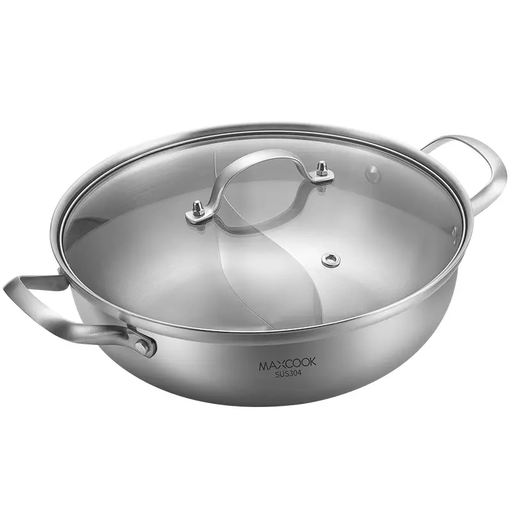
Why This Fits Their Persona: The 26cm format offers a balance between shared dining and manageable storage, making it suitable for regular family hot-pot meals.
The non-removable divider avoids loose insert parts that can be misplaced, while the stated gas and induction compatibility supports common UK kitchens.
Tri-ply 304 stainless steel; dual handles; non-stick-free cooking surface; dishwasher-safe specification.
Why This Fits Their Persona: The 30cm diameter gives larger groups more cooking room, provided the hob and dining table can accommodate its footprint.
The fixed divider reduces the number of detachable components, while the multi-hob specification helps avoid buying a pan restricted to one cooker type.
30cm size; tri-ply 304 stainless steel; dual handles; suitable for gas and induction hobs; dishwasher-safe specification.
We have compiled a complete, real-time list of products that fully satisfy these strict selection criteria and UK safety regulations.
It can be, provided the base is magnetic, flat and specified as induction compatible. Check the manufacturer’s listed hob types and compare the pan’s base diameter with your induction cooking zone. A pan that is too large or poorly centred may heat less evenly.
Stainless steel is generally lighter and can be dishwasher safe when the product specifies this feature. Cast iron retains heat and suits slow cooking but is heavier and usually benefits from careful hand washing. Enamelled cast iron should be dried after cleaning and protected from hard impacts.
For a small household, a 22cm 3.3L stew pot may be sufficient. A 26cm or 28cm pan is more practical for several diners, while a 30cm dual-compartment hot pot is aimed at larger gatherings. Always allow for the divider, which reduces the usable space in each section.