
24/7 Customer Support

Free returns

Same-day & Next-day Delivery

Quality Guaranteed

Unlock Your Welcome Offers: FREE Delivery | Up to 80% OFF | Free 30-day JoyPlus trial
Download the APP
A shared hotpot meal is convenient, sociable and adaptable, but choosing the wrong pan can make cooking frustrating. An induction hob compatible hot pot must do more than look attractive: it needs a suitable base, practical capacity and a design that matches how your household cooks.
Several buying traps appear repeatedly in this category:
For an induction hob compatible hot pot, look for explicit compatibility with induction, rather than relying on the material name. A thick composite or tri-ply base can help distribute heat across the cooking surface and may also support gas and electric hob compatible pot use.
Before buying, confirm that the pan is also suitable for your cooking arrangement:
The MAXCOOK models listed below specify compatibility with induction, gas, electric and ceramic glass hobs. Always compare the pan’s base size with your hob zone, as an oversized pan may heat less evenly at the edges.
A stainless steel hotpot is often selected for its hard-wearing cooking surface and lack of a non-stick coating. The MAXCOOK divided models use 304 food-grade stainless steel, with the product information specifying no non-stick coating. This makes them suitable for hotpot, boiling and simmering meals, although food can still stick if the pan is overheated or used without enough liquid.
A tri-ply hot pot generally refers to a layered construction designed to combine stainless steel with heat-conducting material. This can be useful when simmering broth for longer periods, but buyers should still check the manufacturer’s stated construction rather than assuming every “multi-layer” description means the same thing.
For slow cooking and soups, an enamelled cast iron stew pot offers a different cooking experience. Cast iron is heavy and retains heat well, while enamel provides a smooth cooking surface. The trade-off is weight: a full 3.3-litre pot can be difficult to move safely, particularly when hot.
A yin-yang hotpot or divided hot pot is practical when diners prefer different broths. It can reduce the need to prepare separate pans, but the divider reduces the space available in each section. Consider:
A soup pot with glass lid can be useful when simmering, as the lid allows you to monitor the contents without lifting it repeatedly. However, not every hotpot includes a lid, so check the individual listing before ordering.
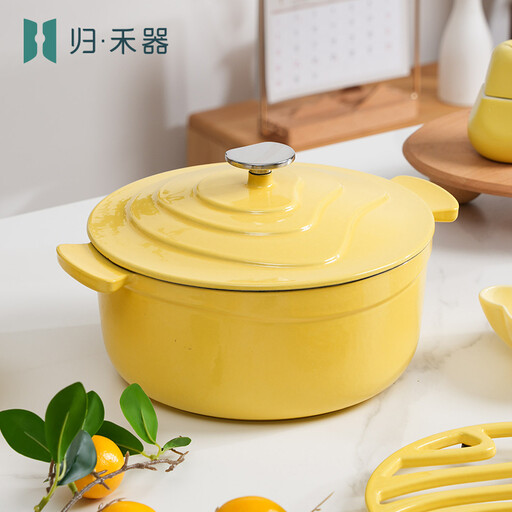
Why This Fits Their Persona: A practical option for households wanting one pot for soup, stew and simmering, without needing a divided layout for every meal.
Its stated 22cm size and 3.3L capacity give clearer guidance than choosing by diameter alone. The flat-bottom design is listed as induction-compatible.
Enamelled cast iron construction; 3.3L capacity; suitable for soup and slow simmering.
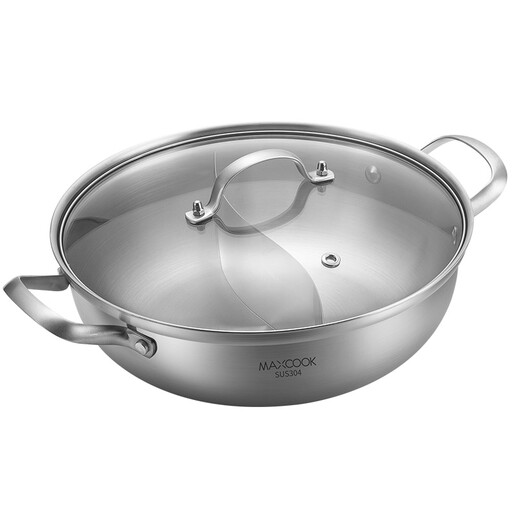
Why This Fits Their Persona: Suitable for shoppers who want separate broths, a glass lid and broad hob compatibility for regular shared meals.
The listing specifies 304 stainless steel, a tri-ply construction, a divided layout and compatibility with induction, gas, electric and ceramic glass hobs.
28cm divided design; glass lid; dishwasher-safe listing; no non-stick coating stated.
Why This Fits Their Persona: The 30cm format suits larger gatherings and frequent hotpot meals where two broths and generous ingredient space are priorities.
Its listed tri-ply 304 stainless-steel construction and thick composite bottom address the common mistake of buying a large pan without checking its base or material specification.
30cm divided cooking surface; dual handles; listed for gas and induction hobs; dishwasher-safe listing.
We have compiled a complete, real-time list of products that fully satisfy these strict selection criteria and UK safety regulations.
Before using a new stainless-steel pan, wash it thoroughly. The MAXCOOK product information notes that black residue may come from polishing wax used during production; it recommends boiling the pot in hot water for five to ten minutes, then wiping it dry. Salt, bicarbonate of soda and washing-up liquid are also suggested for cleaning.
White marks may result from water deposits or food starch. Vinegar or lemon can help loosen these deposits, while rainbow-like discolouration may be treated with edible vinegar or a suitable stainless-steel cleaner. Rinse thoroughly and dry the pan afterwards.
For induction cooking, start at a moderate heat and avoid heating an empty pan for an extended period. When serving at the table, use suitable heat-resistant mats and keep handles positioned away from the edge of the worktop.
Usually, yes, if the product listing specifically states gas compatibility. The MAXCOOK divided models are listed for induction, gas, electric and ceramic glass hobs. Check that the pan sits securely on your burner and that the flame does not extend around the sides.
It can, depending on the base construction, quantity of broth and hob power. A divided pan contains two cooking sections, so each side may hold less liquid than a single-compartment pan. A thick composite or tri-ply base can help distribute heat, but heat settings should still be adjusted gradually.
A dishwasher-safe listing indicates that the product is designed for dishwasher use, but frequent cycles may affect surface brightness over time. For the MAXCOOK models, the product information states that dishwasher use is supported while recommending hand-washing with a soft sponge to help maintain the finish.