Compact-rig drift drivers
You want a wider single-screen cockpit view, but three displays, their mounts and their alignment would be awkward in your room or around your rig.


For a PC drift rig without room for three screens, a 34-inch curved ultrawide is a practical starting point if it fits your setup and your game presents 21:9 correctly. Check your PC’s performance at the intended resolution and the monitor’s connection and refresh options before choosing a faster panel. An OLED model adds manufacturer-rated contrast and response specifications, but its care guidance and warranty terms need a separate check.
You want a wider single-screen cockpit view, but three displays, their mounts and their alignment would be awkward in your room or around your rig.
Fast scene movement makes refresh rate, your PC’s frame rate at the chosen resolution, variable refresh rate (VRR) compatibility and the stated response-time method important checks.
You are weighing an OLED ultrawide’s manufacturer-rated contrast and response specifications against the need to check care guidance and warranty coverage for the exact model.
Start with the space available for the whole monitor, including its stand. If a 34-inch ultrawide will not fit, assess a 16:9 model against your measurements rather than assuming any screen size solves the placement problem; if it will fit, check your game’s 21:9 presentation and your PC’s performance before paying attention to the highest refresh-rate figure.
| Concern | What to check | Who this matters to |
|---|---|---|
| Single-screen view | Check the game’s 21:9 support and field-of-view settings before choosing a curved 3440 × 1440 ultrawide. | I want a wider cockpit view without installing and aligning three screens. Around 36% of consumers put that single-screen view first. |
| Motion and synchronisation | Check achievable game frame rate, refresh rate through your intended connection and VRR compatibility; read whether response time is labelled MPRT or GTG. | When making rapid steering corrections, I care most about how motion looks on my own PC. For around 27% of consumers, smooth motion is the primary concern. |
| Physical fit and setup | Compare available width and depth with dimensions including the stand. For an arm or rig mount, check the exact VESA pattern and supported weight. | My monitor must clear the wheel and fit the desk or rig without a complicated installation. Physical fit comes first for around 27% of consumers. |
| OLED ownership | Read the exact model’s care guidance and UK warranty terms, including whether panel burn-in is covered. | I value OLED image characteristics, but a persistent game HUD makes care and coverage part of my decision. Around 10% of consumers place this trade-off first. |
A single ultrawide removes the centre join and alignment work of a multi-screen installation, but it does not provide the side-screen coverage of triples. Three screens remain an option if that coverage is your priority and you have measured room for the displays, mounts and cables. For a conventional 34-inch ultrawide, manufacturer examples include curved VA and IPS panels; OLED is a further panel choice within the ultrawide route, not an alternative screen layout.
The stand can determine whether a single monitor fits your rig. Gigabyte lists its G34WQC at 808.89 × 488.79 × 234.81 mm including the stand; that is a dimension for this model, not for every 34-inch display.
Measure the placement area and wheel clearance, then use the exact model’s dimensions with its stand. If you plan to mount it, check the monitor’s VESA pattern and the mount’s weight rating.
An arm or rig-mounted stand may be needed if the supplied stand does not suit the available space.
Samsung UK labels the Odyssey G5 G55T LC34G55TWWPXXU at 1 ms MPRT, while LG UK labels the 34GS95QE-B at 0.03 ms GTG. Those figures use different measurement methods and do not establish a like-for-like performance ranking.
Read the method alongside refresh rate and VRR support. If response behaviour is decisive, look for testing of the exact model under comparable conditions.
A monitor’s maximum refresh rate does not tell you the frame rate your PC will deliver in a drift game at 3440 × 1440, or which connection supports the settings you intend to use.
Check performance in your intended game and confirm the monitor, graphics output and cable support the desired resolution and refresh rate together.
Care functions and warranty terms differ by model. ASUS describes OLED Care Pro on its ROG Strix OLED XG34WCDG as a way to reduce burn-in risk, while ASUS UK support directs buyers to the relevant model specifications for warranty coverage.
Read the exact UK warranty wording, check whether burn-in is included and review the recommended care behaviour for your usual HUD and desktop use.
These models illustrate different 34-inch ultrawide specifications; brand inclusion does not mean every model has the same features or ownership terms.
Samsung UK lists the Odyssey G5 G55T LC34G55TWWPXXU as a curved 34-inch, 3440 × 1440 ultrawide with a 165 Hz refresh rate and 1000R curvature.
LG UK lists the UltraGear 34GS95QE-B with a 34-inch 3440 × 1440 OLED panel, 800R curvature, 240 Hz and a 0.03 ms GTG rating.
ASUS ROG lists the Fast IPS XG349C and OLED XG34WCDG as distinct ultrawide routes: the former specifies a 180 Hz overclocked refresh rate, while the latter specifies 175 Hz and a 0.03 ms response rating.
Gigabyte’s G34WQC is a curved 34-inch 3440 × 1440 VA ultrawide with a listed 100 × 100 mm VESA mount.
These single-screen ultrawides are relevant if you are considering a wider display instead of a triple-monitor drift setup. Compare each one with your available space, intended game and PC connections; the LG model here is the 34GX900A-B, not the separate LG 34GS95QE-B discussed above.
 No image available
Consider this single-screen OLED option if its size suits your rig and you want a high-refresh display. The product title specifies a 34-inch OLED WQHD monitor at 240 Hz. Its listing warns of burn-in risk, so check the exact UK care guidance and warranty coverage before choosing it.
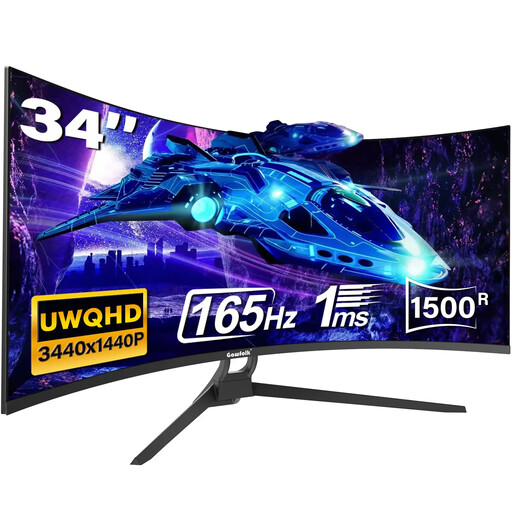 No image available
This is a curved single-screen option for a rig where a three-monitor installation is impractical. The product title specifies a 34-inch 21:9 format, 1500R curvature and 165 Hz. Confirm the exact native resolution and connection capabilities for this variant, then measure its stand before ordering.
 No image available
Consider this single monitor if you are assessing higher refresh rates for your drift setup. Its product title specifies a VA panel, 3440 × 1440 resolution, 200 Hz and DisplayPort 1.4 connections. Check whether your PC and intended connection can deliver the desired resolution and refresh rate together, and confirm dimensions including the base and any VRR requirements.
 No image available
This is another single-monitor option to assess where three screens would complicate placement. Its product title identifies the R34w-30 as a 34-inch UWQHD gaming monitor. Confirm its aspect ratio and dimensions with the stand, as well as the refresh and connection settings you intend to use.
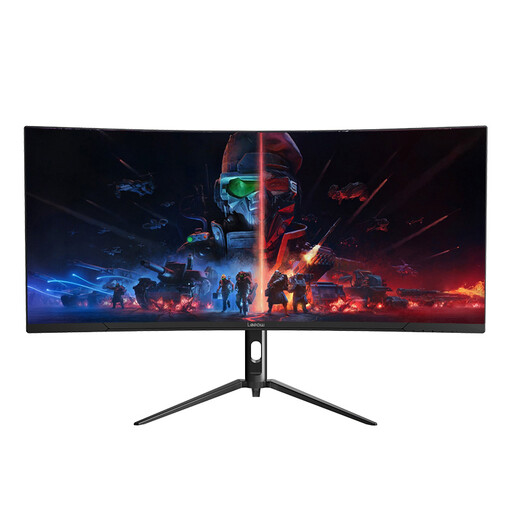 No image available
Consider this curved one-screen format if the display and stand will fit your rig. Its product title specifies 3440 × 1440 resolution and 165 Hz. Check the stand footprint, VRR compatibility and response-time measurement method if those details affect your choice.
A single ultrawide is the simpler layout when you cannot accommodate three screens and their mounts, but it gives up their side-screen coverage. SIMRACINGCOCKPIT.GG describes triple-screen cabling and bezel alignment as setup burdens; measure your available space and decide whether side vision matters more to you than that work.
Measure usable width and depth, wheel clearance and space for cables, then compare those measurements with the exact display’s dimensions including its stand. Gigabyte, for example, lists the G34WQC at 808.89 × 488.79 × 234.81 mm with stand. If you intend to use an arm, check the monitor’s VESA pattern and the arm’s weight capacity.
Not necessarily: the useful refresh rate depends on the frame rate your PC can deliver in your drift game at the intended resolution. Check game performance, the connection needed for the monitor’s stated maximum and VRR compatibility before deciding whether a higher-refresh model is worthwhile for your setup.
Check the exact OLED model’s care instructions and UK burn-in warranty terms before committing to it for prolonged HUD use. ASUS describes OLED Care Pro on its XG34WCDG as burn-in risk mitigation, but that manufacturer claim does not establish identical features or coverage for other OLED monitors.