Daylight script readers
If you read beside windows, outdoors or under strong rehearsal lighting, you need to judge whether a fixed PDF page stays legible at a usable size without losing its page references.


For fixed-layout theatre-script PDFs, start with a document-sized e-paper screen and check whether a full page remains readable in bright daylight without constant zooming. Then choose a device whose annotation and transfer workflow fits your actual scripts: PDF permissions, import methods and note export can matter as much as screen size.
If you read beside windows, outdoors or under strong rehearsal lighting, you need to judge whether a fixed PDF page stays legible at a usable size without losing its page references.
If you mark lines, cues or blocking on the page, check that your script permits annotation and that you can retain or export the marked-up PDF.
If scripts arrive as PDFs alongside other document formats, check accepted files, transfer methods and PDF layout controls before settling on a workflow.
Start by checking a full script page in daylight, then work through the notes, file transfers and lighting conditions your rehearsals require.
| Concern | What to check | Who this matters to |
|---|---|---|
| Daylight reading and page area | Try a fixed-layout script on the e-paper screen at full-page size; check text, margins and page references before relying on zoom. | If I need to follow page references in bright light, I want the whole script page to remain readable without repeatedly enlarging it. Around 36% of consumers put full-page daylight reading first. |
| Notes on the script | Check PDF annotation permissions and whether handwritten notes can be exported with the file. | When I mark cues or blocking, I need those notes on the relevant page and available after rehearsal. Around 29% of consumers make usable script annotation their primary concern. |
| File transfer and layout | Check the formats and import methods you use, plus PDF crop or zoom controls for awkward page layouts. | If revised scripts arrive through different services, I need to open the right version without losing access to its original layout. For around 21% of consumers, handling script files comes first. |
| Carrying and later sessions | Balance device size against the visible PDF page; check how you will read when ambient light fades. | I carry my script reader between sessions and may still need it after daylight fades. Around 14% of consumers prioritise carrying convenience and low-light flexibility. |
A fixed-layout PDF keeps its page design, so small text or wide margins can make frequent zooming necessary on a smaller screen.
Open a representative production script and check full-page text size, page turns, cue references and space for notes.
Rakuten Kobo excludes DRM-protected PDFs and files that disable markup from stylus annotation. Amazon says direct writing on Kindle Scribe PDF pages depends on sending the file through Send to Kindle rather than loading it over USB-C.
Confirm that your script is annotatable and test the same import method you expect to use for rehearsals.
Kindle Scribe cloud-drive transfers are manual, so a newer script in the drive will not simply replace an older copy on the device.
Import each revision deliberately, export marked copies when needed and give files clear revision dates.
UK guidance on waste electrical and electronic equipment addresses recovery, reuse and recycling of devices rather than disposal with general waste.
Keep the retailer’s recycling information and use an appropriate electronics-recycling route when replacing an e-reader.
The newest 11-inch Kindle Scribe is a document-reading route for scripts brought in through Send to Kindle or connected cloud drives.
The 10.3-inch Kobo Elipsa 2E is worth considering when scripts are ordinary PDFs and exporting handwritten notes matters.
The BOOX Go 10.3 range suits readers who need several file formats or more control over the view of a fixed-layout script.
The 11.8-inch reMarkable Paper Pro offers a large document canvas for readers focused on PDF review and markup rather than general-purpose apps.
This document-sized E Ink tablet is a choice to examine for fixed-layout script reading; test your own PDF and note-taking workflow before depending on it in rehearsal.
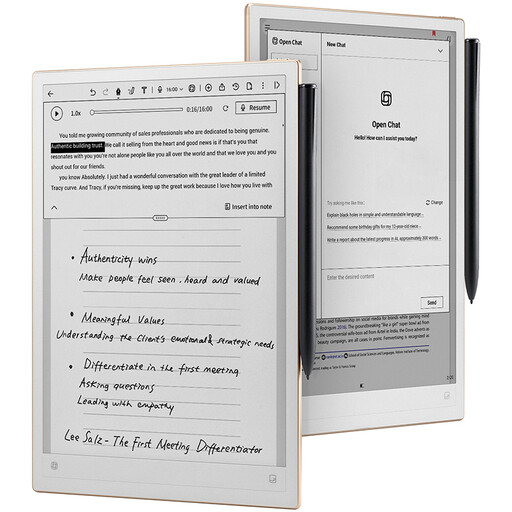 Image unavailable
For theatre-script reading, check how a representative full PDF page appears on its 10.65-inch E Ink screen. This variant is listed with a protective case and a 4.2 mm thickness. Before relying on it for rehearsal notes, confirm on-page PDF annotation, file transfer and export with your own script; plan for adequate ambient light in dim settings.
Start by trying a document-sized screen of around 10.3 inches or larger if seeing a fixed page matters more than pocketability. Amazon UK lists an 11-inch Kindle Scribe, BOOX lists 10.3-inch Go models and reMarkable lists an 11.8-inch Paper Pro, but the right size depends on your script’s text and margins. Check one real page at a comfortable viewing size.
You can on some devices and files, but the file’s permissions and import method matter. Amazon Customer Service says Kindle Scribe permits direct PDF-page writing when the file is sent through Send to Kindle, not loaded by USB-C; Rakuten Kobo excludes protected or annotation-disabled PDFs from stylus markup. Test the actual script before relying on digital rehearsal notes.
Check both how the current script reaches the device and how marked copies leave it. Kindle Scribe supports Google Drive and OneDrive transfers but does not automatically sync those files; BOOX lists several cloud-drive options. If you use reMarkable Paper Pro, its web and USB transfers have a 100 MB file limit, while companion apps can handle larger files.
A front light is not the main reason to choose an e-paper screen for bright daylight; check the display with your script in the light where you will read. It becomes more relevant if rehearsals continue in dim conditions, so confirm the lighting arrangement on the exact model or variant you intend to use.