Choose a flat 34-inch ultrawide if a non-curved reference for straight geometry matters most; consider a curved 39.7-inch 5120 × 2160 model if keeping seam detail, references and tools visible together matters more. In either case, check the colour workflow, your computer’s supported display mode and whether the screen can be positioned comfortably at standing height.
Who this choice affects
Texture and material artists checking continuity
You need room to inspect joins while keeping references or UV tools visible. Dell, LG and BenQ list ultrawides with different native resolutions and colour specifications; choose against the files and colour workflow you use, rather than width alone.
Creators reviewing straight geometry as well as seams
A flat screen may suit you if you prefer a non-curved reference for straight lines. BenQ positions its flat PD3420Q this way, but its distortion and uniformity statements are manufacturer claims, not independent seam-review results.
Standing-desk laptop users
Check screen adjustment, desk or arm capacity and your laptop’s display connection together. The Health and Safety Executive advises placing the top of the screen around eye level and the display about an arm’s length away.
What to check before choosing
Flat 34-inch ultrawide
Choose it when: a non-curved reference for straight geometry takes priority. BenQ lists the PD3420Q at 3440 × 1440 with colour modes and an adjustable stand.
Trade-off: 3440 × 1440 provides fewer desktop pixels than the 5120 × 2160 models listed by Dell and LG; check whether your seam, reference and tool windows still fit.
Curved 39.7-inch 5K2K ultrawide
Choose it when: you want more pixels for an asset, references and editing tools on one display. Dell’s U4025QW and LG’s 40WP95CP-W both list 5120 × 2160.
Trade-off: allow room for the larger screen, confirm a comfortable standing position and decide whether curvature suits your straight-line review.
| Concern |
What to check |
Who this matters to |
| Seam visibility and workspace |
Check native resolution at your intended input mode and whether scaling leaves the interface readable while standing. |
I want the texture, reference and editing controls visible without constantly rearranging windows; around 36% of consumers put working canvas first. |
| Standing-desk fit |
Measure desk depth and check stand adjustment or a compatible arm’s load rating against the monitor. |
If the screen sits too close or too low when I stand, its width will not help me work comfortably; roughly 29% of consumers make physical fit their primary concern. |
| Colour and geometry |
Check the target colour space, available modes and calibration method; decide whether you prefer a flat reference for straight lines. |
I need to judge colour continuity and straight edges in my own workflow, rather than rely on a wide-gamut label; about 21% of consumers prioritise colour and geometry. |
| Laptop connection and setup |
Confirm the laptop and cable support the intended display mode, and check charging and mounting requirements. |
I regularly reconnect a laptop and do not want to plan around a connection it cannot use; around 14% of consumers put docking and setup practicality first. |
Common buying pitfalls
-
Choosing by screen width alone
A wide display still needs to fit at a usable distance and height on the standing desk.
Measure the desk and your standing eye height; check the stand or mounting pattern, monitor weight and rated arm capacity. The Health and Safety Executive advises positioning the top of the screen around eye level and the display about an arm’s length away.
A suitable monitor arm or a different desk setup may be needed to reach that position.
-
Treating wide gamut as proof of accurate seam review
Gamut coverage, stated colour error and uniformity describe different characteristics; none alone establishes the result in your application.
Match the monitor’s colour mode and calibration method to your working colour space and application. LG states that a hardware calibrator is not included with its 40WP95CP-W.
Hardware calibration requires compatible equipment and time to set up the workflow.
-
Assuming any USB-C connection provides every display feature
A connection that charges a laptop does not, by itself, establish support for the intended resolution, refresh mode or daisy chaining.
Check the laptop maker’s display-output documentation and the required cable against the monitor’s ports. Dell says daisy chaining requires Thunderbolt and notes that some M-series chips may not support certain features.
Brands to consider for this setup
Dell
Dell’s UltraSharp curved ultrawides include the U4025QW, a 39.7-inch 5120 × 2160 option for a wide, docked workstation.
- Dell lists 120 Hz, 99% DCI-P3, 100% sRGB, average Delta E below 2, stand adjustment and USB-C Power Delivery up to 90 W for the U4025QW.
- Confirm the laptop’s supported display features; Dell says daisy chaining requires Thunderbolt, and some M-series chips may not support certain features.
LG
LG’s 40WP95CP-W is a curved 39.7-inch 5120 × 2160 option with Thunderbolt 4 for a compatible laptop workstation.
- LG lists typical DCI-P3 coverage of 98%, hardware-calibration readiness and charging up to 96 W.
- LG says a hardware calibrator is not included; check the equipment and workflow you would use for calibration.
BenQ
BenQ’s flat 34-inch PD3420Q offers a non-curved option for creators who also review straight geometry.
- BenQ lists 3440 × 1440, 98% P3, 100% sRGB and Rec.709, average Delta E of 3 or less, 150 mm height adjustment and 100 × 100 mm VESA mounting.
- BenQ’s distortion and uniformity descriptions are its own claims; assess the screen against your geometry and colour workflow.
Joybuy ultrawide options
These 34-inch ultrawides offer options for arranging seam work alongside other windows. Compare their shape, connection requirements and standing-desk fit with the flat and larger 5K2K routes above; a gaming specification does not establish colour accuracy for texture review.
 No image available
Lenovo R34w-30 34-inch UWQHD gaming monitor
Consider this 34-inch ultrawide if you want space for a seam view and nearby tools. Its title identifies UWQHD resolution; check the colour modes and calibration approach for your application, as well as the intended display mode and whether the stand reaches your standing eye height.
View on Joybuy
 No image available
Dahua 34-inch 3440 × 1440 curved VA gaming monitor
The 3440 × 1440 format may suit a seam view beside other work windows if you prefer a curved screen. The title states 200 Hz, 85% DCI-P3 coverage, two HDMI inputs and two DisplayPort 1.4 inputs; the gamut figure does not establish calibrated colour accuracy. Check your colour workflow and whether the screen can be positioned at standing height.
View on Joybuy
 No image available
LG UltraGear 34GX900A-B 34-inch OLED WQHD gaming monitor
Consider this 34-inch OLED ultrawide if its format fits your seam-review layout and you also have a use for its stated 240 Hz refresh rate. Confirm the display mode and colour workflow with your computer. The product information warns of OLED burn-in with static images, so account for prolonged fixed toolbars and use the screen-protection features.
View on Joybuy
 No image available
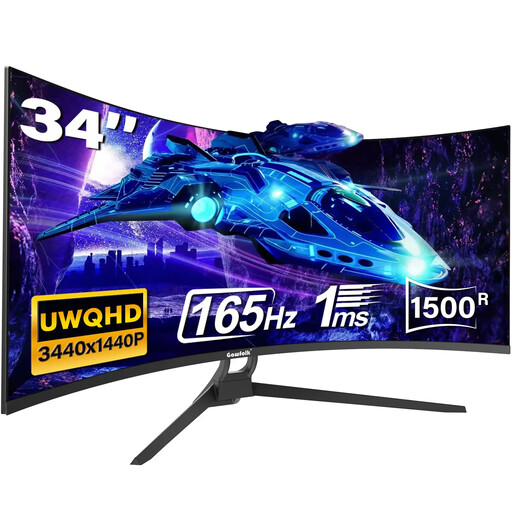
Gawfolk 34-inch 165 Hz curved UWQHD gaming monitor
Its curved 34-inch format and stated 165 Hz refresh rate may suit a workspace shared with other tasks. The product information gives conflicting sRGB coverage figures, so confirm the exact colour specification before using it for colour decisions. Check the required display connection and whether a compatible mount would place it at your standing eye height.
View on Joybuy
 No image available
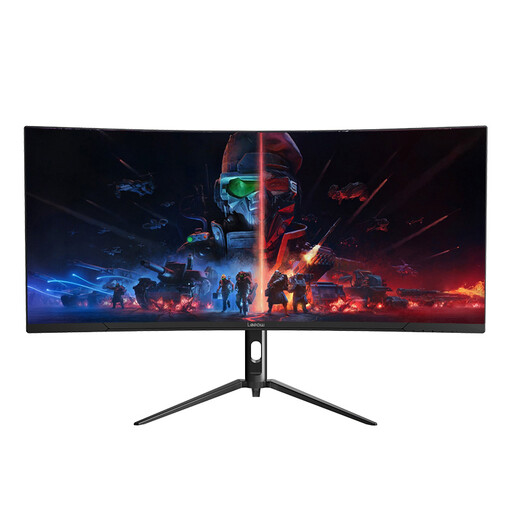
Lepow HC-SJ34MZ5 34-inch curved ultrawide monitor
The stated 3440 × 1440 resolution gives you a wide desktop for seam review alongside other windows. Its title also lists a 165 Hz refresh rate. Check the colour specifications and calibration method for your work, and confirm how the screen can be positioned at standing height.
View on Joybuy
Frequently asked questions
Is a curved ultrawide unsuitable for reviewing texture seams?
No: curvature alone does not settle whether a monitor suits seam review. Dell and LG list curved 5120 × 2160 models that provide more desktop pixels than BenQ’s flat 3440 × 1440 PD3420Q; choose according to your workspace needs and whether you prefer a flat reference for straight geometry. BenQ’s no-distortion wording is a manufacturer claim, not an independent finding about curved screens.
Where should an ultrawide sit on a standing desk?
Place the screen directly in front of you, with its top around eye level and the display about an arm’s length away, following Health and Safety Executive guidance. Check that the supplied stand reaches that position or that a compatible arm and desk can support the monitor.
Will any USB-C cable provide 5K2K video and laptop charging?
No: the connector shape alone does not establish the supported display mode or charging level. Check the exact laptop, cable and monitor specifications; Dell also says daisy chaining requires Thunderbolt and notes limitations for some M-series chips.
Do UK display-screen rules require a particular monitor model?
The Health and Safety Executive’s display-screen guidance focuses on workstation use and positioning rather than naming a monitor model. It says the UK Display Screen Equipment regulations apply to workers who use display-screen equipment daily for continuous periods of an hour or more; for a work setup, assess the screen as part of the whole workstation.


