Shoppers avoiding gluten
An explicitly gluten-free rice cake can be a plain base for toppings at work. Check the current pack for the gluten-free claim and for any other allergens relevant to you.


Choose rice cakes by the exact allergen you need to avoid, not by a general free-from impression: a gluten-free product can still carry a “may contain” statement for milk, soya or sesame. Plain wholegrain cakes offer a straightforward base for a desk lunch, while flavoured, coated and protein-focused options need their own ingredient, allergen and nutrition checks.
An explicitly gluten-free rice cake can be a plain base for toppings at work. Check the current pack for the gluten-free claim and for any other allergens relevant to you.
A gluten-free label does not answer a separate allergen question. For example, Kallo Organic Lightly Salted Rice Cakes and Tesco Free From Wholegrain Rice Cakes both carry precautionary statements naming milk, sesame and soya.
Plain cakes can be paired with a topping that also meets your dietary requirements. If comparing them with a protein-focused product, check the ingredients and compare nutrition using the same per-100 g basis.
Start with the required allergen exclusion, then decide whether you want a plain base for toppings or a flavoured product to eat on its own.
| Priority | What to check | Your needs |
|---|---|---|
| Exact allergen | Read the gluten-free claim, ingredient list and any “may contain” statement on the current pack. The Food Standards Agency states that a UK gluten-free label applies to food containing no more than 20 mg/kg gluten as sold; it does not address every other allergen. | I need the declaration to cover the particular allergen I avoid, whether that is gluten, milk, soya or sesame. |
| Plain base | Compare listed ingredients and salt using the stated serving or per-100 g measure. Tesco Free From Wholegrain Rice Cakes list wholegrain brown rice as the ingredient; M&S Lightly Salted Rice Cakes list wholegrain brown rice and salt. | For lunch at my desk, I would rather choose the topping myself than start with a sweet or strongly flavoured cake. |
| Lunch components | Check a topping separately for ingredients and allergens. If considering a protein-focused cake instead, compare protein and salt per 100 g: M&S lists 24.8 g protein and 0.60 g salt per 100 g for its Barbecue High Protein Rice Cakes. | I want more than a plain rice cake for lunch, so I am deciding between adding a suitable topping and choosing a different recipe. |
| Coatings and flavourings | Treat each flavour as a separate recipe. M&S Dark Chocolate Rice Cakes list soya, carry a milk-allergy warning and list 21.6 g sugars per 100 g. | When I choose a sweet or savoury flavour, I still need to check the full allergen declaration rather than relying on “gluten free” on the front. |
| Storage at work | Follow the chosen pack’s storage and after-opening instructions. M&S instructs shoppers to keep its Lightly Salted Rice Cakes cool and dry and use an airtight container after opening. | I may keep the pack at my desk, so I need a suitable place and a way to close it after lunch. |
Kallo Organic Lightly Salted Rice Cakes are labelled gluten free but may contain milk, sesame and soya. Tesco Free From Wholegrain Rice Cakes carry a similar precautionary statement.
Match both the ingredients and precautionary wording on the current pack to the exact allergen you avoid.
M&S Dark Chocolate Rice Cakes list soya and state that they are not suitable for people with a milk allergy. Their 21.6 g sugars per 100 g also differs from what a shopper might expect of a plain base.
Check coated and flavoured cakes as separate products, including their ingredients, suitability warnings and per-100 g nutrition.
M&S Barbecue High Protein Rice Cakes include ingredients beyond rice, including buckwheat, pea protein and lentil flour. M&S lists 0.60 g salt per 100 g for this product.
Compare the full recipes and nutrition on the same basis, or choose a plain cake with a separately checked topping.
A previous listing cannot establish the ingredients and allergen wording on the pack you are about to use.
Read the physical label when buying, particularly after a substitution, flavour change or packaging update. If an allergy declaration is unclear, do not assume the product is suitable.
These examples illustrate product-specific differences; a brand name or free-from range does not establish the allergen profile of every item it sells.
Kallo’s Organic Lightly Salted Wholegrain Rice Cakes are labelled gluten free and list organic wholegrain brown rice and sea salt.
Tesco Free From Wholegrain Rice Cakes are labelled wheat and gluten free and list wholegrain brown rice as the ingredient.
ASDA Free From Slightly Salted Rice Cakes are listed as gluten free and free from cereals containing gluten.
M&S lists gluten-free rice cakes in plain, protein-focused and chocolate-coated recipes, each requiring its own label check.
Snack a Jacks offers flavoured rice cakes; its Caramel Jumbo product page lists 51 kcal and 3.6 g sugars per cake.
These options cover a lightly salted rice cake for toppings and a lentil cake to consider as an alternative desk-lunch base. Lentil cakes are a different product type, so check their own label rather than applying rice-cake allergen information to them.
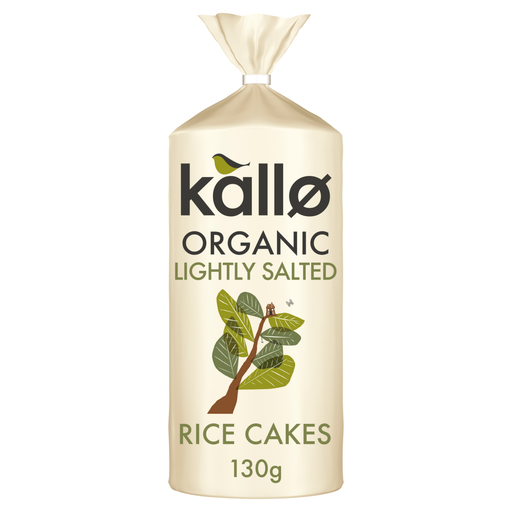 No image available
A plain rice-cake base to consider when choosing your own desk-lunch topping. Kallo lists organic wholegrain brown rice and sea salt for its Organic Lightly Salted product and labels it gluten free. Its precautionary statement says it may contain milk, sesame and soya; check the current pack and your topping separately.
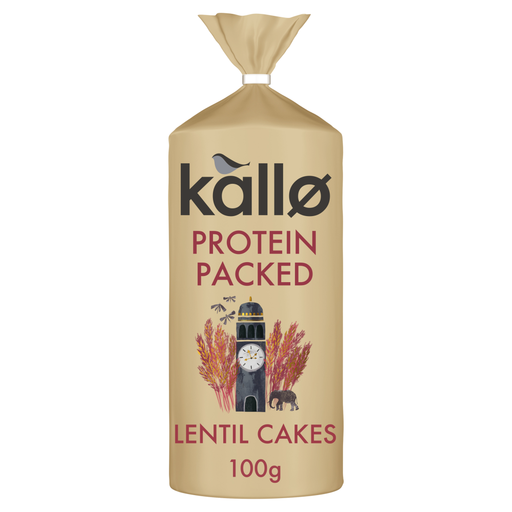 No image available
These lentil cakes are an alternative to rice cakes for a desk lunch, not another plain rice-cake option. If you need a gluten-free product or avoid another named allergen, check this exact pack’s ingredients and allergen declaration before choosing it.
No. The Food Standards Agency states that the UK gluten-free label applies to food with no more than 20 mg/kg gluten as sold; it does not make a claim about milk, soya or sesame. Kallo Organic Lightly Salted Rice Cakes are labelled gluten free but may contain all three, so check the exact pack for the allergens you avoid.
It is a precautionary warning that a named allergen could be unintentionally present, separate from the ingredients list. The Food Standards Agency describes this as the purpose of precautionary allergen labelling; read it alongside the ingredients when deciding whether a product fits your requirements.
Start with a plainly flavoured product bearing the gluten-free claim if you need one, then check its full allergen declaration. Tesco Free From Wholegrain Rice Cakes list wholegrain brown rice as the ingredient, while M&S Lightly Salted Rice Cakes list wholegrain brown rice and salt. Check the topping separately.
Do not infer that from “dark chocolate” or “gluten free”. M&S states that its Dark Chocolate Rice Cakes are not suitable for people with a milk allergy and lists soya among the ingredients. Check the exact product’s current label for the exclusion that matters to you.
Follow that pack’s after-opening instructions. M&S says to keep its Lightly Salted Rice Cakes in a cool, dry place and use an airtight container once opened. Instructions can differ: Tesco’s listing for Nature’s Store Wholegrain Rice Cakes also specifies consuming them within two days of opening.