For a PC racing game that supports ultrawide output, a 34-inch 21:9 monitor is a route to a wider horizontal view without moving to a 49-inch screen. A 27-inch QHD 16:9 monitor is a more straightforward starting point for console use or a conventional desk layout; consider 49-inch 32:9 only after checking the game, PC performance and desk space. Whichever format you choose, make sure you can place the screen directly ahead at a comfortable seated distance.
Who each setup suits
PC racers seeking more horizontal track view
If you want a single screen with more horizontal display area than 16:9, investigate a curved 21:9 monitor. Check that your racing game renders the format properly and that your PC can run its native resolution at settings you find suitable.
Console or mixed-platform circuit learners
If you use Xbox or PS5 alongside, or instead of, a PC, start with the output modes your console and chosen monitor can use together. A QHD 16:9 screen aligns with documented 1440p output; check the HDMI connection, variable refresh rate (VRR) and game support separately.
Seated players working with a fixed desk
If you expect repeated sessions at the same chair and desk, check screen height, stand adjustment and viewing distance before choosing a wider panel. The Health and Safety Executive advises positioning a display directly ahead, with its top around eye level and roughly an arm's length away.
What matters when choosing
27-inch QHD 16:9
Choose it when: A console-compatible format or conventional desk layout matters more than extra horizontal screen area.
Trade-off: It does not provide the wider display area of a 21:9 or 32:9 panel.
34-inch 21:9 ultrawide
Choose it when: Your PC game supports ultrawide output and you want more horizontal screen area on one monitor.
Trade-off: Game rendering and PC frame-rate capability need checking at the monitor's native resolution.
49-inch 32:9 super-ultrawide
Choose it when: You have room for a very wide screen and a PC game that supports the format.
Trade-off: BenQ's sim-racing guidance notes greater graphics demands for 32:9 resolutions than for 3440 × 1440; desk fit needs checking too.
| Concern |
What to check |
Who this matters to |
| Horizontal track view |
Check the game's aspect-ratio support and the monitor's native resolution before choosing 21:9 or 32:9. |
I want more room to see the circuit's approaches and visual references on one screen. Around 33% of consumers put wider track context first. |
| Motion and output |
Match the intended input and cable to its supported refresh mode; check VRR and the game's achievable frame rate. |
As the view moves through corners, I care most about a display mode my gaming device can actually deliver. For around 25% of consumers, achievable motion performance is the primary concern. |
| Console compatibility |
Check the recognised resolution and refresh mode on your Xbox or PS5, plus the monitor's HDMI capabilities. |
If I mainly play on console, I want the image format and output mode to work without relying on PC-only specifications. Conventional-format compatibility comes first for around 25% of consumers. |
| Seated desk fit |
Measure usable desk width and depth, then check stand adjustment or compatible mounting. |
I need the screen centred and at a workable height and distance for repeated sessions. Around 17% of consumers make seated placement their deciding need. |
Checks before you buy
-
Choosing 32:9 before checking the whole setup
A wider panel will not ensure a useful racing-game view if the title does not render 32:9 as expected. BenQ's sim-racing guidance also identifies greater graphics demands at 32:9 resolutions than at 3440 × 1440.
Check the exact game and your PC's likely performance at the intended resolution, then measure desk width and depth.
A graphics-card change or a different desk or mounting arrangement may be needed to make the setup workable.
-
Assuming the headline refresh rate works on every connection
Refresh modes depend on the source device, input and cable. For example, LG says the 200Hz overclock on its 27GS85Q-B requires a DisplayPort 1.4-capable graphics card and cable; that mode should not be treated as a console output feature.
Check the monitor's modes for the port you will use and confirm that your game and source device support the intended output.
You may need a suitable cable or graphics-card connection for a particular mode.
-
Expecting a console to fill an ultrawide screen natively
Xbox's documented 1440p output uses a 16:9 viewing area. A physical 21:9 or 32:9 panel does not, by itself, establish native ultrawide output from a console racing game.
For console-first use, check the console's recognised display mode and how the exact game appears on the monitor before choosing ultrawide for its width.
-
Choosing screen width before checking seated position
A wide display still needs to fit directly ahead at a suitable height and distance. The Health and Safety Executive advises placing the top around eye level and the screen roughly an arm's length away.
Check desk depth, stand adjustment and the monitor's mounting options against your chair position.
If the supplied stand cannot provide the required position, a compatible monitor arm or different stand may be needed.
Relevant brands to consider
Samsung
Samsung's Odyssey G91F illustrates the 49-inch curved 32:9 route for a wide single-screen PC setup.
- Samsung lists 144Hz and FreeSync Premium Pro for the G91F.
- Its stated 1ms grey-to-grey response time comes from Samsung's internal testing; check game support, PC output and desk fit rather than using that figure as a cross-monitor performance comparison.
Alienware
Dell's Alienware AW3426DWM illustrates a 34-inch curved 21:9 PC-monitor route.
- Dell lists 3440 × 1440 at 240Hz and 110mm of stand height adjustment for this model.
- Its 1ms grey-to-grey specification applies in Extreme Mode. Check the racing game's ultrawide rendering and your PC's output capability separately.
LG UltraGear
LG's 27GS85Q-B illustrates a 27-inch QHD 16:9 route for a conventional desktop or compatible console setup.
- LG lists 2560 × 1440 resolution and a native 180Hz refresh rate for this model.
- LG says its optional 200Hz overclock requires a DisplayPort 1.4-capable graphics card and cable; check the mode available from your own device.
Joybuy monitor choices
These monitors offer 34-inch ultrawide, 49-inch super-ultrawide and 27-inch QHD options for the seated setup. Check each candidate against your racing game, gaming device and available desk space.
 No image available
LG UltraGear 34GX900A-B 34-inch OLED monitor
Consider this 34-inch display if you want the ultrawide PC route and your game supports the format. Its product title specifies OLED, WQHD and 240Hz; check the exact game's output and whether your PC can sustain your chosen settings. Consider OLED screen-care requirements for long sessions.
View on Joybuy
 No image available
Dahua 34-inch UWQHD 200Hz curved gaming monitor
Consider this ultrawide option if your PC game supports the format and you want a curved screen for circuit context. The product title specifies 3440 × 1440 resolution, a VA panel, 200Hz and DisplayPort 1.4 connections. Check the refresh mode available through your intended input and cable, as well as desk fit.
View on Joybuy
 No image available
Acer X Predator X49X 49-inch QD-OLED monitor
Consider this 32:9 option only if your PC game supports the format and your desk can accommodate a 49-inch curved screen. The product title specifies QD-OLED, a 1800R curve and 240Hz. Check the native resolution, the refresh mode available on your chosen input and your PC's capability before deciding.
View on Joybuy
 No image available
Lenovo R34w-30 34-inch UWQHD gaming monitor
Consider this 34-inch UWQHD model if you are investigating an ultrawide PC setup. Confirm its exact native resolution, aspect ratio and input-specific refresh modes against your game and PC before choosing it for circuit learning.
View on Joybuy
 No image available
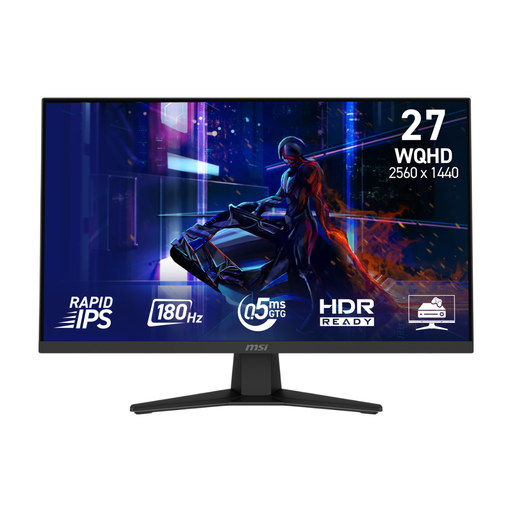
MSI MAG 274QF 27-inch WQHD gaming monitor
Consider this 27-inch WQHD model if you prefer a more compact seated desktop display. Check its aspect ratio if you specifically need 16:9, and confirm the refresh mode available through your chosen input. Check whether its positioning options will place the screen at a comfortable height.
View on Joybuy
Frequently asked questions
Will a console racing game automatically fill a 21:9 or 32:9 monitor?
No. Xbox documents standard 16:9 viewing areas for its 1440p output, so an ultrawide panel alone does not establish native ultrawide console output. Check the exact game and how your console's recognised mode appears on the monitor.
Do I need 240Hz to learn a street circuit?
No specific refresh rate is required simply to learn a circuit. Choose a mode your game, source device, connection and monitor can use together; a monitor's headline refresh figure does not guarantee that mode from every input.
Where should the monitor sit for repeated seated sessions?
Place it directly in front of you at a comfortable distance. The Health and Safety Executive advises keeping the top around eye level and the screen roughly an arm's length away; check that the stand, desk and chair let you achieve that position.
Could a wider monitor call for changes to my PC or cabling?
Yes, depending on the resolution and mode you intend to use. BenQ's sim-racing guidance describes greater graphics demands for 32:9 resolutions than for 3440 × 1440, while LG specifies a DisplayPort 1.4-capable graphics card and cable for the 200Hz overclock on its 27GS85Q-B. Check the requirements of the exact monitor and your PC before choosing either route.


