For virtual-hospital management in a bright room, start with screen reflections, stated typical brightness and enough space to read maps and menus; a headline refresh rate comes later. A flat 27-inch QHD monitor suits a more compact desk, while a 34-inch ultrawide offers more horizontal workspace if the desk and game layout accommodate it. Neither an HDR peak-brightness figure nor an anti-glare label guarantees that small text will remain clear in your room.
Who is this for?
Players in bright rooms
If daylight or lamps reach your desk, readable alerts and small menus matter more than a refresh-rate figure alone. Check the screen finish and typical brightness, and position the display to avoid direct reflections. The Health and Safety Executive also recommends arranging screens and lighting to avoid glare in display-screen work settings.
Map-and-dashboard multitaskers
If you like keeping a hospital map, queues and other panels in view, consider whether a wider screen would help your layout. LG describes its 34-inch 21:9 34G630A-B as providing added screen space; you still need to allow for its wider footprint on the desk.
Players with a mixed game library
If you also play faster games, a high-refresh QHD monitor may serve both uses. Check the refresh rate available through the connection you will actually use: Dell, for example, specifies different DisplayPort and HDMI limits for its G2725D.
What matters when choosing?
Decide whether readable menus in your room or room for more simultaneous panels comes first. Then check desk positioning and the refresh rate your device can output.
| Concern |
What to check |
Who this matters to |
| Bright-room legibility |
Compare the exact model’s stated typical brightness and screen finish; check where windows and lamps will reflect. |
If daylight catches the screen, I need to read small alerts without losing them in reflections. Around 40% of consumers put bright-room legibility first. |
| Workspace for maps and panels |
Compare a 27-inch QHD layout with a 34-inch 21:9 WQHD layout, and measure usable desk width. |
When I keep a map, queues and build controls open, I want space to see them together. For around 30% of consumers, that workspace is the primary need. |
| Smoothness across games |
Check the refresh rate available through your intended input and whether your device supports the mode. |
If I switch from hospital management to faster games, I also care about the monitor’s high-refresh capability. Around 20% of consumers place mixed-game smoothness first. |
| Desk setup |
Check supplied stand adjustment and compatible mounting options against your desk and chair. |
For longer sessions, I need to position the screen comfortably rather than work around a fixed height. Desk adjustability comes first for around 10% of consumers. |
Buying pitfalls
-
Treating an HDR badge as a bright-room guarantee
HDR performance and reflections are different questions. VESA identifies DisplayHDR 400 as a baseline HDR tier; the badge does not tell you how your desk lighting will affect small game menus.
Compare typical brightness and screen finish on the exact monitor, then arrange the screen and lighting to avoid direct reflections.
-
Choosing an ultrawide before measuring the desk
A 34-inch 21:9 display provides a wider canvas than a conventional 27-inch 16:9 display, but also takes up more desk width.
Measure the space available and decide whether you will use the extra width for maps and simultaneous panels.
A different desk layout or monitor arm may be needed if the display does not fit your current setup.
-
Assuming the supplied stand adjusts in height
Stand movement varies by model: BenQ lists 100 mm of height adjustment for the EX2710Q, while ASUS lists no height adjustment for the VG27AQ3A.
Check height, tilt, swivel and mounting specifications for the model you intend to buy.
A compatible arm or riser may be needed if the supplied stand cannot place the screen at a comfortable height.
-
Assuming every input supports the headline refresh rate
Dell specifies up to QHD 180 Hz over DisplayPort but up to QHD 144 Hz over HDMI for the G2725D.
Check both the monitor input and your device’s output before choosing a connection or cable.
Relevant brands to consider
BenQ MOBIUZ
The EX2710Q is a 27-inch QHD option for players considering a matte screen, stand adjustment and an ambient-light feature.
- BenQ specifies a matte 2560 × 1440 panel, 100 mm height adjustment and Brightness Intelligence Plus for this model.
- Its stated typical brightness is 250 nits; BenQ’s separate 400-nit HDR peak figure should not be used as its ordinary desktop-brightness figure.
Dell / Alienware
Dell’s G2725D provides a flat 27-inch QHD Fast IPS comparison point for this bright-room decision.
- Dell states 400 cd/m² typical brightness for the G2725D.
- Dell specifies up to QHD 180 Hz through DisplayPort and QHD 144 Hz through HDMI on that model; check which connection you will use.
ASUS TUF Gaming
The VG27AQ3A is a 27-inch QHD Fast IPS option for a mix of management and faster games.
- ASUS specifies an anti-glare surface and up to 180 Hz refresh rate for the VG27AQ3A.
- ASUS states 250 cd/m² typical brightness and no height adjustment on its supplied stand.
LG UltraGear
The 34G630A-B represents a 34-inch 21:9 WQHD route for players who want more horizontal space for a hospital map and panels.
- LG specifies 3440 × 1440 resolution and describes the format as providing added screen space.
- Measure desk space and assess the model’s screen finish and typical brightness for your room; its DisplayHDR 400 designation does not settle reflection handling.
Joybuy product choices
These monitors cover wide screens for keeping hospital panels in view and smaller QHD screens for a more compact desk. Compare each screen’s finish, typical brightness and physical fit against your bright-room setup before choosing.
 No image available
Dahua 34-inch UWQHD 200 Hz curved gaming monitor
Consider its wide screen if you want hospital maps and panels visible together, provided your desk has room for it.
The product name specifies 3440 × 1440 resolution, a VA panel and 200 Hz. Check the screen finish in your room and confirm the refresh rate available through your intended input.
View on Joybuy
 No image available
Samsung Odyssey G6 S27DG612 27-inch QHD OLED monitor
This smaller format may suit a compact management-game desk that also serves faster games.
The product name specifies QHD OLED and 240 Hz. Check whether the stated typical brightness suits your room; an anti-glare treatment alone does not guarantee readable menus under your lighting.
View on Joybuy
 No image available
LG UltraGear 34GX900A-B 34-inch OLED WQHD monitor
Its ultrawide format is worth considering if you want more room for a hospital map and persistent information panels.
The product name specifies OLED and 240 Hz. Check typical brightness for your room rather than relying on an HDR peak figure. For long sessions with static menus, review the screen-protection settings and the product description’s OLED burn-in warning.
View on Joybuy
 No image available
CRUA 49-inch curved DQHD 165 Hz gaming monitor
Consider this 32:9 screen only if an especially wide hospital dashboard fits both your preferred layout and your desk.
The product name specifies 5120 × 1440 resolution, a VA panel and 165 Hz. Confirm its screen finish and supplied stand’s height range before buying; the product information gives conflicting descriptions of height adjustment. Plan how the large display will be handled and supported during installation.
View on Joybuy
 No image available
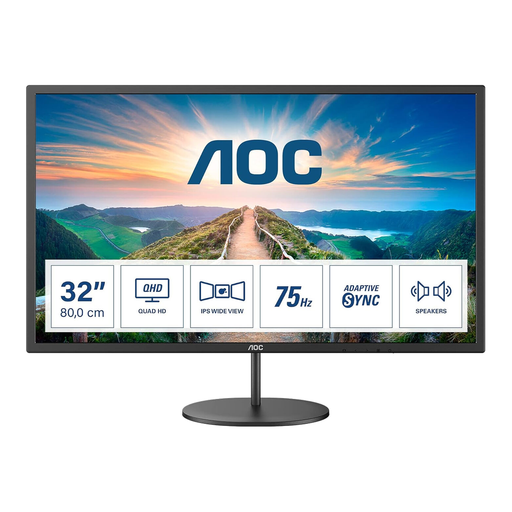
AOC Q32V4 31.5-inch IPS Adaptive-Sync monitor
This general-purpose screen may suit hospital management if you value a larger QHD workspace more than high-refresh gaming.
The product name specifies an IPS panel and Adaptive-Sync. Check the screen finish, typical brightness and supplied stand adjustment against your room and desk before choosing it.
View on Joybuy
Questions and answers
Will DisplayHDR 400 make menus easy to read in a bright room?
No, the badge alone cannot establish bright-room readability. VESA describes DisplayHDR 400 as a baseline HDR tier; for small menus, also check typical brightness and screen finish, and keep direct reflections off the display.
Should I choose a 34-inch ultrawide or a 27-inch QHD monitor?
Choose the wider format if keeping maps and multiple panels in view matters most and your desk can accommodate it. A 27-inch QHD monitor is a more compact route; whichever format you prefer, assess its particular screen finish and typical brightness for your lighting.
Do HDMI and DisplayPort give the same refresh rate?
Not necessarily: the available rate depends on the monitor and connection. Dell specifies up to QHD 180 Hz over DisplayPort 1.4 and QHD 144 Hz over HDMI 2.1 for the G2725D, so check your chosen monitor and device outputs before assuming you can use the headline rate.
How can I make a bright-room setup more comfortable for long sessions?
Place the monitor and lighting so windows and lamps do not reflect directly in the screen, then check that the stand or a compatible mount lets you position it comfortably. The Health and Safety Executive gives reflection-control advice for display-screen work settings; it does not prescribe a particular monitor for recreational gaming.


