Replay-detail reviewers
If you pause and compare tournament moments, footage detail, room for review controls and a practical screen position may matter more to you than the highest advertised refresh rate.


Start with a 27-inch QHD IPS monitor if you review standard 16:9 tournament footage and also want a screen for high-refresh play; check its stand and choose a refresh rate your source device can deliver. Consider a higher-refresh QHD model when fast live play is a substantial part of the same setup, or an ultrawide when space for a timeline and notes matters more than matching the footage frame. Check the exact monitor’s headphone output and your headset connection separately.
If you pause and compare tournament moments, footage detail, room for review controls and a practical screen position may matter more to you than the highest advertised refresh rate.
If the screen serves both replay review and fast live play, a high-refresh QHD model is worth considering when your connected hardware can output the mode you intend to use.
If you review quietly, decide whether your headphones will connect to the monitor or directly to the PC or console. An analogue monitor output is a different connection from USB or wireless audio.
Choose when: You want a 16:9 QHD frame for replay review and also use the screen for high-refresh play.
Keep in mind: The higher modes can be conditional: LG UK specifies 180Hz normally for the 27GS85Q-B, with 200Hz requiring a DisplayPort 1.4-capable graphics card and cable.
Choose when: Fast live play is a substantial part of the setup and your hardware can deliver the intended QHD output.
Keep in mind: A higher panel refresh rate cannot add frames to recorded footage; confirm the usable mode rather than relying on the headline rate.
Choose when: Keeping footage, a timeline and notes visible side by side is central to your review work.
Keep in mind: A 21:9 screen does not match a standard 16:9 footage frame, so plan how you will use the space beside the video.
| Concern | Buying checks | Who this matters to |
|---|---|---|
| Footage detail and workspace | Check native resolution, aspect ratio and stand adjustment; decide whether review windows need space beside the video. | When I pause on a small detail, I need to see the footage clearly while arranging my review tools. Around 36% of consumers put footage detail and workspace first. |
| Motion and dual-use play | Compare native and conditional refresh modes, then check the QHD output available from your device and connection. | If I also play fast matches on this screen, I want its refresh capability to be usable with my setup. For around 36% of consumers, motion and dual-use play are the primary concern. |
| Headphone routing | Identify whether your headset uses 3.5mm, USB or wireless; check the exact monitor output and source-device audio settings. | I want to review quietly without discovering that my headset needs a different connection. Headphone routing comes first for around 28% of consumers. |
A headphone socket is model-specific, and it does not establish that a USB or wireless headset can connect through the monitor.
Check the exact model’s audio-output specification, your headset connector and how the selected PC or console sends audio.
LG UK lists the 27GS85Q-B at 180Hz normally; its 200Hz mode requires a DisplayPort 1.4-capable graphics card and cable.
Choose on the basis of a mode your setup can use, then check every stated condition if the higher rate matters to you.
A 3440×1440 workspace gives you room beside a 16:9 video, but the footage will not fill the wider shape without changing its framing.
Work out where the player, timeline and notes will sit, and check that the screen fits your desk.
For applicable UK distance sales, GOV.UK says traders must tell customers they can cancel up to 14 days after delivery without giving a reason. Change-of-mind cancellation is separate from remedies for faulty or misdescribed goods.
Check the seller’s delivery arrangements, cancellation instructions and return-postage terms, and keep a record of the exact model ordered.
The EX2710Q is a reference point for a 27-inch QHD IPS review-and-play setup where an analogue headphone connection and stand adjustment matter.
LG’s documented models illustrate different QHD refresh rates and a model-specific headphone connection.
Dell UK’s Alienware specifications provide examples for comparing a standard QHD gaming screen with a wider review workspace.
These models cover standard-format QHD screens and wider ultrawide layouts for a combined review-and-play desk. Check headphone connectivity on the exact model, particularly if you want to plug analogue headphones into the monitor.
 No image available
Consider the 34-inch ultrawide layout if you want review controls or notes beside the footage.
The product name specifies OLED, WQHD and 240Hz. A 21:9 layout differs from standard 16:9 footage framing; check how you will use the side space and whether your source supports your intended display mode.
The listing warns that the OLED screen is susceptible to burn-in. Check its screen-protection guidance if static controls or menus will remain visible for long sessions.
 No image available
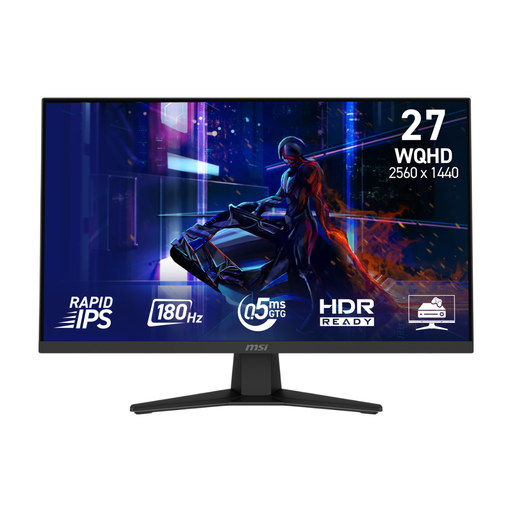
Consider this standard-format QHD option for reviewing footage and using the same desk for gaming.
The product name specifies a 27-inch WQHD Rapid IPS screen and 180Hz. The listing gives 180Hz via DisplayPort but 144Hz via HDMI, so choose the connection with your source device in mind.
If screen height or monitor-connected headphones are important, check the exact stand adjustment and audio connection before ordering.
 No image available
Consider the wider screen if a timeline or other review windows need to remain beside the footage.
The product name specifies 3440×1440, a VA panel and 200Hz. The listing specifies 100Hz over HDMI at 3440×1440; check which connection delivers the mode you intend to use.
Plan for 16:9 footage within the wider layout. If you want to connect analogue headphones to the monitor, confirm what its listed audio output accepts.
 No image available
Consider this QHD model if the screen also needs to serve fast live play alongside footage review.
The product name specifies a 27-inch QHD OLED display at 240Hz. Confirm that your source and connection can deliver your intended resolution and refresh rate.
If your headphones must connect to the monitor, check the exact model’s audio outputs before choosing it.
 No image available
Consider this standard-format QHD option if you also want a high-refresh screen for live play.
The product name specifies a 26.5-inch 2560×1440 QD-OLED display at 240Hz. Check that your source supports the display mode you intend to use.
Confirm the stand adjustments you need and whether the exact model has a suitable headphone output; built-in speakers alone do not answer the headphone question.
No: a higher monitor refresh rate cannot add frames to a recording. Consider 240–280Hz QHD if you also play fast games and your source can output the intended mode; otherwise, assess a lower-refresh QHD model against your review workflow.
No: a monitor headphone socket is an analogue connection, while USB and wireless headsets generally use their own connection to the PC or console. Check your headset type, the exact monitor output and the source device’s audio-routing settings.
LG UK specifies a DisplayPort 1.4-capable graphics card and DisplayPort 1.4 cable for the 27GS85Q-B’s 200Hz mode; it lists 180Hz as the normal supported rate. Check your source hardware before making the higher mode a deciding factor.
Check the exact model, delivery arrangements, cancellation instructions and return-postage terms before ordering. For applicable distance sales, GOV.UK says traders must tell customers they can cancel up to 14 days after delivery without giving a reason; remedies for faulty or misdescribed goods are a separate matter.