Cockpit-view ultrawide shoppers
If you want flight and trading interfaces spread across a 21:9 view, start by considering a 34-inch ultrawide and checking that it fits your desk.


Choose a 34-inch 3440×1440 ultrawide if a broad cockpit view is your priority, or a 32-inch 4K monitor if you spend more of the session reading maps, cargo screens and small interface text. A 45-inch 5120×2160 ultrawide is another option if your desk, viewing position and PC suit its size and native resolution; for any of these choices, check how you will position the screen during a long session.
If you want flight and trading interfaces spread across a 21:9 view, start by considering a 34-inch ultrawide and checking that it fits your desk.
If you spend much of a session reading maps, cargo screens and station interfaces, compare the detail offered by 32-inch 4K and 45-inch 5120×2160 displays with the wider-view alternatives.
If screen placement is a deciding factor, measure your desk and check the stand or mounting options before choosing a large curved display. The Health and Safety Executive advises positioning a screen about an arm’s length away, with its top level with your eyes.
Decide whether cockpit width or interface detail matters more to you, then check the refresh mode your PC can use and where the monitor will sit.
Choose it when: You want a broad cockpit layout without moving to a 45-inch screen.
Trade-off: The 3440×1440 models discussed here have fewer pixels than the 4K and 5120×2160 options.
Choose it when: You want a much larger single-screen flight and trading layout and have room to position it.
Trade-off: Check desk depth and whether your PC can run games at the chosen model’s 5120×2160 native resolution.
Choose it when: Maps, text and interface detail take priority over a panoramic layout.
Trade-off: Its 16:9 shape does not give you the lateral width of a 21:9 monitor; check gaming performance at 4K on your PC.
| Concern | Buying checks | Who it matters to |
|---|---|---|
| Cockpit width | Check the aspect ratio, physical width, desk depth and whether your game supports the intended ultrawide resolution. | I want room across the screen for flight and trading interfaces, but still need the monitor to fit my desk. Around 36% of consumers put cockpit width first. |
| Interface detail | Compare native resolution and the display’s size; check how maps and text look at the scaling you intend to use. | When I spend a long route reading maps and cargo screens, clear small text matters more to me than extra width. Roughly 29% of consumers prioritise interface detail. |
| Smooth flight | Check the resolution and refresh rate supported through your chosen port, plus graphics-card and variable-refresh compatibility. | I notice motion most while docking or moving the camera, so I want a refresh mode my PC can actually use. Around 21% of consumers make smooth flight their primary concern. |
| Screen position | Measure usable desk space and check stand adjustment or VESA mounting against your seated position. | For a long session, I need the screen at a workable height and distance, even if that limits the size I choose. Approximately 14% of consumers put physical setup first. |
AOC lists 4ms grey-to-grey (GtG) and a separate 1ms moving-picture response time (MPRT) for the CU34G2XE/BK. The labels describe different measurements, so the smaller figure alone is not a sound comparison.
Compare figures with the same measurement label and check the stated test conditions before using response time to choose between monitors.
The available refresh rate can depend on the connector and resolution. Acer, for example, specifies up to 3440×1440 at 165Hz through DisplayPort for the Nitro XZ342CU P, but up to 100Hz at that resolution through HDMI.
Check the exact monitor mode alongside your graphics output and cable before ordering.
A large screen needs a usable viewing position as well as enough desk space. The Health and Safety Executive advises placing a display about an arm’s length away, with its top level with your eyes.
Measure the desk’s usable width and depth, then check the stand footprint, height adjustment and mounting options for the model you want.
AOC’s CU34G2XE/BK is a conventional curved VA option for a 34-inch ultrawide setup.
The AW3425DW is a 34-inch-class QD-OLED ultrawide for shoppers considering high refresh alongside a 21:9 view.
The 45GX950A-B is a large OLED ultrawide to consider if both desk placement and PC capability suit the display.
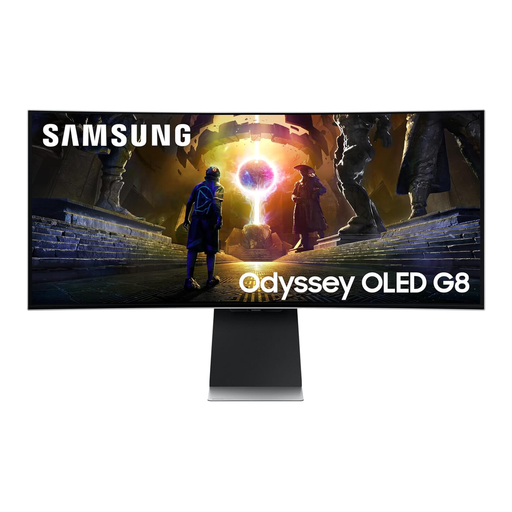
The 32-inch Odyssey OLED G8 G80SH is a 4K QD-OLED route for shoppers who favour interface detail over an ultrawide shape.
The Nitro XZ342CU P is a curved 34-inch VA option with positioning adjustments to check against a long-session desk setup.
These choices include ultrawide monitors for a broad cockpit view and a 32-inch monitor for shoppers considering 4K interface detail. Check each model’s connection modes and physical fit against your own setup.
 No image available
Consider this model if you want an ultrawide cockpit view with a stated high refresh rate.
WQHD OLED display; 240Hz. For persistent game interfaces during long sessions, consider the listing’s OLED burn-in warning and screen-protection advice. Check the resolution and refresh mode supported by your PC connection.
 No image available
This curved ultrawide suits a shopper who prioritises a broad game and interface layout.
WQHD display; 175Hz stated refresh rate. Check the supported mode for your chosen connection and leave enough room to position the screen.
 No image available
Its ultrawide format is relevant if cockpit width is your main reason for changing monitors.
200Hz stated refresh rate; 1ms MPRT; two HDMI and two DisplayPort 1.4 inputs. Check the refresh rate available through the port you intend to use.
 No image available
Consider this 32-inch option if map and interface detail matter more to you than an ultrawide layout.
Check its supported resolution and refresh mode with your graphics output, and confirm that the stand can place the screen where you need it.
 No image available
This 34-inch option is worth checking if you want an ultrawide gaming setup for flight and trading screens.
Confirm the resolution and refresh mode available through your intended connection, and check how the screen and stand fit your desk.
Choose a 34-inch 3440×1440 ultrawide for a broad 21:9 cockpit layout, or a 32-inch 4K monitor if maps, text and interface detail matter more than extra horizontal width. Check that your game and PC support the resolution and refresh mode you plan to use.
The Health and Safety Executive advises placing a display about an arm’s length away, with its top level with your eyes. Measure desk depth before choosing a large curved screen, and check height adjustment or compatible VESA mounting if the supplied stand will not give you a suitable position.
Not necessarily: supported resolution and refresh combinations depend on the model and connection. Acer specifies up to 3440×1440 at 165Hz through DisplayPort for the Nitro XZ342CU P, but up to 100Hz at that resolution through HDMI. Check the exact monitor mode, graphics output and cable before buying.