Immersion-first virtual racers
You want a broad, curved driving view. Check that your game supports 21:9, your system can run your preferred settings at 3440 × 1440 and your desk has room for the screen.


A curved 21:9 monitor suits long virtual-kart sessions if you want a wider driving view and your game, desk and system can accommodate it. Choose a fast 16:9 display if you prefer a conventional layout; consider OLED if its response specifications matter to you and you are willing to follow the exact model’s panel-care guidance. Whichever format you choose, check the refresh rate available through your connection and plan for comfortable screen positioning.
You want a broad, curved driving view. Check that your game supports 21:9, your system can run your preferred settings at 3440 × 1440 and your desk has room for the screen.
You notice tearing or uneven motion in fast racing scenes. Match the monitor’s refresh-rate and adaptive-sync options to the output port, cable and device you will use.
You need a screen position that works with your seat and lighting. Consider stand adjustment or mounting, manage reflections and make room for breaks rather than relying on display settings alone.
For long virtual-kart sessions, choose your screen format alongside the connection and physical setup: a refresh-rate specification is useful only if your device can deliver the mode you intend to use.
Consider it when: You prefer a conventional game layout or cannot accommodate a wide screen.
Trade-off: It does not provide the horizontal screen space of a 21:9 ultrawide; check its stand and viewing position for your setup.
Consider it when: You want a curved ultrawide layout without making an OLED panel a requirement.
Trade-off: Refresh modes vary by model and input: BenQ lists 144 Hz through DisplayPort and 120 Hz through HDMI for the EX3410R.
Consider it when: A wide driving layout and the fast stated response specifications of models such as the LG 34GS95QE-B matter to you.
Trade-off: Static racing displays make model-specific panel care worth reviewing; Dell documents Pixel Refresh guidance for its AW3423DWF.
| Concern | What to check | Who this matters to |
|---|---|---|
| Wider driving view | Confirm 21:9 game support and space for the screen; consider your system’s performance at 3440 × 1440. | I want a broad view while racing, but only if the game displays it as intended. Around 31% of consumers put that wider driving view first. |
| Smooth motion | Check the native-resolution refresh mode by input and compatible variable refresh rate on your device. | Fast turns make uneven motion distracting, so I care most about a mode my system can sustain. For around 25% of consumers, smooth motion is the primary need. |
| Long-session setup | Check stand adjustment or mounting options and how you can position the screen away from reflections. | I need the display to sit comfortably within my seating and lighting arrangement over a long session. That setup is the first priority for around 25% of consumers. |
| System and panel-care fit | Match the source device, port and cable to the intended mode; for OLED, read the exact model’s care and warranty guidance. | I do not want to choose a display mode I cannot use or an OLED care routine I will not follow. Around 19% of consumers place this fit ahead of the other concerns. |
A monitor can offer different maximum modes through HDMI and DisplayPort. BenQ specifies 144 Hz through DisplayPort and 120 Hz through HDMI for the EX3410R.
Before choosing, match your device’s output, cable and the monitor’s input to the resolution and refresh rate you want.
An ultrawide screen gives you more horizontal display space, but that alone does not establish how a particular game renders its driving view.
Check the game’s aspect-ratio options, your system’s performance at the intended resolution and the space available on your desk.
Stand adjustment and display settings cannot correct an awkward screen position or distracting reflections. The Health and Safety Executive’s display-screen guidance also addresses workstation arrangement and glare.
Check the adjustment range or mounting options, position the screen for your seat and lighting, and take breaks during long sessions.
Persistent interface elements make the exact monitor’s panel-care instructions relevant. Dell documents Pixel Refresh for the AW3423DWF; ASUS describes its PG34WCDM heatsink as a burn-in risk-management feature, not protection that eliminates the risk.
Read the model-specific care and warranty guidance before deciding whether an OLED ultrawide suits your usage.
LG’s 34GS95QE-B is a reference point for a curved 34-inch 21:9 OLED racing setup.
The ROG Swift OLED PG34WCDM is a curved ultrawide option for buyers also considering desk connectivity.
The EX3410R offers a curved 34-inch VA ultrawide route with physical stand adjustment.
Dell’s AW3423DWF provides a QD-OLED ultrawide specification reference rather than an availability recommendation.
These choices include curved ultrawide monitors for a wider racing layout and a 16:9 option for a conventional layout. Compare each model’s stated features with your game, connection and desk setup rather than assuming the formats will suit the same needs.
 No image available
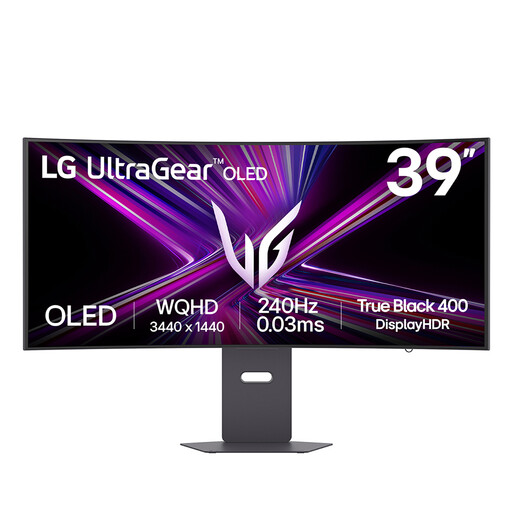
Consider this larger screen if a wide racing display fits your desk and viewing position. The product name states QHD and 240 Hz; check the exact resolution, available mode through your connection and OLED care guidance before choosing it.
 No image available
Consider this 34-inch option if you want an ultrawide racing layout. Confirm the game’s display support and check the refresh mode available through your intended device, input and cable.
 No image available
Consider this 34-inch OLED option if an ultrawide racing view suits your game and setup. The product name states WQHD and 240 Hz; confirm the mode available through your connection and review care guidance for static racing displays.
 No image available
Consider this curved ultrawide if you have room for a 34-inch racing display. Its product name specifies 3440 × 1440 and 200 Hz; check the refresh mode for your chosen input and confirm adaptive-sync compatibility if you need variable refresh rate.
 No image available
Consider this 16:9 option if you prefer a conventional racing-game layout to an ultrawide view. Its product name lists dual 240 Hz and 480 Hz modes and AMD FreeSync Premium Pro; check which resolution, mode and connection your system can use.
No. A 21:9 monitor suits you if you want the wider layout and your game supports the aspect ratio. Check your desk space and system performance at the monitor’s native resolution before choosing one.
Not necessarily: choose a refresh mode your device can use at the resolution you intend to play. VESA’s AdaptiveSync Display programme addresses gaming refresh-rate and latency performance, but a monitor’s maximum mode still depends on the source device and connection.
The available refresh rate can differ by input. BenQ UK lists 144 Hz through DisplayPort and 120 Hz through HDMI for the EX3410R, while Dell UK lists 165 Hz and 100 Hz respectively for the AW3423DWF. Check the exact monitor mode against your device and cable.
Yes, if you are willing to follow the exact model’s panel-care guidance and accept its limitations for static content. Dell documents Pixel Refresh for the AW3423DWF; ASUS describes burn-in risk reduction for the PG34WCDM, not elimination of that risk.
Choose a monitor you can position appropriately for your seat and lighting, then take breaks during extended play. The Health and Safety Executive’s display-screen guidance addresses glare and workstation arrangement; monitor comfort settings do not replace a workable physical setup.