What to check when choosing
Start with the device supplying the game and whether removing its charger is possible. Then decide how much screen detail, device switching and refresh rate matter for the way you play.
| Concern | What to check | Who this matters to |
|---|
| Laptop charging through the monitor |
Confirm USB-C video mode, Power Delivery wattage and the laptop and cable requirements; check whether the stated output needs a monitor setting. |
I want to use my laptop without occupying another socket with its charger, but only if one cable can carry both video and enough power. Around 40% of consumers put that single-cable need first. |
| Space-game image detail |
Compare native resolution, panel type, HDR specifications and screen size at your viewing distance. |
When I explore detailed scenery and dark environments, the picture matters more to me than a higher refresh-rate number alone. Roughly 30% of consumers prioritise those visual details. |
| Several connected devices |
Check the required HDMI, DisplayPort and USB-C connections, plus KVM support if you plan to share a keyboard and mouse. |
I switch between a laptop and another gaming device and would rather manage their connections than repeatedly change cables. Around 20% of consumers place device switching first. |
| High-refresh PC play |
Compare native resolution, refresh rate and variable refresh rate (VRR) support with the output your PC can provide. |
If I favour fast PC play, I may accept QHD rather than make 4K my priority; that does not itself free a socket. Roughly 10% of consumers put high-refresh play first. |
Joybuy monitors for these setups
These monitors cover both laptop setups where USB-C charging is a consideration and desktop or console setups using conventional video connections. Choose by the connections your device needs; screen resolution and shape are separate decisions from whether a laptop charger can be removed.
 No image available
Acer X Predator X49X 49-inch QD-OLED ultrawide monitor
Consider its wide format if you have room for a 49-inch screen; confirm USB-C video and charging compatibility with your laptop before planning to remove its charger.
The product title specifies a 32:9 aspect ratio, 1800R curve and 240 Hz refresh rate. Its wide format is a different choice from a conventional 4K screen.
View on Joybuy
 No image available
Dahua 32-inch curved 4K OLED gaming monitor, 165 Hz
Its stated Type-C 65 W output makes laptop charging worth checking, but confirm that the port carries the video mode your laptop needs and that 65 W meets its charging requirement.
The product title specifies 3840 × 2160 resolution, 165 Hz and a USB hub. The monitor still needs a mains socket.
View on Joybuy
 No image available
Samsung Odyssey G6 S27DG612 27-inch QHD OLED monitor
Consider this QHD display for a gaming PC or console setup, while checking the exact connections required by your device. Confirm USB-C video and charging functions separately if replacing a laptop charger is your aim.
The product title specifies a 240 Hz refresh rate.
View on Joybuy
 No image available
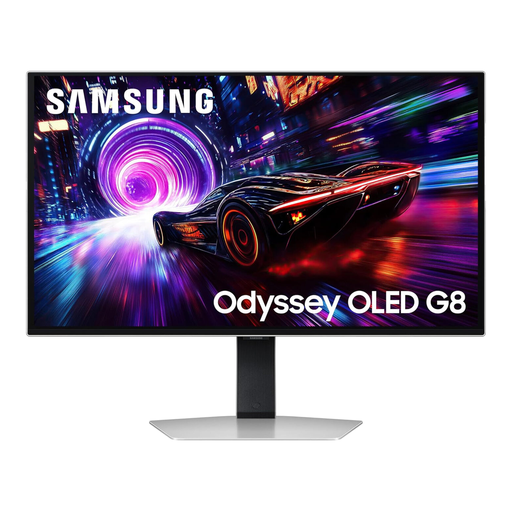
Samsung Odyssey OLED LS32FG810SUXXU 32-inch monitor
For a desktop or console setup, check that the connections on the exact LS32FG810SUXXU variant match your devices. If laptop charger consolidation matters, confirm its USB-C video and Power Delivery capabilities before relying on them.
View on Joybuy
 No image available
Dahua 34-inch UWQHD curved gaming monitor, 200 Hz
Consider the ultrawide format if it fits your desk and your PC or console has a suitable video connection. Check USB-C video and charging separately if you need the monitor to replace a laptop charger.
The product title specifies 3440 × 1440 resolution, a VA panel, two HDMI inputs and two DisplayPort 1.4 inputs.
View on Joybuy
Common questions
Can a USB-C gaming monitor free up a plug socket?
It can remove the need to plug in a separate laptop charger if the laptop accepts USB-C charging and the monitor and cable can supply the required video and power. The monitor itself still needs a socket. ASUS states that its ROG Swift OLED PG32UCDMZ defaults to 65 W Power Delivery and requires an on-screen setting for its 90 W mode; BenQ UK specifies 90 W for the EX321UZ.
Is 15 W USB-C Power Delivery enough to replace a gaming laptop charger?
Do not rely on 15 W for that purpose without checking the laptop manufacturer’s USB-C charging requirements. The Joybuy listing describes the Alienware AW3225QF’s 15 W USB-C output as charging for secondary devices, rather than establishing that it can power your laptop.
Can I use an extension lead instead of changing my monitor setup?
An extension lead can provide more outlets, but the connected load must stay within its marked rating. Electrical Safety First advises using only one extension device per wall socket and not connecting extension leads to one another. A suitable lead does not change whether your laptop and monitor can share a USB-C video and charging connection.
What should I do with an old monitor in the UK?
Check a suitable electrical-equipment collection or take-back route rather than putting the monitor in ordinary household waste. GOV.UK identifies the Waste Electrical and Electronic Equipment Regulations 2013, as amended, as the basis of UK rules encouraging recovery, reuse and recycling; check your local authority’s collection options or the retailer’s arrangements.


