Control-focused new pilots
If reading cockpit labels and keybind prompts is your priority, assess a QHD 16:9 monitor alongside your PC’s performance. LG’s 27GS85Q-B is one example with QHD resolution and adaptive-sync support.


Start with a 27-inch QHD 16:9 monitor if you want room to read cockpit controls without choosing 4K resolution. A 34-inch ultrawide offers more horizontal space but needs more desk space and graphics capacity; choose 4K when finer detail justifies its greater graphics load for your PC. If you plan to connect headphones to the monitor, check the exact model’s audio output rather than assuming one is fitted.
If reading cockpit labels and keybind prompts is your priority, assess a QHD 16:9 monitor alongside your PC’s performance. LG’s 27GS85Q-B is one example with QHD resolution and adaptive-sync support.
If you want more horizontal room for cockpit panels, maps or reference windows, consider a 21:9 ultrawide once you have checked desk fit and how your game handles that format. Dell and BenQ specify 3440×1440 models in this size range.
If fine image detail leads your decision, consider 4K after checking your GPU and preferred game settings. Roberts Space Industries notes that Star Citizen performance can also vary with location, server population, background applications and network conditions.
Decide whether readable controls, a wider view or finer detail matters most, then check the PC connection and where your headphones will plug in.
| Concern | What to check | Who this matters to |
|---|---|---|
| Readable controls | Compare native resolution with your GPU and intended game settings; check whether the desired refresh mode needs a particular port or cable. | I need to read prompts and cockpit displays without taking on more graphics load than my PC can manage. Around 36% of consumers put that resolution-and-performance balance first. |
| Horizontal space | Check desk dimensions, game behaviour at 21:9 and PC performance at 3440×1440. | I want room across the screen for cockpit panels and navigation information, and I can accommodate a wider display. For around 21% of consumers, that workspace is the primary concern. |
| Fine detail | Check performance at 3840×2160 and the exact model’s connection requirements; for OLED, read its care guidance. | I care most about finely rendered scenery and interface elements, even if that places greater demands on my PC. That is the leading need for around 29% of consumers. |
| Headphone connection | Confirm whether the exact monitor has audio output and whether your chosen source connection sends audio to it. | I want a straightforward place to connect my headphones and do not want to rely on speakers I will not use. Around 14% of consumers make that connection their first priority. |
A monitor’s refresh specification is not an in-game frame-rate promise. LG says the optional 200Hz mode on its 27GS85Q-B requires a DisplayPort 1.4-capable graphics card and cable; Roberts Space Industries also notes that Star Citizen performance varies with game and system conditions.
Check your graphics output, cable and intended game resolution before choosing a high-refresh mode.
A 3440×1440 screen needs more horizontal desk space and has more pixels to render than 2560×1440. The cited Alienware and BenQ models also have different panel and refresh specifications.
Measure your desk, check the game at 21:9 and compare the exact model’s input-specific refresh limits.
Audio connections are model-specific: BenQ lists a headphone jack for the EX3410R, while Dell’s specifications for the earlier AW3423DWF distinguish its headphone or audio output from its lack of built-in speakers.
Choose whether headphones will connect to the PC, another source device or the monitor, then check the exact model’s audio specification and routing.
Samsung describes panel-protection features for its G80SD, but those manufacturer claims are not an assurance for every pattern of use with static cockpit elements.
Read the exact OLED model’s care and warranty guidance before planning extended control-heavy sessions.
The 27GS85Q-B illustrates a conventional 27-inch QHD IPS option for learners considering a 16:9 screen.
Dell’s AW3425DW illustrates a 34-inch-class, 3440×1440 QD-OLED ultrawide for buyers prioritising a wider view.
Samsung’s G80SD illustrates a 32-inch 4K QD-OLED route for buyers considering finer detail.
BenQ’s EX3410R illustrates a 34-inch curved VA ultrawide with a specified headphone jack.
These choices span conventional QHD and 4K screens and wider ultrawides. Compare each one with your PC, desk and preferred headphone connection rather than treating one format as suitable for every setup.
 No image available
Consider this 16:9 option if you want 4K detail in a 27-inch format and can check your PC’s performance at that resolution.
The product name specifies dual 240Hz/480Hz modes, DisplayPort 2.1 and HDMI 2.1. Check which resolution, graphics output and cable are needed for the mode you intend to use; if headphones will connect at the monitor, confirm that its output suits your headset.
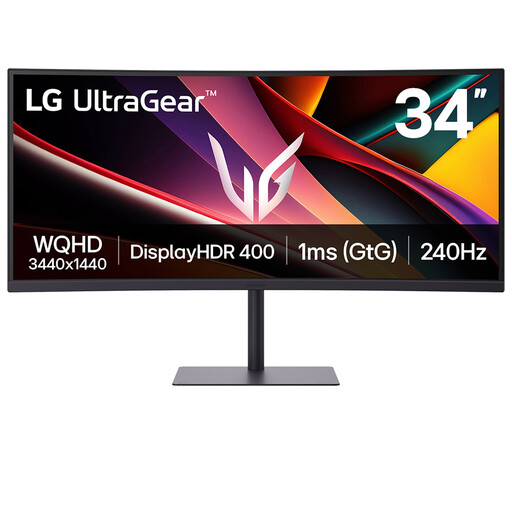 No image available
Consider this wider screen if horizontal cockpit space matters most and your desk can accommodate a 34-inch monitor.
The product name specifies 240Hz. Check performance at the intended ultrawide resolution, the connection needed for your preferred refresh rate and how your headphones will connect.
 No image available
This is an ultrawide OLED option to assess if a wider cockpit view is a priority and your desk and PC suit the format.
The product name specifies 240Hz. Check game performance at your chosen resolution and read the exact model’s OLED care guidance for sessions with static cockpit elements.
 No image available
Consider its 21:9 format if you need horizontal space for cockpit information and can accommodate the screen on your desk.
The product name specifies 200Hz and two HDMI and two DisplayPort 1.4 inputs. Check the refresh limit for the input you will use, and confirm the audio-output connector before relying on monitor-side headphones.
 No image available
Its 2560×1440 format is worth considering if you want a conventional 16:9 screen for reading controls.
The product name specifies 220Hz. Before planning your setup around that rate or a monitor-side headphone connection, check the input-specific refresh limit and the exact model’s audio outputs.
Choose QHD 16:9 if readable controls and manageable graphics demand lead your decision; choose 3440×1440 ultrawide for horizontal cockpit space, or 4K when finer detail matters and your PC can run the game acceptably at that resolution. Roberts Space Industries notes that Star Citizen performance can vary with location, server population, background applications and network conditions.
No: 240Hz describes a monitor capability, not the frame rate your simulator will deliver. Match your target resolution and refresh mode to your PC, port and cable; AMD and NVIDIA describe their respective compatible variable-refresh technologies as ways to address visual disruption when frame rates vary.
Yes, if the exact monitor has a suitable audio output and your source sends audio to it. BenQ lists a headphone jack for the EX3410R, but connections vary by model; otherwise, check whether connecting to your PC or another source device suits your setup.
Check the markings and requirements applicable to the exact monitor, and plan to use an electrical-equipment collection route when disposing of it. GOV.UK says Great Britain continues to recognise CE marking alongside UKCA marking for products covered by its guidance; its waste electrical and electronic equipment guidance addresses recovery, reuse and recycling. Ask your retailer or local authority about available collection arrangements.