Dedicated virtual-climb riders
You have a fixed trainer position and want the route, climbing metrics and workout prompts visible on one display. A wider screen is relevant if the room has space for it.


Start with the device running your virtual-cycling app: its graphics capability and output connection affect which resolution and refresh rate you can use. A 34-inch ultrawide is worth considering for a fixed room where you want the route and ride information on one wide screen; a 16:9 monitor suits a more compact setup. If you choose OLED for repeated sessions with persistent ride data on screen, check the exact model’s panel-care instructions as well.
You have a fixed trainer position and want the route, climbing metrics and workout prompts visible on one display. A wider screen is relevant if the room has space for it.
You need a monitor that works with the computer already running your cycling app. Zwift Support notes that graphics quality and frame rate depend heavily on the graphics processor, so check the computer before choosing a demanding display mode.
You are considering an OLED display but expect ride data to remain in similar positions through repeated sessions. Check the exact model’s screen-care instructions and warranty conditions alongside its display specifications.
For a dedicated virtual-climbing room, settle the screen format against your existing ride device, then plan where the display will sit in front of the trainer.
Choose it when: you have room for a fixed, wide screen showing the route alongside ride information.
Trade-off: a 3440 × 1440 display needs a suitable graphics output, and stand adjustment varies by model.
Choose it when: you want an ultrawide format and are specifically comparing OLED display characteristics.
Trade-off: repeated display of persistent ride information makes the exact model’s OLED-care instructions important.
Choose it when: a more compact screen fits your trainer position better, or you want to consider a lower-resolution QHD option for your existing computer.
Trade-off: you give up the wider 21:9 workspace; the usable resolution and refresh rate still depend on your device and connection.
| Concern | What to check | Who this matters to |
|---|---|---|
| Route view and ride data | Compare a 34-inch, 21:9 screen with a 16:9 layout; measure the available width and viewing distance. | I want the climb and my ride information visible together without arranging a second display. Around 36% of consumers choosing a monitor for this dedicated-room use put the wide single-screen view first. |
| Ride-device compatibility | Identify the device and graphics processor running the app; check its output and the monitor’s supported mode on the port you will use. | If I am keeping my current computer, I need a display mode it can run acceptably. Device fit is the primary concern for around 29% of consumers making this choice. |
| Long-session panel care | For OLED, read the exact model’s image-retention guidance, care functions and warranty terms. | With ride data staying on screen through repeated sessions, I would want to understand the panel-care routine before choosing OLED. Around 21% of consumers put this consideration first. |
| Positioning and mounting | Check stand adjustment, screen dimensions and the exact VESA mount pattern against the planned trainer position. | I need the screen at a comfortable height in front of the trainer, not simply one that fits on the desk. For around 14% of consumers, positioning is the main priority. |
A high-resolution monitor cannot improve the computer’s rendering performance. Zwift Support says a lower-end graphics processor may affect visual quality and frame rate; Dell UK’s AW3423DWF specification also illustrates that supported refresh rates can differ between DisplayPort and HDMI.
Check your device, graphics processor, output port and cable, then compare them with the exact monitor’s supported resolution and refresh modes.
Stand options differ: BenQ specifies 100 mm of height adjustment for the EX3410R, while the listed Samsung Odyssey G55T specification states that it has no height adjustment.
Measure the intended screen position and check the exact model’s stand movement, VESA pattern, weight and mounting-hardware requirements.
If the supplied stand cannot reach the required height, a compatible monitor arm or mount may be needed.
Ride metrics and other interface elements may stay in similar places on screen. LG describes Screen Move, Screen Saver and Image Cleaning as afterimage and burn-in prevention measures for its 34GS95QE-W; do not assume another model has identical functions.
Follow the care instructions for the OLED monitor you choose, and read its model-specific warranty terms before ordering.
Samsung’s Odyssey G55T is a reference point for a 34-inch curved VA ultrawide in a fixed trainer setup.
The EX3410R is a 34-inch VA ultrawide to examine when connection limits and physical adjustment both matter.
LG’s 34GS95QE-B provides a model-specific reference for a 34-inch, 21:9 OLED ultrawide.
Dell’s AW3423DWF is a useful model-specific reference when comparing ultrawide connections with compact 16:9 options.
These 34-inch ultrawide monitors suit a fixed trainer-room layout where you want a wide route view and space for ride information. Choose between them by checking your device connection, screen position and, for the OLED model, panel-care requirements; a compact 16:9 monitor remains another route if width is the constraint.
 No image available
Consider this wide screen for a fixed trainer position where the route and ride data need to share one display.
The product name specifies 3440 × 1440 resolution, a VA panel and a 200 Hz refresh rate. Check which refresh mode your device can use through the intended connection.
 No image available
Consider this model if you want an ultrawide display and need to plan around both your connection and screen position.
The product name states 3440 × 1440 resolution, up to 175 Hz through DisplayPort and 100 Hz through HDMI, plus height, swivel and tilt adjustment. Confirm the exact model’s other display characteristics before relying on them.
 No image available
Consider this OLED model if panel choice matters to you alongside an ultrawide route view.
Its product name states a 240 Hz refresh rate. For repeated sessions with persistent ride data, follow the 34GX900A-B’s own screen-care instructions and check its warranty and supported modes for your connection.
 No image available
Consider this 34-inch ultrawide for a planned, fixed trainer position.
Check the R34w-30’s supported resolution and refresh mode on your chosen connection, as well as whether its stand places the screen at the height you need.
 No image available
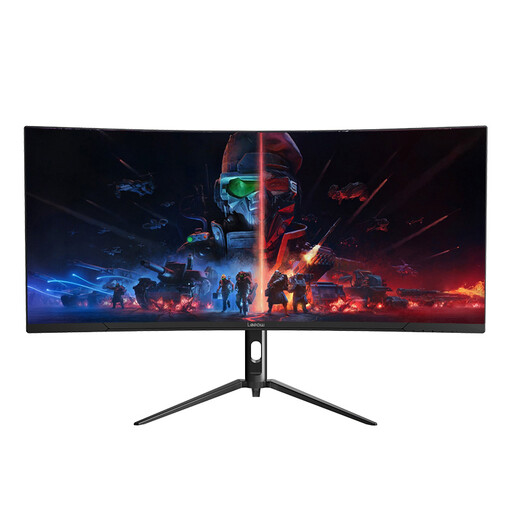
Consider this model if a wide screen for the virtual route and ride information is your main requirement.
The product name specifies 3440 × 1440 resolution and a 165 Hz refresh rate. Check the supported mode for your device and connection, and confirm the stand’s adjustment range against your trainer position.
No: choose a refresh rate your ride device can use at the resolution you want, rather than treating 240 Hz as a requirement. Zwift Support says graphics quality and frame rate depend heavily on the graphics processor; check your device, port, cable and the monitor’s connection-specific modes together.
Yes, if you want the virtual route and ride information on one wide display and have room to position it comfortably. Samsung UK and BenQ UK specify 34-inch, 3440 × 1440 models, but you should measure the space and confirm that your ride device can use the resolution before choosing one.
Read the exact monitor’s panel-care instructions and warranty terms, particularly if ride data remains in similar positions on screen. LG describes Screen Move, Screen Saver and Image Cleaning for its 34GS95QE-W; check the features of the model you are actually buying rather than assuming they are identical across OLED monitors.
Check an electrical-equipment recycling route rather than putting the monitor in general rubbish. UK government guidance on waste electrical and electronic equipment addresses recovery, reuse and recycling; your local authority or retailer can tell you which collection or take-back arrangements are available to you.