Snackers prioritising protein
You want a crunchy snack whose protein content holds up when checked against its energy value, not simply a product that contains some protein.


If protein is the deciding factor, consider a lentil-and-corn cake rather than assuming a familiar puffed maize snack meets the high-protein benchmark: the specific Wotsits, Monster Munch and Quavers variants compared here do not. Kallo’s own Protein Packed Lentil Cakes listing gives 26 g protein per 100 g, but a similarly named Joybuy listing describes a different formulation, so check the exact pack before applying those nutrition figures. If flavour and the familiar puffed texture matter more, compare portions, salt and allergens as well as protein.
The useful starting point is whether protein, dietary suitability or a familiar snack texture matters most for your TV night.
You want a crunchy snack whose protein content holds up when checked against its energy value, not simply a product that contains some protein.
You may be looking for a product labelled vegan or gluten-free, while still needing to read the exact pack’s ingredients and allergen warnings.
You prefer the texture and flavours of Wotsits, Monster Munch or Quavers, and want to know how the checked variants compare when protein is part of the decision.
Start with protein and energy on the same per-100 g basis, then look at the amount you expect to eat. A lentil-led cake, a sharing mix and a puffed maize snack can serve different preferences even when all contain maize or corn.
| Priority | What to check | Your needs |
|---|---|---|
| Protein claim | Compare protein and energy per 100 g. The annex to Regulation (EC) No 1924/2006 published on legislation.gov.uk gives 20% of food energy from protein as the criterion for a high-protein claim; grams of protein × 4 kcal ÷ total kcal gives the protein-energy share. | If protein is my main reason for choosing the snack, I want to check that share rather than judge it by its maize content or product name. |
| Portion size | Read the protein figure for the stated portion or individual cake, as well as per 100 g. Tesco lists about four portions in its 100 g Graze Marmite Crunch sharing bag. | For a bowl in front of the TV, I want to know what the amount I plan to eat contains—not mistake a whole sharing bag for one portion. |
| Salt and energy | Compare salt and energy using the same per-100 g or per-portion basis. Tesco lists 1.1 g salt per 100 g for Graze Marmite Crunch; the figure for the amount eaten depends on portion size. | I might have more than one portion, so protein alone does not tell me enough about the snack I am choosing. |
| Ingredients and allergens | Check the current ingredients, suitability declarations and contains or may-contain statements for the exact product. Kallo’s own listings give differing cross-contact warnings for its Protein Packed Lentil Cakes. | If I avoid particular ingredients or allergens, I need the declaration on the pack I am buying; a lentil base or vegan label is not a substitute for that check. |
Protein grams alone do not show what proportion of a snack’s energy comes from protein. Walkers’ published figures for the checked Wotsits, Monster Munch and Quavers variants differ, but none of those variants meets the 20%-of-energy benchmark used here.
Use protein and energy figures for the same quantity when comparing packs, and keep the conclusion specific to the flavour whose label you checked.
Tesco lists 3.8 g protein per 25 g portion for Graze Marmite Crunch and about four portions in the bag. The per-100 g figure describes a different amount of food.
Decide roughly how much you intend to put in a bowl, then compare the per-portion and per-100 g nutrition information on that basis.
Kallo’s listings warn of possible cross-contact for its lentil cakes, while allergen declarations differ between the checked Walkers flavours. A suitability description does not replace the product-specific warning.
Read the current pack for the exact flavour and size, particularly if milk, gluten-containing cereals, soya, sesame or mustard are relevant to you.
Joybuy’s listing for Kallo Protein Packed Lentil Cakes describes 48% lentil flour and 9% pea protein, while Kallo’s own product page describes 85% lentil flour. The similarly named listings should not be treated as interchangeable nutrition panels.
Check the ingredients, nutrition and allergen information for the version you are buying before using figures from another listing to make the decision.
These examples show how particular product lines differ; the figures and suitability statements do not apply to every snack from each brand.
Kallo’s Protein Packed Lentil Cakes are lentil-led cakes containing corn flour, rather than conventional puffed maize snacks.
Graze Marmite Crunch is a broad-bean-and-corn sharing mix, offering a different format from both lentil cakes and puffed maize snacks.
Walkers produces the checked Wotsits, Monster Munch and Quavers variants for readers who prefer those familiar snack formats.
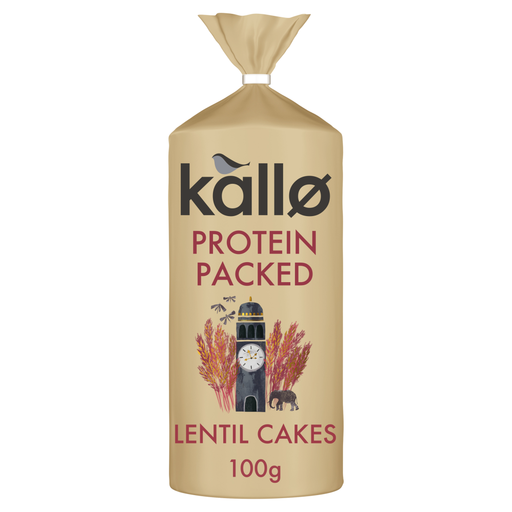
This lentil cake is an option if you are open to a crisp snack containing corn flour instead of a familiar puffed maize snack. Check its own pack details rather than applying nutrition figures from Kallo’s differently formulated listing.
 No image available
A crisp lentil-cake format for a TV night when you want an alternative to puffed maize snacks. Joybuy’s listing describes lentil flour (48%), corn flour and pea protein (9%). Kallo’s own page describes a different formulation, so check the current pack’s protein, portion and allergen information before comparing the two.
The benchmark used here is at least 20% of food energy from protein, the criterion for a high-protein claim given in the annex to Regulation (EC) No 1924/2006 published on legislation.gov.uk. Compare protein and energy for the same quantity of food; grams of protein × 4 kcal ÷ total kcal gives the protein-energy percentage.
The specific variants compared here do not meet the 20%-of-energy benchmark. Walkers lists 9.0 g protein per 100 g for Wotsits Crispy Bacon, 8.0 g for Wotsits Cheese Toastie, 6.0 g for Monster Munch Pickled Onion and 2.5 g for Quavers Cheese. Check the label of any other flavour rather than extending these figures across the ranges.
Not necessarily. Tesco lists about four 25 g portions in its 100 g Graze Marmite Crunch bag, with 3.8 g protein per stated portion. Use the portion you expect to eat when comparing it with a cake or an individual snack pack.
No. Read the ingredients and contains or may-contain statement on the exact pack. Kallo’s product page says its Protein Packed Lentil Cakes may contain sesame and soya, while its shop listing also warns of possible milk cross-contact; the checked Walkers flavours have different declarations from one another.