
24/7 Customer Support

Free returns

Same-day & Next-day Delivery

Quality Guaranteed

Unlock Your Welcome Offers: FREE Delivery | Up to 80% OFF | Free 30-day JoyPlus trial
Download the APP
Choosing Bluetooth speakers can look straightforward until marketing terms, battery estimates and water-resistance ratings make the comparison confusing. A compact model may suit a kitchen shelf but sound underpowered for a garden gathering, while a powerful tabletop speaker may be inconvenient to carry between rooms.
For UK buyers, the sensible approach is to match the speaker with its main use, then check the specifications that affect everyday performance.
A larger wattage figure does not automatically mean clearer music or stronger bass. Output depends on the driver arrangement, amplifier design, cabinet and digital signal processing. A speaker with a separate tweeter and mid-bass driver may produce a more balanced presentation than a higher-rated model using a single full-range driver.
Also check whether the listing specifies RMS output, which describes continuous power more usefully than an unspecified “peak” figure.
“Up to” battery life is normally measured under particular conditions, often at moderate volume. Higher volume, bass modes, lighting, Wi-Fi and Bluetooth use can reduce practical playtime. Buyers looking for speakers with long battery life should check the stated capacity, charging connection and whether the battery is built in.
Water resistance is not a general description. Look for an IP rating, and check what its two digits mean. For example, IP67 indicates dust protection and temporary immersion resistance under specified conditions. Ports must be sealed correctly, and water-resistant speakers should not be charged while wet. A model with no stated rating should be treated as suitable for dry environments only.
For a desk, bedroom or small living room, compact desktop speakers may provide more separation than a single portable unit. Two-speaker systems can create a left and right soundstage, while tabletop speakers generally prioritise convenience and a fuller cabinet sound.
The Edifier M60, for example, uses a 3-inch mid-bass driver and 1-inch tweeter per speaker, with a stated 66W RMS total output. Its two-way active crossover and bundled angled stands are relevant features for a desktop listening position.
For stronger low frequencies, look for a dedicated mid-bass driver, passive radiator or bass-reflex design. These features can support Bluetooth speakers with strong bass, although placement near a wall or corner will also affect the result.
Bluetooth 5.3 or later can offer modern connectivity, but the version alone does not determine sound quality. Codec support and the source device matter too. LDAC, for example, is supported by some Android devices and is not universally available across phones, tablets or computers.
If you plan to connect a PC, monitor, projector or turntable preamp, check for USB-C, AUX or USB inputs. Wired connections can be useful when low latency matters for gaming or when you want to avoid relying on a wireless connection.
Consider how often the speaker will move. A handle, loop or compact footprint can matter more than a small difference in weight. For commuting, a mini speaker such as the Mifa A1 measures approximately 85 × 46 × 86mm and weighs around 175g. For louder outdoor use, a larger enclosure may provide more acoustic headroom but take up more room in a bag.
Check the manufacturer’s stated playtime, charging method and protection rating together. A speaker advertised for outdoor use is not necessarily suitable for heavy rain unless the IP specification supports it.
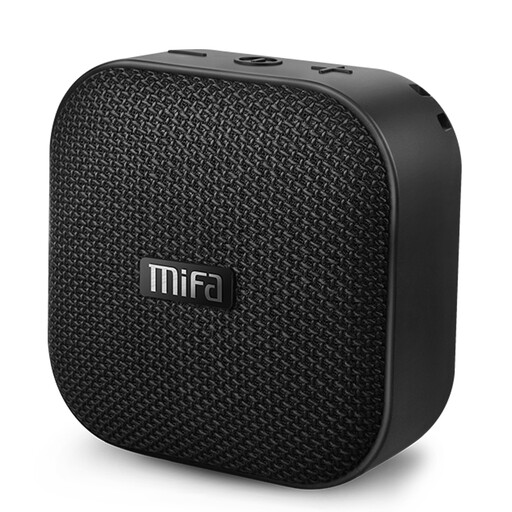
Why This Fits Their Persona: Its compact format suits first-time buyers, commuters and anyone wanting a small speaker for a bedroom, kitchen or day trip.
The listing provides physical dimensions, weight and a stated waterproof design rather than relying only on vague outdoor wording.
AUX input, Micro-SD support, hands-free microphone and auto-reconnect function.

Why This Fits Their Persona: A suitable match for listeners prioritising desktop clarity, high-resolution playback and a tidy stereo arrangement for music, films or office use.
Its specification identifies RMS output, driver sizes, Bluetooth 5.3, LDAC, USB-C and AUX, making the main performance factors easier to compare.
Hi-Res Audio certification for wired and wireless transmission, plus 15-degree aluminium stands and touch controls.
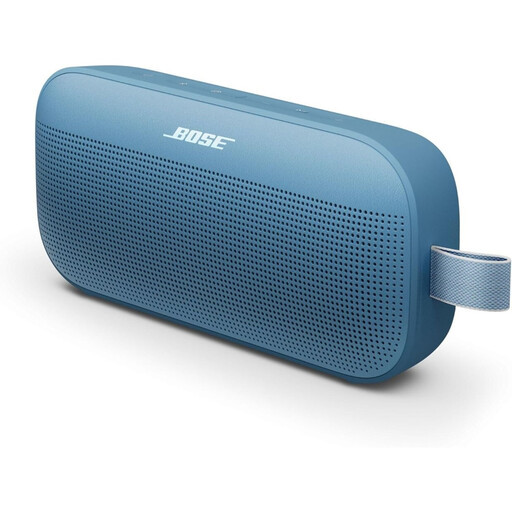
Why This Fits Their Persona: Designed for buyers who regularly move between home, parks, beaches and travel, and need a speaker with stated dust and water protection.
The product specification states an IP67 rating, dust protection, floating design and a 12-hour stated playtime.
Bluetooth 5.3, adjustable EQ through the app, an integrated utility loop and stereo or party pairing.
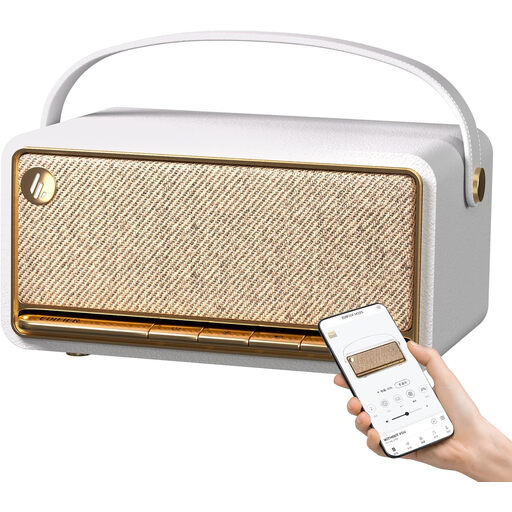
Why This Fits Their Persona: Its handle and multiple input options suit users who want one speaker for indoor listening, gatherings and occasional outdoor use.
The listing gives a specific 19-hour playtime condition at 50% volume, helping set a more realistic expectation than an unqualified battery claim.
40W RMS output, 360-degree audio, Bluetooth multipoint, AUX, USB-C and TF card support.
Use the following checklist before ordering:
We have compiled a complete, real-time list of products that fully satisfy these strict selection criteria and UK safety regulations.
Yes, provided the design matches the desk. A pair of compact desktop speakers can create clearer left-right separation, while a tabletop speaker saves space and can be moved more easily. Check whether the model includes USB, AUX or low-latency options if you use it with a computer.
Battery lifespan depends on charging cycles, storage temperature, listening volume and care. Keep the speaker away from excessive heat, avoid using damaged cables and follow the supplied charging guidance. Water-resistant models should be dried before charging.
They typically use modest power compared with larger wired audio systems, but consumption varies by amplifier output, volume, lighting and Wi-Fi features. For frequent listening at home, a tabletop or desktop model connected to mains power may be more convenient than repeatedly charging a portable unit.