
24/7 Customer Support

Free returns

Same-day & Next-day Delivery

Quality Guaranteed

Unlock Your Welcome Offers: FREE Delivery | Up to 80% OFF | Free 30-day JoyPlus trial
Download the APP
Changing a wheel at home is straightforward when the socket fits correctly. The wrong tool, however, can round a wheel nut, scratch an alloy rim or fail under the force of an impact wrench. For UK motorists, a suitable 1/2-inch impact socket set for lug nuts should match the vehicle’s nut sizes, the available drive tools and the condition of the wheels.
The product description alone does not tell the whole story. These are three common buying traps to avoid.
A standard chrome socket is not automatically suitable for an impact wrench. Impact tools deliver rapid torque changes, so the socket should be made for impact use and clearly identified as such. Ordinary hand-tool sockets may be more prone to cracking or premature wear when used with powered equipment.
Look for heat-treated Cr-Mo steel, often written as Chrome Molybdenum steel, rather than choosing purely by drive size.
A metal socket can mark painted, chrome or alloy wheels, particularly when grit becomes trapped between the socket and the wheel nut. A brightly coloured finish does not necessarily mean the socket is non-marring.
For delicate finishes, consider protective lug nut sockets with an outer plastic sleeve and an internal plastic insert. These features can help reduce direct metal-to-wheel contact, but they still require careful cleaning and full seating before use.
Many UK cars use metric wheel nuts, but the required size varies by vehicle and may differ between factory and aftermarket wheels. A set containing 17mm, 19mm and 21mm impact sockets covers several common applications, but it should not be treated as a guarantee of compatibility.
Check the vehicle handbook, existing wheel-nut size or the manufacturer’s specification before ordering. Also consider whether deep recesses require thin-wall impact sockets or an extended design.
A 1/2-inch drive is widely used with automotive breaker bars, torque wrenches, air tools and cordless impact wrenches. Confirm that the tool’s anvil accepts a 1/2-inch square drive and that the socket’s length suits the wheel.
An extended 86mm socket can help reach recessed wheel nuts, while a 3-inch extension rod may be useful when access is awkward. However, an extension can alter handling and clearance, so keep the socket fully aligned with the fastener.
For common passenger-car applications, check whether the set includes 17mm, 19mm and 21mm impact sockets. Some mixed sets also include imperial sizes such as 3/4", 13/16", 7/8" and 15/16", which may be useful for older vehicles, commercial vehicles or non-standard fasteners.
A flip-style design can provide two sizes in one socket, reducing storage space. The trade-off is that a dedicated three-piece metric set may be quicker to identify when most of your work involves modern cars.
Cr-Mo impact sockets are designed to handle the repeated loading associated with impact tools. A six-point profile generally contacts the flat sides of a wheel nut rather than its corners, helping reduce slipping when the size is correct.
Laser-etched markings and colour coding make selection faster in a busy garage. A storage case or rail also prevents sockets from rolling around with metal swarf and road grit. Before each use, inspect protective sleeves and inserts for cracks, and remove debris that could scratch a wheel.
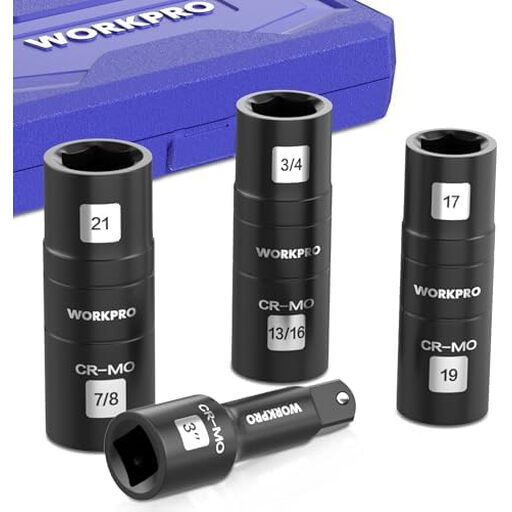
Why This Fits Their Persona: A practical choice for occasional driveway tyre changes, with metric and SAE coverage in a compact blue storage box.
It is made from heat-treated Cr-Mo steel and includes clearly marked 17mm, 19mm, 21mm, 3/4", 13/16" and 7/8" sizes.
Flip-style sockets reduce the number of separate pieces, while the 3-inch extension rod helps with access.
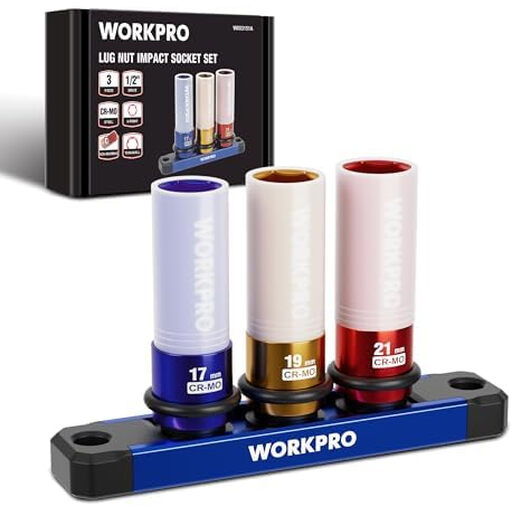
Why This Fits Their Persona: Suited to motorists who want wheel protection, straightforward size identification and tidy storage for regular home-garage work.
Protective inner inserts and outer sleeves are designed to reduce scratching on alloy and painted wheels when the socket is correctly seated.
The set includes three common metric sizes, a thin-wall profile and an 86mm length for deeper recesses.
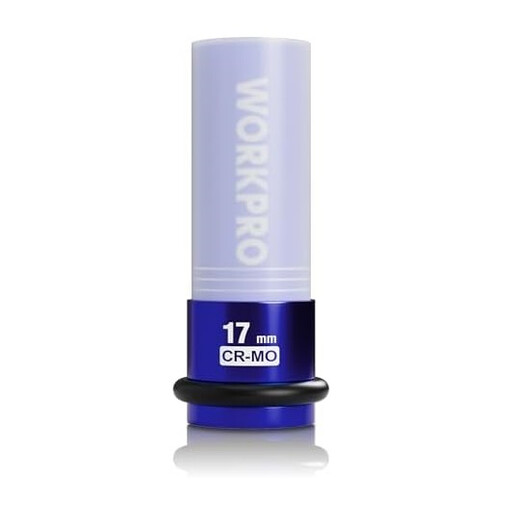
Why This Fits Their Persona: Appropriate when your vehicle consistently uses 17mm wheel nuts and wheel-finish protection is more important than buying multiple sizes.
Its thin-wall construction is intended for narrow recesses, while the plastic sleeve and insert help limit marking during use.
The 17mm size works with standard 1/2-inch impact wrenches, air tools and breaker bars.
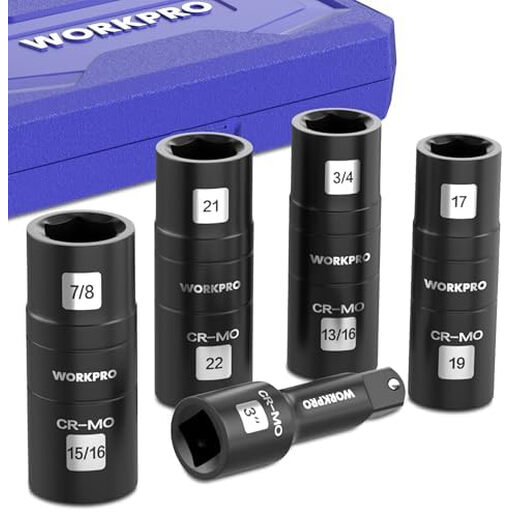
Why This Fits Their Persona: Designed for garages, tyre fitters and frequent car repairs where broader size coverage reduces tool changes.
It combines Cr-Mo construction, laser-etched markings and a secure extension rod system rather than relying on appearance alone.
It provides eight sizes: 17mm, 19mm, 21mm, 22mm, 3/4", 13/16", 15/16" and 7/8".
We have compiled a complete, real-time list of products that fully satisfy these strict selection criteria and UK safety regulations.
Yes, provided the torque wrench and socket use the same 1/2-inch square drive and the socket is suitable for the fastener. Use the torque wrench for final tightening, following the vehicle manufacturer’s torque setting. Avoid using an impact wrench to apply the final torque unless the manufacturer specifically permits it.
17mm, 19mm and 21mm impact sockets are frequently used on passenger vehicles, but the correct size depends on the car and wheel fitment. Check the handbook or measure the existing wheel nut before buying. Some sets also include 22mm and imperial sizes for wider coverage.
There is no fixed lifespan. Usage frequency, impact force, storage conditions and contact with grit all affect service life. A Cr-Mo socket may remain usable while its protective sleeve or insert becomes worn first. Replace damaged protective components, and stop using the socket if its fit, drive opening or protective covering is compromised.