What matters when choosing
Start with how regularly you print feedback and project pages, then decide whether your routine calls for automatic double-sided printing or batch scanning and copying.
| Concern | What to check | Who this matters to |
|---|
| Recurring ink use |
Compare refillable and cartridge supplies, stated black and colour yields, and the exact replacement consumables. |
If I print colour project pages and feedback regularly, I want to plan for refills without relying on a black-page figure alone. Around 45% of consumers put recurring ink use first. |
| Automatic duplex |
Look for an explicit automatic two-sided printing specification; manual duplex requires you to handle the sheets. |
When I make double-sided feedback packs, I want the printer to turn the pages without my intervention. For around 33% of consumers, automatic duplex is the primary need. |
| Batch scanning and copying |
Check for an ADF, its sheet capacity and whether it accepts the kinds of originals you need to process. |
If I often turn marked worksheets into copies or scans, placing each page on the glass interrupts the job. Batch handling comes first for around 22% of consumers. |
Brands to consider
These model lines illustrate different ways to handle recurring printing and marked originals; the relevant features depend on the exact model.
Epson
The EcoTank ET-2950 is a reference point for A4 feedback printing when automatic duplex matters more than feeding batches of originals.
- Epson United Kingdom specifies print, scan and copy functions, Wi-Fi and automatic two-sided printing for the ET-2950. Its stated included-ink yields are up to 8,500 black and 6,500 colour pages.
- The ET-2950 is not the model to choose for an ADF-led copying or scanning workflow; plan to handle multi-page originals individually.
Brother
The DCP-T780DW combines automatic duplex printing with an ADF for households that also process bundles of marked work.
- Brother UK specifies a 20-sheet ADF, a 150-sheet tray and Wi-Fi. Its stated bottle yields are 15,000 black and 5,000 colour pages.
- Those yield figures alone do not establish running costs for your particular mix of pages; check the exact replacement bottles.
Canon
The PIXMA G4570 is worth examining when batch scanning or copying matters and manually handling double-sided print jobs is acceptable.
- Canon UK specifies a 35-sheet, one-sided ADF, Wi-Fi and print, scan, copy and fax functions for the G4570.
- Canon specifies manual two-sided printing for this model, so frequent double-sided feedback packs require more handling.
Joybuy product choices
These inkjet printer choices relate to school-project and feedback printing. Consider the functions needed for your own workflow: an all-in-one is relevant if you also handle marked originals, while the printer-only option calls for particular care over format and scan or copy requirements.
 No image available
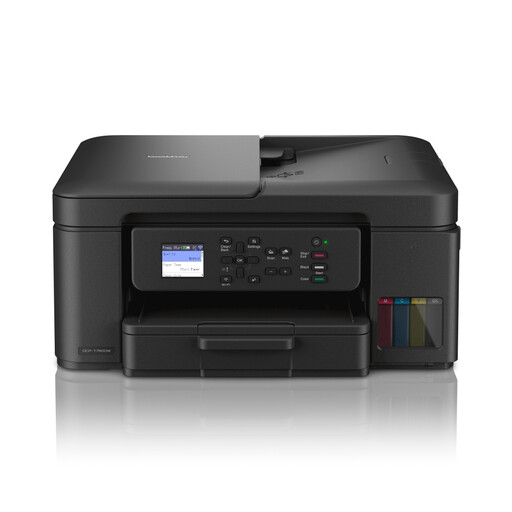
Brother DCP-T780DW 3-in-1 ink-tank printer
Consider this model if double-sided feedback printing goes alongside regular copying or scanning of marked sheets. Brother UK specifies automatic two-sided printing, a 20-sheet ADF and a 150-sheet tray for the DCP-T780DW. Its stated bottle yields are 15,000 black and 5,000 colour pages; your own output will depend on what you print.
Joybuy
 No image available
Canon MAXIFY GX6150
For a workflow that combines feedback printing with batches of marked originals, check this exact model’s ADF capacity and duplex-printing specification before choosing it. Confirm the replacement ink bottles that fit the GX6150 when comparing recurring supplies.
Joybuy
 No image available
Epson EcoTank ET-5150 +Ink A4 multifunction printer
This A4 multifunction variant is one to assess if feedback sheets and handling marked originals both matter. Check the exact ET-5150 functions, automatic duplex capability and any document-feeder capacity against the jobs you expect to do; confirm what the +Ink variant includes.
Joybuy
 No image available
Brother MFC-J6760DW all-in-one inkjet printer
An all-in-one inkjet is relevant when your project workflow also involves marked originals. Before choosing the MFC-J6760DW, confirm its paper-format, duplex and document-feeder specifications, and compare the exact replacement cartridges with your expected printing routine.
Joybuy
 No image available
Epson EcoTank ET-18100 printer
Consider this printer for the project-printing side of the task only after checking that it accepts the sheet size you need. If you also want to copy or scan marked feedback on the same device, confirm those functions for the ET-18100 rather than assuming them from the EcoTank name.
Joybuy
Common questions
Is automatic duplex worth choosing for lesson feedback?
Choose automatic duplex if you regularly print double-sided A4 feedback or project sheets and want to avoid turning pages yourself. Epson lists it for the EcoTank ET-2950 and Brother for the DCP-T780DW; Canon specifies manual two-sided printing for the PIXMA G4570.
Do I need an ADF for a school project?
An ADF is useful when you repeatedly copy or scan batches of marked sheets, but is less important for occasional single pages. Brother UK specifies a 20-sheet ADF for the DCP-T780DW, while Canon UK specifies a 35-sheet, one-sided ADF for the PIXMA G4570; compare the capacity with your usual bundle.
Will a stated ink yield tell me how many feedback sheets I can print?
No: a manufacturer’s stated yield is not a guarantee for your mix of black text and colour project pages. Compare black and colour figures separately, check their test conditions and identify the correct replacement supplies.
What should I check when disposing of an old printer?
Check your local authority or retailer for an electrical-equipment collection or recycling route available to you. UK government guidance identifies the Waste Electrical and Electronic Equipment framework, but the practical household collection option depends on where you live and the service you use.


