Small-desk recipe-card makers
You need room to operate the printer, load cards and collect prints, not just enough space for its closed casing.


Choose an inkjet printer only after checking that the exact model accepts your intended recipe-card size and media type; a compact casing alone does not establish that heavier card will feed reliably. Then measure the space needed with trays open and decide whether you also need scanning, wireless printing or capacity for regular household documents.
You need room to operate the printer, load cards and collect prints, not just enough space for its closed casing.
You want to print directly onto your chosen cards, so their dimensions, media type and feed route matter before you buy a larger pack.
You print recipe cards alongside other documents and need to consider paper handling, ink replenishment and whether wireless printing fits your routine.
Start with the cards you intend to use, then check the printer's working footprint and everyday paper handling.
| Concern | What to check | Who this matters to |
|---|---|---|
| Card size and feed | Check the exact model's accepted dimensions, media types, weight limits and feed route for your chosen card. | If I want to print directly onto heavier or unusually sized cards, I need to know they can pass through the printer. Around 42% of consumers put media compatibility first. |
| Working footprint | Measure the desk space needed for open trays, paper movement, cables and scanner access where applicable. | On a shallow desk, I need room to load and retrieve prints without moving the printer each time; roughly 33% of consumers make usable desk space their primary concern. |
| Routine printing | Check paper capacity, mobile-printing options and ink-plan terms if you will print other documents regularly. | If recipe cards are part of my regular household printing, I want paper loading and ink replenishment to fit that routine. About 25% of consumers prioritise everyday convenience. |
Supported weights can depend on the media type and tray. Canon UK's higher stated weight for the PIXMA TS3750i applies to Canon photo paper, not every craft card of the same weight; Epson United Kingdom also advises checking the individual printer's paper guidance.
Check the exact manual, then try a small pack of your chosen stock before buying cards in quantity.
Unsuitable stock can mean wasted cards and time spent resolving feed problems.
A tray, rear feed or scanner lid may need space beyond the printer's closed dimensions, particularly on a shallow desk.
Measure the intended position and compare it with the model's operating dimensions and paper path before ordering.
An optional ink-delivery plan may not fit occasional card projects in the same way as regular household printing.
Use your realistic monthly output to assess the plan, and read its eligibility, rollover and cancellation terms before enrolling.
Canon's PIXMA TS3750i is a model to examine if you want documented small photo sizes and a custom-size range.
Epson's Expression Home XP-4200 is a compact A4 multifunction option for household documents alongside recipe-card projects.
HP's DeskJet 4310 is a compact wireless print, scan and copy option for light household use.
Brother's DCP-J1360DW is worth examining when recipe cards are among regular household print jobs.
These Brother inkjets offer choices to consider for recipe cards alongside household printing. Check each model against your card stock and available desk space before deciding.
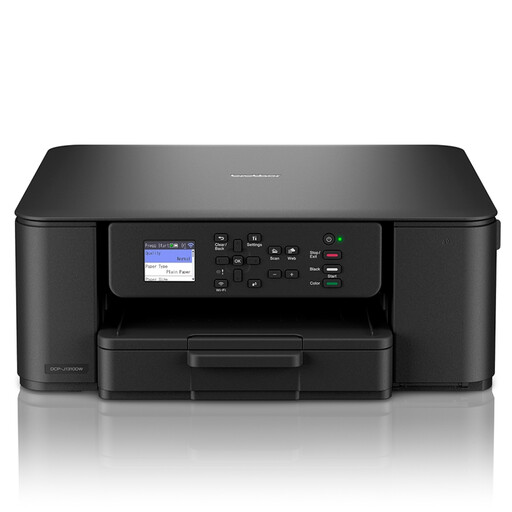 No image available
Consider this wireless inkjet if the printer must share a small desk. Check the space needed while it is in use, and confirm that the exact manual permits your chosen card size, media type and feed route.
 No image available
Consider this inkjet for recipe cards alongside regular printing only if its operating footprint fits your desk. Check the exact manual for your card size, media type and feed requirements.
No: check the exact model's supported sizes, media types, weights and feed route against your cards. Canon UK lists small photo and custom sizes for the PIXMA TS3750i, but that does not establish support for every card stock.
Use thicker card only if the printer's guidance supports that particular media type and feed route. Brother UK lists 64–220 g/m² for specified media in the DCP-J1360DW standard tray; that range alone does not confirm compatibility with textured or pre-scored cards.
No, an ink subscription is optional. If you are considering one, compare its current page allowance and terms with how often you expect to print cards and other documents.
Contact the seller with your proof of purchase and explain the fault. Citizens Advice notes that a warranty or guarantee adds to your legal rights; the appropriate remedy depends on the circumstances, so do not assume that the manufacturer's warranty is your only route.
Use an electrical-waste collection route rather than putting it in ordinary household waste. Check your local authority's arrangements or whether a retailer offers take-back for the printer.